AIDS and Cancer Virus Program, SAIC-Frederick Inc., National Cancer Institute at Frederick, Frederick, Maryland, United States of America.
PLoS One. 2011;6(8):e23703. doi: 10.1371/journal.pone.0023703. Epub 2011 Aug 23.
The SIV/rhesus macaque model for HIV/AIDS is a powerful system for examining the contribution of T cells in the control of AIDS viruses. To better our understanding of CD8(+) T-cell control of SIV replication in CD4(+) T cells, we asked whether TCRs isolated from rhesus macaque CD8(+) T-cell clones that exhibited varying abilities to suppress SIV replication could convey their suppressive properties to CD8(+) T cells obtained from an uninfected/unvaccinated animal.
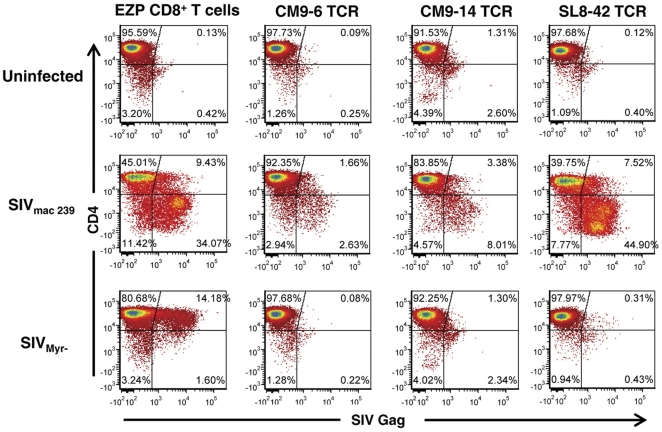
We transferred SIV-specific TCR genes isolated from rhesus macaque CD8(+) T-cell clones with varying abilities to suppress SIV replication in vitro into CD8(+) T cells obtained from an uninfected animal by retroviral transduction. After sorting and expansion, transduced CD8(+) T-cell lines were obtained that specifically bound their cognate SIV tetramer. These cell lines displayed appropriate effector function and specificity, expressing intracellular IFNγ upon peptide stimulation. Importantly, the SIV suppression properties of the transduced cell lines mirrored those of the original TCR donor clones: cell lines expressing TCRs transferred from highly suppressive clones effectively reduced wild-type SIV replication, while expression of a non-suppressing TCR failed to reduce the spread of virus. However, all TCRs were able to suppress the replication of an SIV mutant that did not downregulate MHC-I, recapitulating the properties of their donor clones.
Our results show that antigen-specific SIV suppression can be transferred between allogenic T cells simply by TCR gene transfer. This advance provides a platform for examining the contributions of TCRs versus the intrinsic effector characteristics of T-cell clones in virus suppression. Additionally, this approach can be applied to develop non-human primate models to evaluate adoptive T-cell transfer therapy for AIDS and other diseases.
SIV/恒河猴艾滋病模型是研究 T 细胞在控制艾滋病病毒方面作用的强大系统。为了更好地了解 CD8(+)T 细胞对 CD4(+)T 细胞中 SIV 复制的控制,我们想知道,从表现出不同抑制 SIV 复制能力的恒河猴 CD8(+)T 细胞克隆中分离出的 TCR 是否可以将其抑制特性传递给从未感染/未接种疫苗的动物获得的 CD8(+)T 细胞。
我们通过逆转录病毒转导,将从具有不同抑制 SIV 复制能力的恒河猴 CD8(+)T 细胞克隆中分离出的 SIV 特异性 TCR 基因转移到从未感染的动物获得的 CD8(+)T 细胞中。经过分选和扩增,获得了特异性结合其同源 SIV 四聚体的转导 CD8(+)T 细胞系。这些细胞系表现出适当的效应功能和特异性,在肽刺激下表达细胞内 IFNγ。重要的是,转导细胞系的 SIV 抑制特性与原始 TCR 供体克隆的特性相吻合:表达从高度抑制性克隆中转移的 TCR 的细胞系有效地降低了野生型 SIV 的复制,而表达非抑制性 TCR 的细胞系未能降低病毒的传播。然而,所有 TCR 都能够抑制不下调 MHC-I 的 SIV 突变体的复制,这再现了它们供体克隆的特性。
我们的研究结果表明,通过 TCR 基因转移,可以在同种异体 T 细胞之间简单地转移抗原特异性 SIV 抑制。这一进展为研究 TCR 与 T 细胞克隆固有效应特征在病毒抑制中的作用提供了一个平台。此外,这种方法可用于开发非人类灵长类动物模型,以评估过继性 T 细胞转移治疗艾滋病和其他疾病的效果。