Wellcome Trust Major Overseas Programme, Oxford University Clinical Research Unit, Ho Chi Minh City, Viet Nam.
PLoS Negl Trop Dis. 2011 Aug;5(8):e1282. doi: 10.1371/journal.pntd.0001282. Epub 2011 Aug 23.
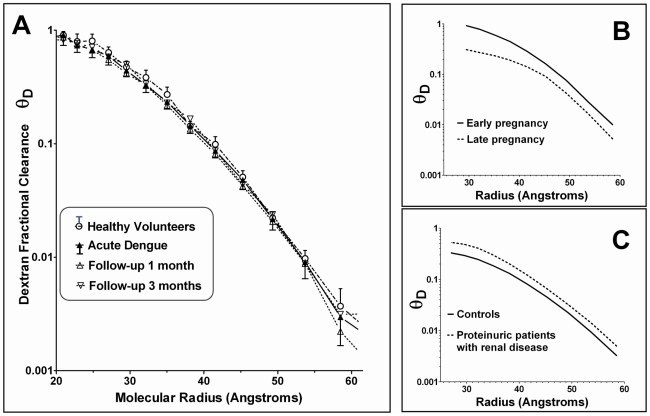
Although increased capillary permeability is the major clinical feature associated with severe dengue infections the mechanisms underlying this phenomenon remain unclear. Dextran clearance methodology has been used to investigate the molecular sieving properties of the microvasculature in clinical situations associated with altered permeability, including during pregnancy and in various renal disorders. In order to better understand the characteristics of the vascular leak associated with dengue we undertook formal dextran clearance studies in Vietnamese dengue patients and healthy volunteers.
METHODOLOGY/PRINCIPAL FINDINGS: We carried out serial clearance studies in 15 young adult males with acute dengue and evidence of vascular leakage a) during the phase of maximal leakage and b) one and three months later, as well as in 16 healthy control subjects. Interestingly we found no difference in the clearance profiles of neutral dextran solutions among the dengue patients at any time-point or in comparison to the healthy volunteers.
CONCLUSIONS/SIGNIFICANCE: The surface glycocalyx layer, a fibre-matrix of proteoglycans, glycosaminoglycans, and plasma proteins, forms a complex with the underlying endothelial cells to regulate plasma volume within circumscribed limits. It is likely that during dengue infections loss of plasma proteins from this layer alters the permeability characteristics of the complex; physical and/or electrostatic interactions between the dextran molecules and the glycocalyx structure may temporarily restore normal function, rendering the technique unsuitable for assessing permeability in these patients. The implications for resuscitation of patients with dengue shock syndrome (DSS) are potentially important. It is possible that continuous low-dose infusions of dextran may help to stabilize the permeability barrier in patients with profound or refractory shock, reducing the need for repeated boluses, limiting the total colloid volume required. Formal clinical studies should help to assess this strategy as an alternative to conventional fluid resuscitation for severe DSS.
尽管毛细血管通透性增加是与重症登革热感染相关的主要临床特征,但这一现象的机制仍不清楚。葡聚糖清除方法已被用于研究与通透性改变相关的临床情况下,包括妊娠期间和各种肾脏疾病期间,微血管的分子筛特性。为了更好地了解与登革热相关的血管渗漏的特征,我们在越南登革热患者和健康志愿者中进行了正式的葡聚糖清除研究。
方法/主要发现:我们对 15 名患有急性登革热和血管渗漏证据的年轻成年男性进行了连续清除研究,a)在最大渗漏阶段,b)一个月和三个月后,以及 16 名健康对照者。有趣的是,我们发现在任何时间点,登革热患者的中性葡聚糖溶液清除曲线与健康志愿者均无差异。
结论/意义:表面糖萼层是一种由糖胺聚糖、蛋白聚糖和血浆蛋白组成的纤维基质,与底层内皮细胞形成复合物,以在限定的范围内调节血浆容量。在登革热感染期间,这种糖萼层中的血浆蛋白丢失可能会改变复合物的通透性特征;葡聚糖分子与糖萼结构之间的物理和/或静电相互作用可能会暂时恢复正常功能,从而使该技术不适合评估这些患者的通透性。这对登革热休克综合征(DSS)患者的复苏具有潜在的重要意义。持续小剂量输注葡聚糖可能有助于稳定严重 DSS 患者的通透性屏障,减少对反复推注的需求,限制所需的胶体总容量。正式的临床研究应有助于评估这种策略作为严重 DSS 传统液体复苏的替代方法。