Yong Loo Lin School of Medicine, National University of Singapore, Singapore, Singapore.
Department of Infectious Diseases, Tan Tock Seng Hospital, Singapore, Singapore.
PLoS One. 2020 Jul 1;15(7):e0235166. doi: 10.1371/journal.pone.0235166. eCollection 2020.
Monitoring of blood pressure is an important part of management of dengue illness. Large scale studies of temporal trend of blood pressure in adult dengue are lacking. In this study, we examined the differences in time trend of systolic (SBP) and diastolic blood pressure (DBP) in patients with and without severe dengue (SD), dengue hemorrhagic fever (DHF) and pre-existing hypertension, and elderly versus non-elderly patients.
We studied a retrospective cohort from 2005 to 2008 of 6,070 hospitalized adult dengue patients confirmed by polymerase chain reaction or clinical criteria plus positive dengue serology. Dengue severity was defined according to World Health Organization 1997 and 2009 guidelines. We used Bayesian hierarchical Markov models to compare the daily mean SBP and DBP between different subgroups. Analysis was conducted by day of defervescence (denoted as day 0), and day of illness onset (denoted as day 1) respectively.
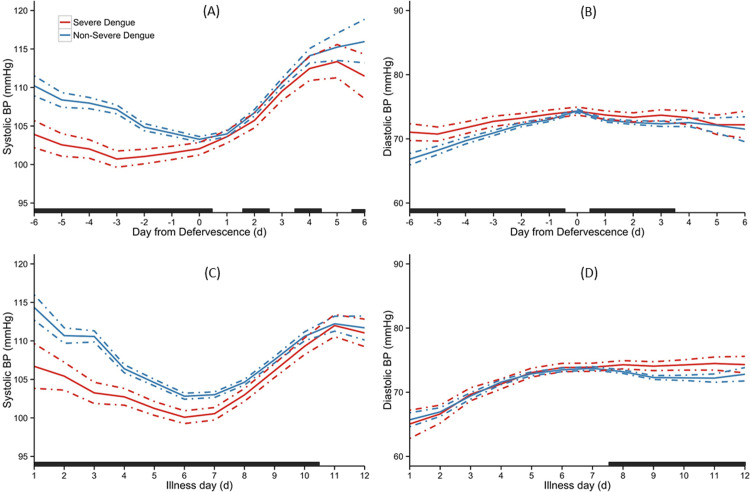
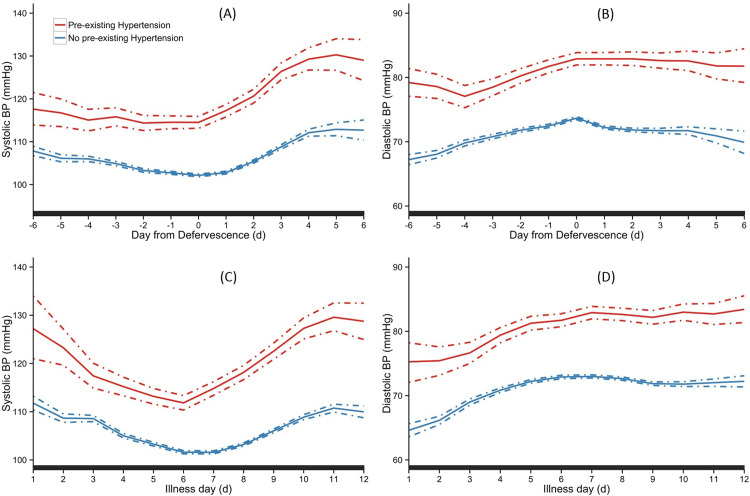
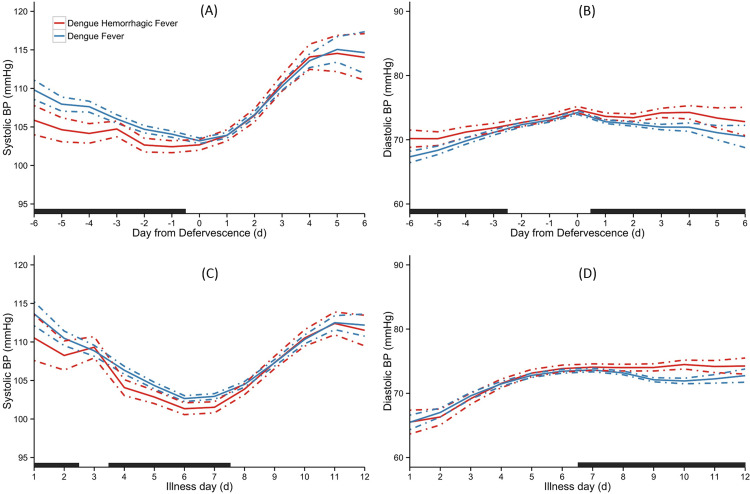
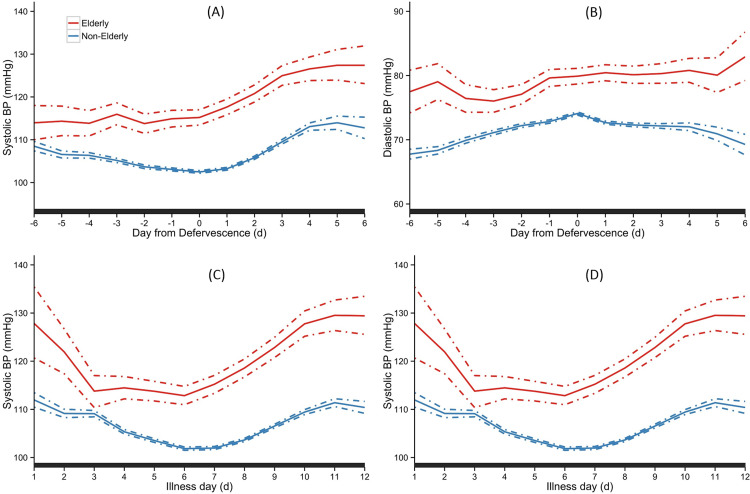
SBP decreased to a nadir during the critical phase before defervescence and was significantly lower for patients with SD or DHF, compared with patients without SD or DHF. DBP increased marginally more for patients with SD or DHF in the critical phase before defervescence. By day of defervescence, comparison of patients with and without SD showed significant difference in SBP from day -6 to day +6, except days +1, +3 and +5, and similarly in DBP except days 0, and +4 to +6. Comparison of patients with and without DHF showed significant difference in SBP from day -6 to day -1, but for DBP, significant difference was noted from day -6 to day +6, except day -2 to day 0. By day of illness, SBP differed significantly between patients with and without SD from illness days 1 to 10, and DBP from illness days 7 to 12. Between patients with and without DHF, SBP differed significantly on illness days 1, 2, 4 to 7, while DBP from days 7 to 12. On analysis by days of defervescence or by days of illness, elderly patients and those with hypertension showed consistently higher SBP and DBP throughout their hospitalization, as compared with their younger and non-hypertensive counterparts.
In SD or DHF, SBP decreased to a nadir around the day of defervescence, and recovered to a level exceeding that in febrile phase by days 2 or 3 post-defervescence. Elderly patients and patients with pre-existing hypertension maintained higher SBP and DBP throughout the duration of dengue infection.
血压监测是登革热疾病管理的重要组成部分。目前缺乏关于成人登革热患者血压时间趋势的大规模研究。在这项研究中,我们研究了患有和不患有重症登革热(SD)、登革出血热(DHF)以及患有和不患有高血压的患者之间的收缩压(SBP)和舒张压(DBP)时间趋势的差异,以及老年患者和非老年患者之间的差异。
我们研究了 2005 年至 2008 年期间 6070 名因聚合酶链反应或临床标准加上阳性登革热血清学而确诊的住院成人登革热患者的回顾性队列。根据世界卫生组织 1997 年和 2009 年的指南,登革热的严重程度被定义为。我们使用贝叶斯分层马尔可夫模型来比较不同亚组之间的每日平均 SBP 和 DBP。分析分别在退热日(表示为第 0 天)和发病日(表示为第 1 天)进行。
SBP 在退热前的危急期降至最低点,且患有 SD 或 DHF 的患者 SBP 明显低于不患有 SD 或 DHF 的患者。在退热前的危急期,患有 SD 或 DHF 的患者的 DBP 略有升高。到退热日时,与无 SD 患者相比,有 SD 患者的 SBP 从第-6 天到第+6 天有显著差异,除第+1、+3 和+5 天外,DBP 也有显著差异,除第 0 天和第+4 天到第+6 天外。与无 DHF 患者相比,有 DHF 患者的 SBP 从第-6 天到第-1 天有显著差异,但 DBP 从第-6 天到第+6 天有显著差异,除第-2 天到第 0 天外。到发病日时,与无 SD 患者相比,有 SD 患者的 SBP 在发病第 1 天到第 10 天之间有显著差异,DBP 在发病第 7 天到第 12 天之间有显著差异。与无 DHF 患者相比,SBP 在发病第 1、2、4 天到第 7 天之间有显著差异,DBP 在发病第 7 天到第 12 天之间有显著差异。在按退热日或发病日分析时,与年轻且无高血压的患者相比,老年患者和患有高血压的患者在整个住院期间的 SBP 和 DBP 一直较高。
在 SD 或 DHF 中,SBP 在退热日左右降至最低点,在退热后第 2 或 3 天恢复到发热期以上的水平。老年患者和患有高血压的患者在整个登革热感染期间维持较高的 SBP 和 DBP。