International Centre for Genetic Engineering and Biotechnology, Trieste, Italy.
PLoS One. 2011;6(8):e23712. doi: 10.1371/journal.pone.0023712. Epub 2011 Aug 24.
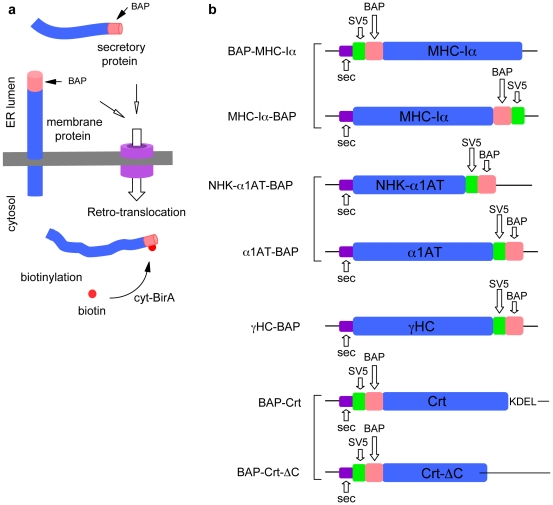
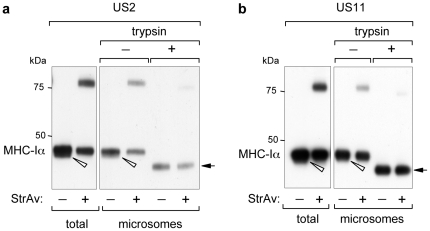
Retro-translocation from the ER to the cytosol of proteins within the secretory pathway takes place on misfolded molecules that are targeted for degradation by the cytosolically located 26S proteasome complex. Retro-translocation occurs also for other proteins (such as calreticulin) that, despite being synthesized and transported to the ER, are in part dislocated to the cytosol. We have taken advantage of the E. coli derived biotin-ligase (BirA) expressed in the cytosol of mammalian cells to specifically biotin-label in vivo proteins within the secretory pathway that undergo retro-translocation. We validated the method using four different proteins that are known to undergo retro-translocation upon different conditions: the human trans-membrane protein MHC class-I α chain (MHC-Iα), the Null Hong Kong mutant of the secretory α1 anti-trypsin (NHK-α1AT), the immunoglobulin heavy chain (HC) and the ER chaperone calreticulin (Crt). We observed specific mono-biotinylation of cytosolically dislocated molecules, resulting in a novel, reliable way of determining the extent of retro-translocation.
蛋白质在分泌途径中从内质网到细胞质的逆行易位发生在错误折叠的分子上,这些分子被细胞质中定位的 26S 蛋白酶体复合物靶向降解。逆行易位也发生在其他蛋白质(如钙网蛋白)上,尽管这些蛋白质被合成并运输到内质网,但部分被移位到细胞质中。我们利用在哺乳动物细胞质中表达的源自大肠杆菌的生物素连接酶(BirA),特异性地对分泌途径中经历逆行易位的体内蛋白质进行生物素标记。我们使用四种不同的蛋白质验证了该方法,这些蛋白质在不同条件下已知会经历逆行易位:人类跨膜蛋白 MHC Ⅰ类 α 链(MHC-Iα)、分泌型α1抗胰蛋白酶的香港突变体(NHK-α1AT)、免疫球蛋白重链(HC)和内质网伴侣钙网蛋白(Crt)。我们观察到细胞质移位分子的特异性单生物素化,从而为确定逆行易位的程度提供了一种新颖、可靠的方法。