Department of Psychology, Queen's University, Kingston, Ontario, Canada.
PLoS One. 2011;6(8):e23885. doi: 10.1371/journal.pone.0023885. Epub 2011 Aug 22.
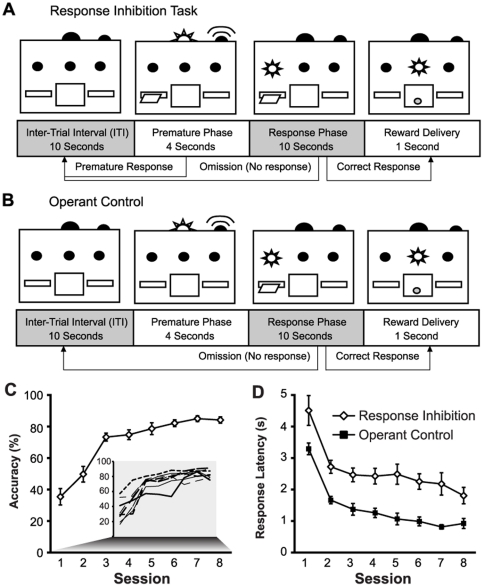
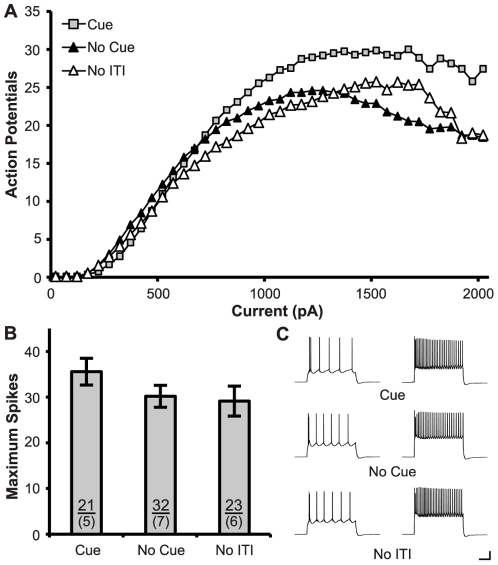
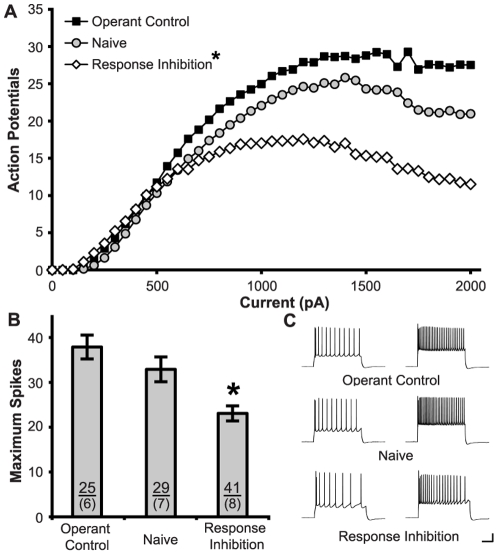
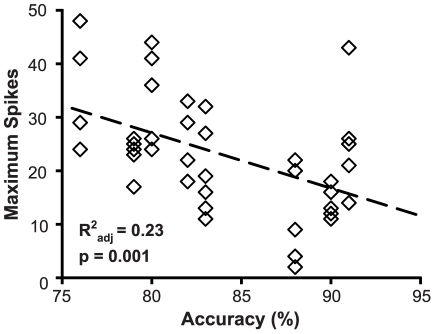
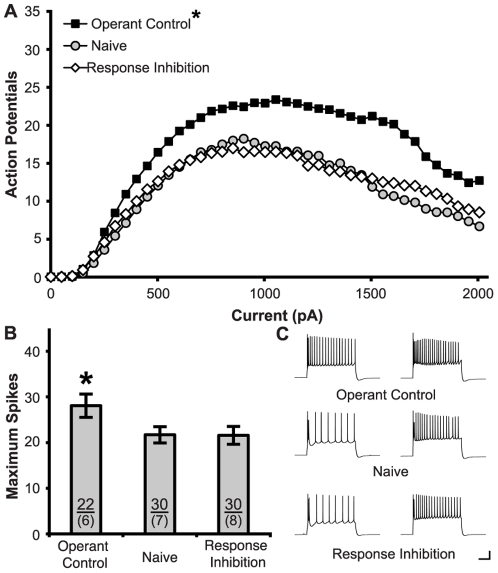
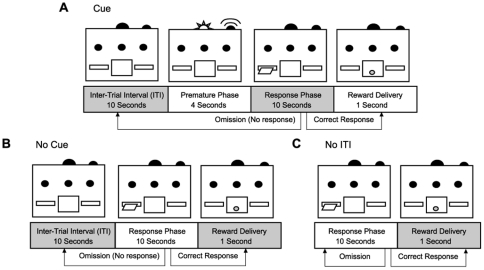
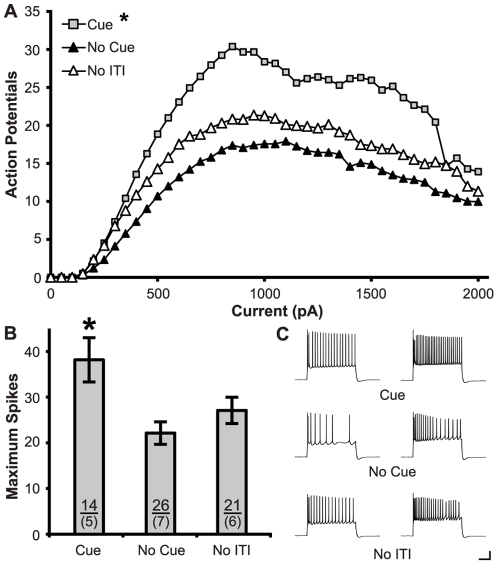
Impulse control is an executive process that allows animals to inhibit their actions until an appropriate time. Previously, we reported that learning a simple response inhibition task increases AMPA currents at excitatory synapses in the prelimbic region of the medial prefrontal cortex (mPFC). Here, we examined whether modifications to intrinsic excitability occurred alongside the synaptic changes. To that end, we trained rats to obtain a food reward in a response inhibition task by withhold responding on a lever until they were signaled to respond. We then measured excitability, using whole-cell patch clamp recordings in brain slices, by quantifying action potentials generated by the injection of depolarizing current steps. Training in this task depressed the excitability of layer V pyramidal neurons of the prelimbic, but not infralimbic, region of the mPFC relative to behavioral controls. This decrease in maximum spiking frequency was significantly correlated with performance on the final session of the task. This change in intrinsic excitability may represent a homeostatic mechanism counterbalancing increased excitatory synaptic inputs onto those neurons in trained rats. Interestingly, subjects trained with a cue that predicted imminent reward availability had increased excitability in infralimbic, but not the prelimbic, pyramidal neurons. This dissociation suggests that both prelimbic and infralimbic neurons are involved in directing action, but specialized for different types of information, inhibitory or anticipatory, respectively.
冲动控制是一种执行过程,使动物能够抑制其行为,直到适当的时间。此前,我们报道学习简单的反应抑制任务会增加内侧前额叶皮层(mPFC)前额叶区兴奋性突触处的 AMPA 电流。在这里,我们检查了内在兴奋性的变化是否伴随着突触变化。为此,我们通过在杆上抑制反应直到收到响应信号来训练大鼠在反应抑制任务中获得食物奖励。然后,我们通过测量通过注入去极化电流阶跃产生的动作电位来使用脑切片中的全细胞膜片钳记录来测量兴奋性。与行为对照相比,在该任务中训练会使前额叶的 V 层锥体神经元的兴奋性降低,但不是下边缘区。最大放电频率的这种降低与任务的最后一次会议上的表现显著相关。这种内在兴奋性的变化可能代表一种平衡那些在训练大鼠上增加的兴奋性突触输入的同型性机制。有趣的是,用预测即将到来的奖励可用性的线索训练的受试者在 infralimbic 而不是在 prelimbic 锥体神经元中具有更高的兴奋性。这种分离表明,前额叶和下边缘区神经元都参与了动作的指导,但分别用于不同类型的信息,即抑制性或预期性。