Musculoskeletal Research Program, School of Physiotherapy and Exercise Science, Griffith University, Queensland, Australia.
PLoS One. 2011;6(8):e23917. doi: 10.1371/journal.pone.0023917. Epub 2011 Aug 22.
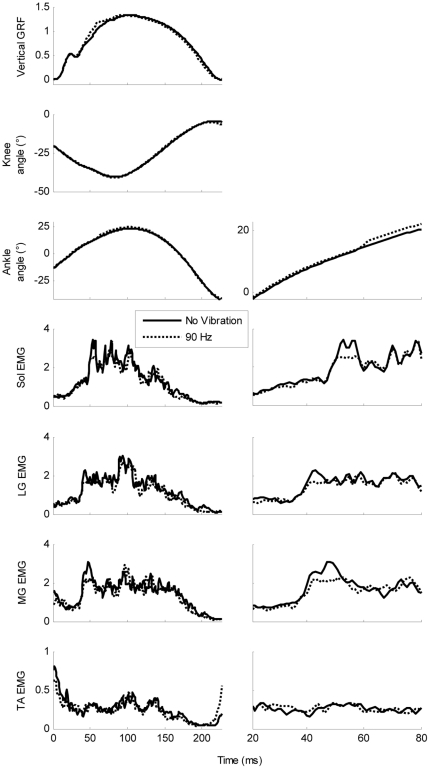
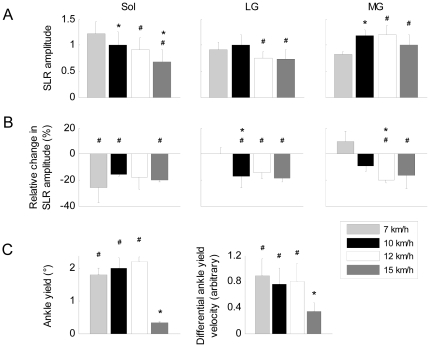
During human running, short latency stretch reflexes (SLRs) are elicited in the triceps surae muscles, but the function of these responses is still a matter of controversy. As the SLR is primarily mediated by Ia afferent nerve fibres, various methods have been used to examine SLR function by selectively blocking the Ia pathway in seated, standing and walking paradigms, but stretch reflex function has not been examined in detail during running. The purpose of this study was to examine triceps surae SLR function at different running speeds using Achilles tendon vibration to modify SLR size. Ten healthy participants ran on an instrumented treadmill at speeds between 7 and 15 km/h under 2 Achilles tendon vibration conditions: no vibration and 90 Hz vibration. Surface EMG from the triceps surae and tibialis anterior muscles, and 3D lower limb kinematics and ground reaction forces were simultaneously collected. In response to vibration, the SLR was depressed in the triceps surae muscles at all speeds. This coincided with short-lasting yielding at the ankle joint at speeds between 7 and 12 km/h, suggesting that the SLR contributes to muscle stiffness regulation by minimising ankle yielding during the early contact phase of running. Furthermore, at the fastest speed of 15 km/h, the SLR was still depressed by vibration in all muscles but yielding was no longer evident. This finding suggests that the SLR has greater functional importance at slow to intermediate running speeds than at faster speeds.
在人类跑步过程中,三腿肌会产生短潜伏期伸展反射(SLR),但这些反应的功能仍存在争议。由于 SLR 主要由 Ia 传入神经纤维介导,因此已经使用各种方法通过选择性阻断坐姿、站立和行走范式中的 Ia 途径来检查 SLR 功能,但是在跑步过程中尚未详细检查伸展反射功能。本研究的目的是使用跟腱振动来改变 SLR 大小,在不同的跑步速度下检查三腿肌 SLR 功能。10 名健康参与者在装有仪器的跑步机上以 7 至 15km/h 的速度跑步,在 2 种跟腱振动条件下:无振动和 90Hz 振动。同时采集三腿肌和胫骨前肌的表面肌电图、3D 下肢运动学和地面反作用力。响应振动时,所有速度下三腿肌的 SLR 均被抑制。这与 7 至 12km/h 速度下踝关节的短暂屈服同时发生,这表明 SLR 通过最小化跑步早期接触阶段的踝关节屈服,有助于肌肉刚度调节。此外,在最快的 15km/h 速度下,振动仍会抑制所有肌肉的 SLR,但屈服不再明显。这一发现表明,与更快的速度相比,SLR 在较慢至中等跑步速度下具有更重要的功能。