Center for Mind/Brain Sciences, University of Trento Trento, Italy.
Front Psychol. 2011 Aug 23;2:198. doi: 10.3389/fpsyg.2011.00198. eCollection 2011.
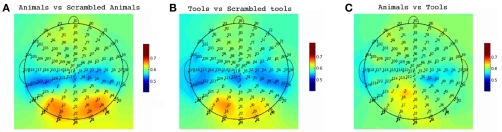
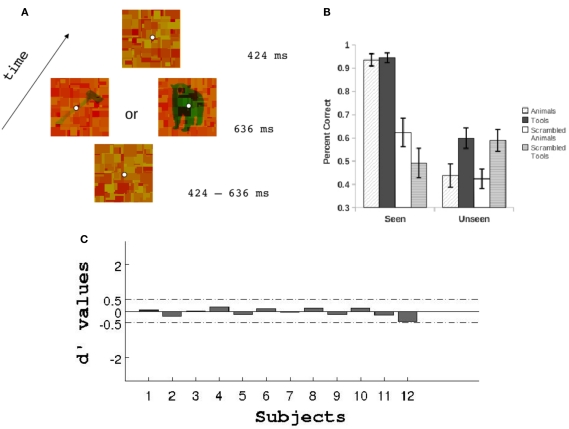
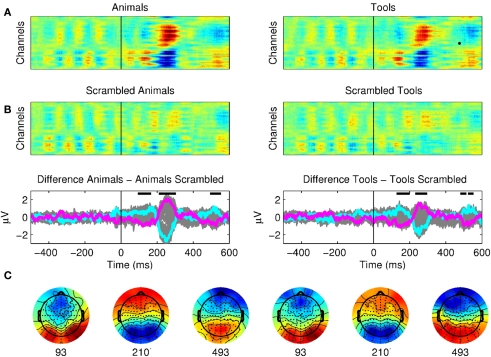
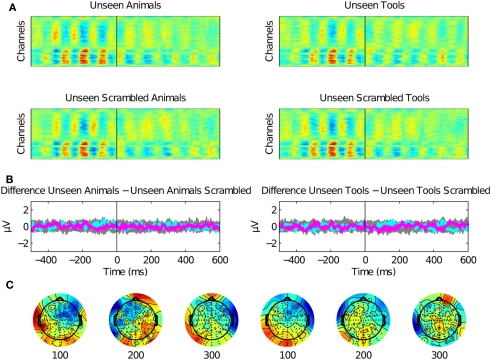
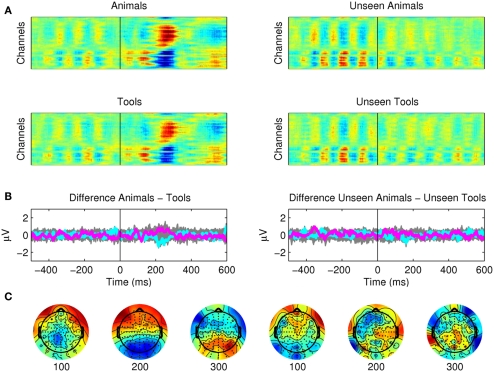
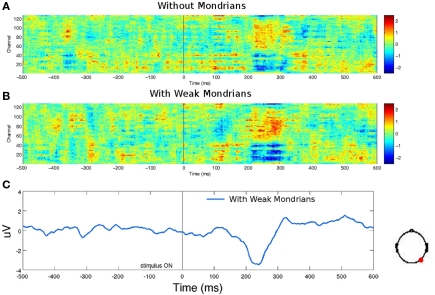
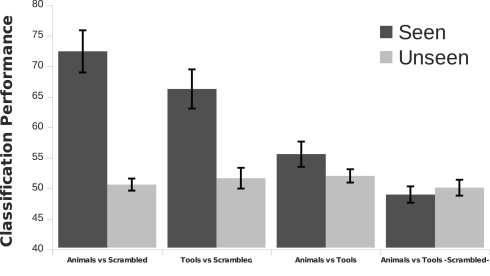
The operations and processes that the human brain employs to achieve fast visual categorization remain a matter of debate. A first issue concerns the timing and place of rapid visual categorization and to what extent it can be performed with an early feed-forward pass of information through the visual system. A second issue involves the categorization of stimuli that do not reach visual awareness. There is disagreement over the degree to which these stimuli activate the same early mechanisms as stimuli that are consciously perceived. We employed continuous flash suppression (CFS), EEG recordings, and machine learning techniques to study visual categorization of seen and unseen stimuli. Our classifiers were able to predict from the EEG recordings the category of stimuli on seen trials but not on unseen trials. Rapid categorization of conscious images could be detected around 100 ms on the occipital electrodes, consistent with a fast, feed-forward mechanism of target detection. For the invisible stimuli, however, CFS eliminated all traces of early processing. Our results support the idea of a fast mechanism of categorization and suggest that this early categorization process plays an important role in later, more subtle categorizations, and perceptual processes.
人类大脑用于实现快速视觉分类的操作和过程仍然存在争议。第一个问题涉及快速视觉分类的时间和地点,以及信息是否可以通过视觉系统的早期前馈传递来完成。第二个问题涉及到未达到视觉意识的刺激的分类。对于这些刺激与被有意识感知的刺激激活相同的早期机制的程度存在分歧。我们使用连续闪光抑制 (CFS)、EEG 记录和机器学习技术来研究可见和不可见刺激的视觉分类。我们的分类器能够根据 EEG 记录预测可见试验中的刺激类别,但不能预测不可见试验中的刺激类别。在枕叶电极上,可以在 100 毫秒左右检测到有意识图像的快速分类,这与目标检测的快速前馈机制一致。然而,对于不可见的刺激,CFS 消除了所有早期处理的痕迹。我们的结果支持快速分类机制的观点,并表明这个早期的分类过程在后来更微妙的分类和感知过程中起着重要作用。