Lee Gil Ya Cancer and Diabetes Institute, Gachon University of Medicine and Science, Incheon, Korea.
PLoS One. 2011;6(8):e23894. doi: 10.1371/journal.pone.0023894. Epub 2011 Aug 29.
Betacellulin (BTC), a member of the epidermal growth factor family, is known to play an important role in regulating growth and differentiation of pancreatic beta cells. Growth-promoting actions of BTC are mediated by epidermal growth factor receptors (ErbBs), namely ErbB-1, ErbB-2, ErbB-3 and ErbB-4; however, the exact mechanism for beta cell proliferation has not been elucidated. Therefore, we investigated which ErbBs are involved and some molecular mechanisms by which BTC regulates beta cell proliferation.
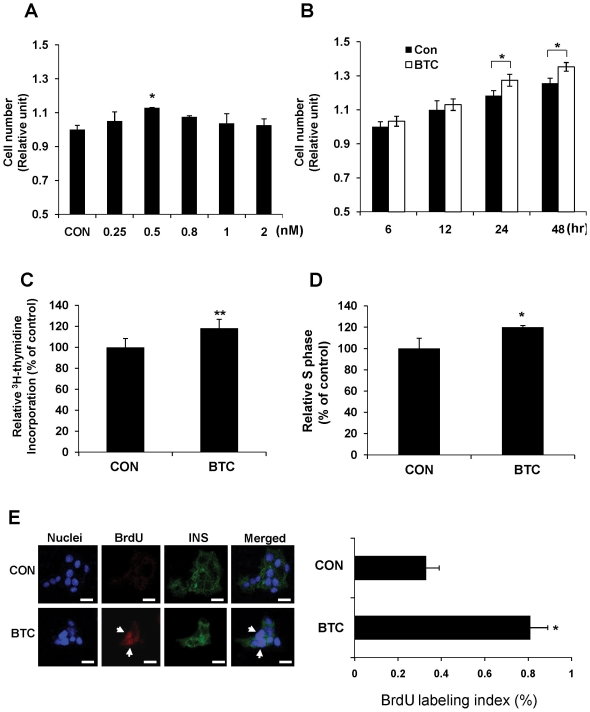
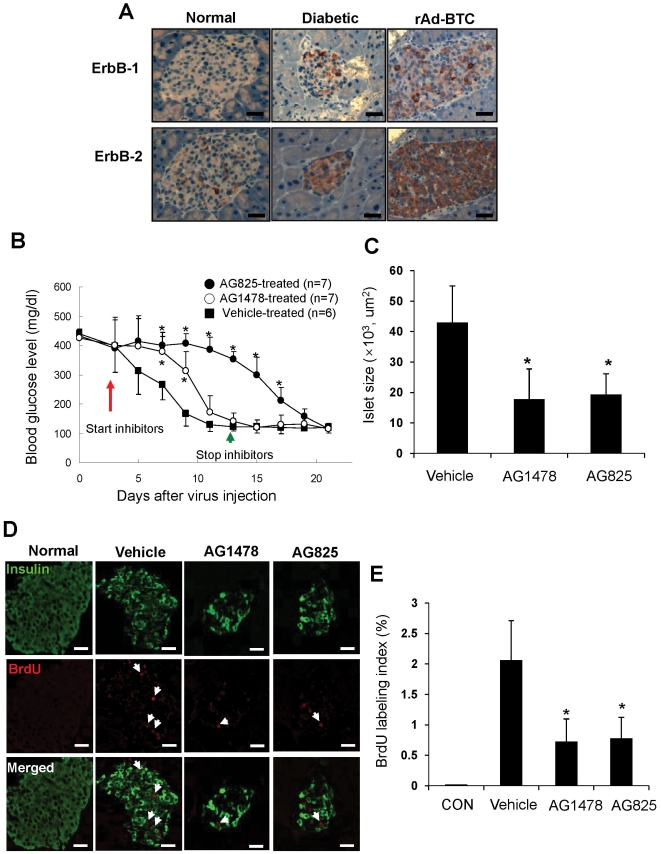
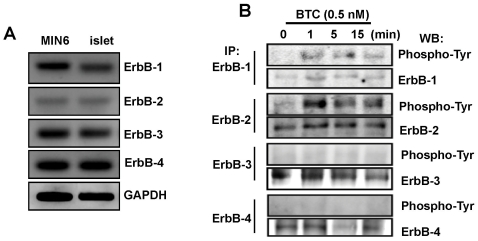
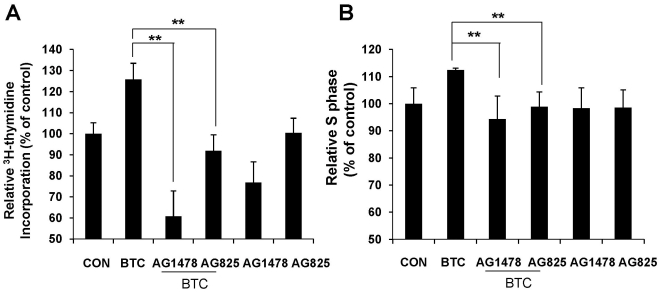
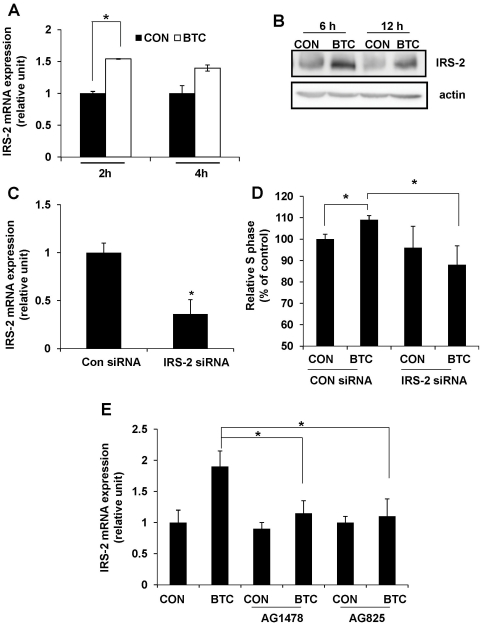
METHODOLOGY/PRINCIPAL FINDINGS: The expression of ErbB-1, ErbB-2, ErbB-3, and ErbB-4 mRNA was detected by RT-PCR in both a beta cell line (MIN-6 cells) and C57BL/6 mouse islets. Immunoprecipitation and western blotting analysis showed that BTC treatment of MIN-6 cells induced phosphorylation of only ErbB-1 and ErbB-2 among the four EGF receptors. BTC treatment resulted in DNA synthetic activity, cell cycle progression, and bromodeoxyuridine (BrdU)-positive staining. The proliferative effect was blocked by treatment with AG1478 or AG825, specific tyrosine kinase inhibitors of ErbB-1 and ErbB-2, respectively. BTC treatment increased mRNA and protein levels of insulin receptor substrate-2 (IRS-2), and this was blocked by the ErbB-1 and ErbB-2 inhibitors. Inhibition of IRS-2 by siRNA blocked cell cycle progression induced by BTC treatment. Streptozotocin-induced diabetic mice injected with a recombinant adenovirus expressing BTC and treated with AG1478 or AG825 showed reduced islet size, reduced numbers of BrdU-positive cells in the islets, and did not attain BTC-mediated remission of diabetes.
CONCLUSIONS/SIGNIFICANCE: These results suggest that BTC exerts proliferative activity on beta cells through the activation of ErbB-1 and ErbB-2 receptors, which may increase IRS-2 expression, contributing to the regeneration of beta cells.
β细胞素(BTC)是表皮生长因子家族的成员,已知在调节胰岛β细胞的生长和分化中发挥重要作用。BTC 的促生长作用是通过表皮生长因子受体(ErbB)介导的,即 ErbB-1、ErbB-2、ErbB-3 和 ErbB-4;然而,β细胞增殖的确切机制尚未阐明。因此,我们研究了哪些 ErbB 参与其中,以及 BTC 调节β细胞增殖的一些分子机制。
方法/主要发现:通过 RT-PCR 在β细胞系(MIN-6 细胞)和 C57BL/6 小鼠胰岛中检测到 ErbB-1、ErbB-2、ErbB-3 和 ErbB-4 mRNA 的表达。免疫沉淀和 Western blot 分析表明,BTC 处理 MIN-6 细胞仅诱导四个 EGF 受体中的 ErbB-1 和 ErbB-2 磷酸化。BTC 处理导致 DNA 合成活性、细胞周期进程和溴脱氧尿苷(BrdU)阳性染色。用 ErbB-1 和 ErbB-2 的特异性酪氨酸激酶抑制剂 AG1478 或 AG825 处理可阻断增殖作用。BTC 处理增加了胰岛素受体底物-2(IRS-2)的 mRNA 和蛋白水平,而这被 ErbB-1 和 ErbB-2 抑制剂阻断。用 siRNA 抑制 IRS-2 阻断了 BTC 处理诱导的细胞周期进程。用表达 BTC 的重组腺病毒注射糖尿病小鼠,并联合使用 AG1478 或 AG825 治疗,导致胰岛体积减小,胰岛内 BrdU 阳性细胞数量减少,并且无法达到 BTC 介导的糖尿病缓解。
结论/意义:这些结果表明,BTC 通过激活 ErbB-1 和 ErbB-2 受体对β细胞发挥增殖活性,这可能增加 IRS-2 的表达,有助于β细胞的再生。