Department of Food Science and Experimental Nutrition, Faculty of Pharmaceutical Sciences, University of São Paulo, São Paulo, Brazil.
Nutr Metab (Lond). 2011 Sep 7;8(1):62. doi: 10.1186/1743-7075-8-62.
Studies suggest that leucine supplementation (LS) has a therapeutic potential to prevent obesity and to promote glucose homeostasis. Furthermore, regular physical exercise is a widely accepted strategy for body weight maintenance and also for the prevention of obesity. The aim of this study was to determine the effect of chronic LS alone or combined with endurance training (ET) as potential approaches for reversing the insulin resistance and obesity induced by a high-fat diet (HFD) in rats.
Forty-seven rats were randomly divided into two groups. Animals were fed a control diet-low fat (n = 10) or HFD (n = 37). After 15 weeks on HFD, all rats received the control diet-low fat and were randomly divided according to treatment: reference (REF), LS, ET, and LS+ET (n = 7-8 rats per group). After 6 weeks of treatment, the animals were sacrificed and body composition, fat cell volume, and serum concentrations of total cholesterol, HDL-cholesterol, triacylglycerol, glucose, adiponectin, leptin and tumor necrosis factor-alpha (TNF-α) were analyzed.
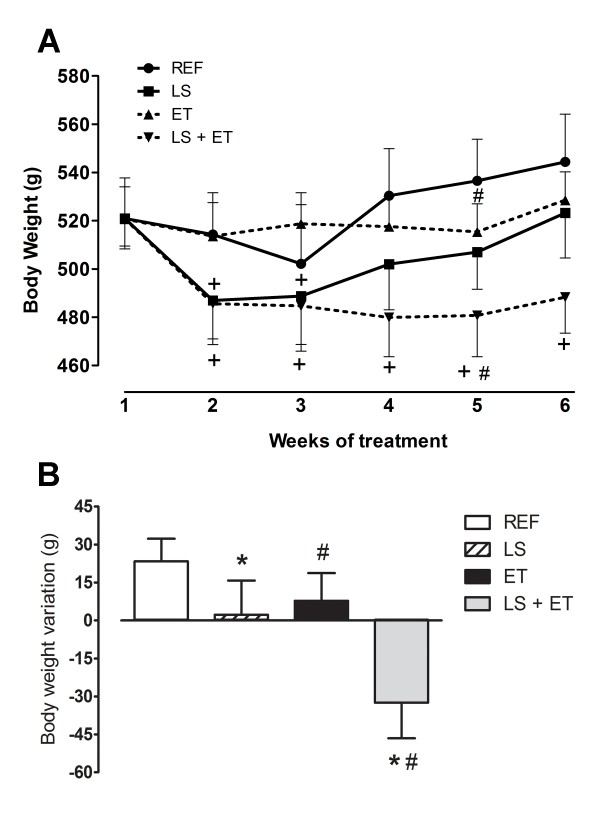
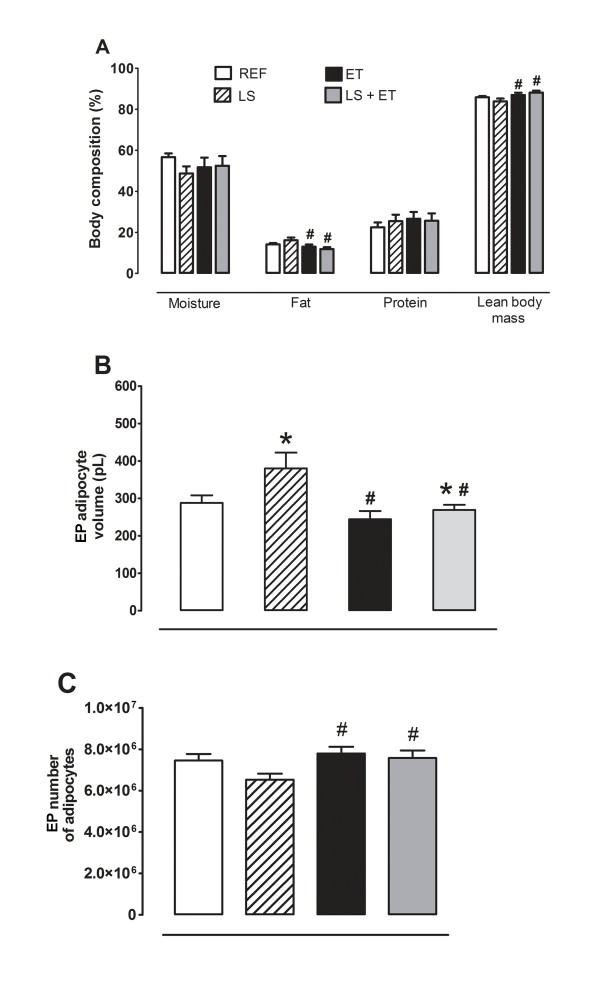
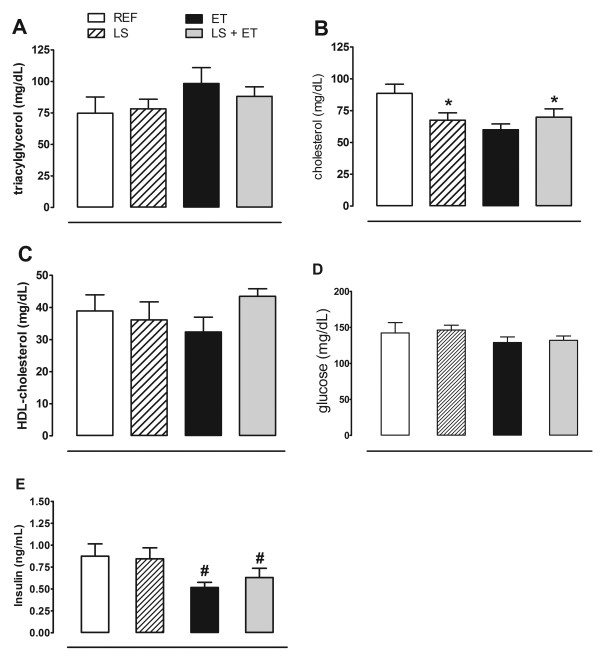
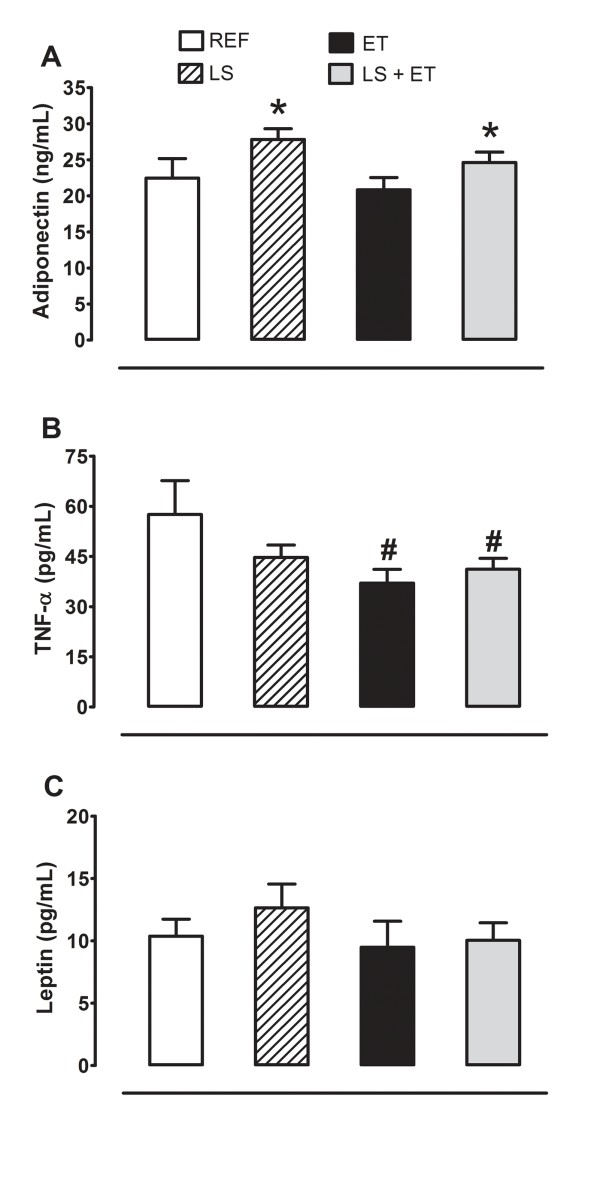
At the end of the sixth week of treatment, there was no significant difference in body weight between the REF, LS, ET and LS+ET groups. However, ET increased lean body mass in rats (P = 0.019). In addition, ET was more effective than LS in reducing adiposity (P = 0.019), serum insulin (P = 0.022) and TNF-α (P = 0.044). Conversely, LS increased serum adiponectin (P = 0.021) levels and reduced serum total cholesterol concentration (P = 0.042).
The results showed that LS had no beneficial effects on insulin sensitivity or adiposity in previously obese rats. On the other hand, LS was effective in increasing adiponectin levels and in reducing total cholesterol concentration.
研究表明亮氨酸补充(LS)具有预防肥胖和促进葡萄糖内稳态的治疗潜力。此外,定期进行体育锻炼是维持体重和预防肥胖的广泛接受的策略。本研究的目的是确定单独使用 LS 或与耐力训练(ET)联合使用作为逆转高脂肪饮食(HFD)引起的胰岛素抵抗和肥胖的潜在方法的效果。
47 只大鼠随机分为两组。动物喂食对照低脂肪饮食(n = 10)或 HFD(n = 37)。在 HFD 上 15 周后,所有大鼠均接受对照低脂肪饮食,并根据治疗方案随机分组:参照(REF)、LS、ET 和 LS+ET(每组 n = 7-8 只大鼠)。治疗 6 周后,处死动物并分析体成分、脂肪细胞体积以及血清总胆固醇、HDL-胆固醇、三酰甘油、葡萄糖、脂联素、瘦素和肿瘤坏死因子-α(TNF-α)浓度。
在治疗的第六周结束时,REF、LS、ET 和 LS+ET 组之间的体重没有显著差异。然而,ET 增加了大鼠的瘦体重(P = 0.019)。此外,ET 比 LS 更有效地降低肥胖(P = 0.019)、血清胰岛素(P = 0.022)和 TNF-α(P = 0.044)。相反,LS 增加了血清脂联素(P = 0.021)水平并降低了血清总胆固醇浓度(P = 0.042)。
结果表明 LS 对先前肥胖大鼠的胰岛素敏感性或肥胖没有有益影响。另一方面,LS 有效增加脂联素水平并降低总胆固醇浓度。