Departamento de Genética, Facultad de Veterinaria. Universidad de Santiago de Compostela, Lugo, Spain.
PLoS One. 2011;6(8):e24041. doi: 10.1371/journal.pone.0024041. Epub 2011 Aug 31.
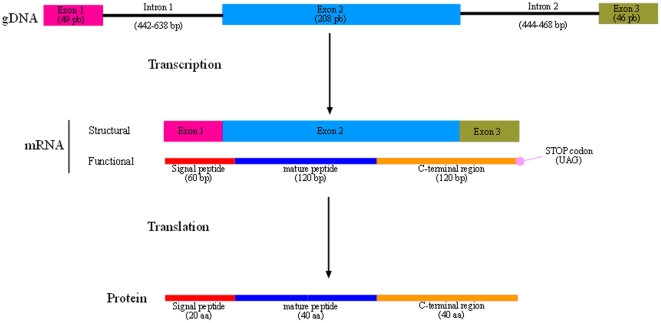
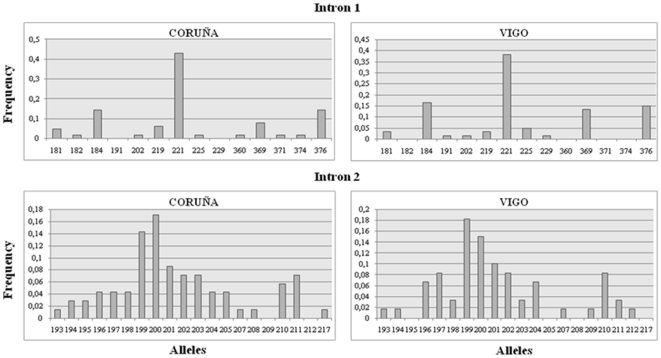
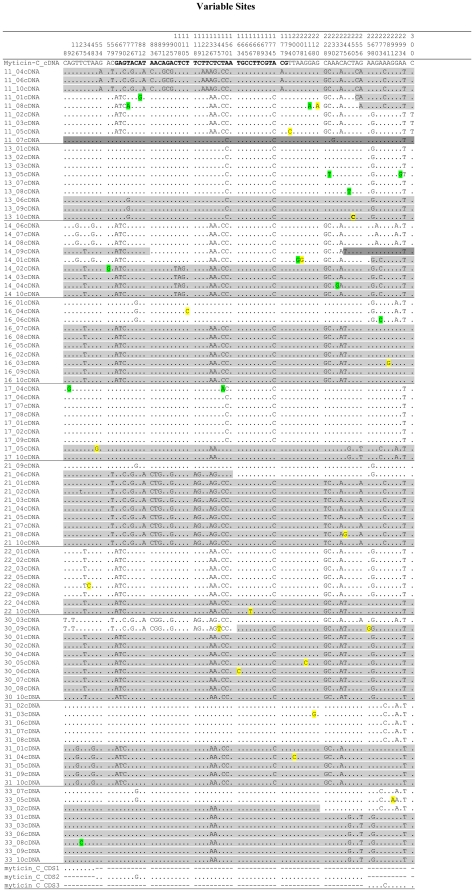
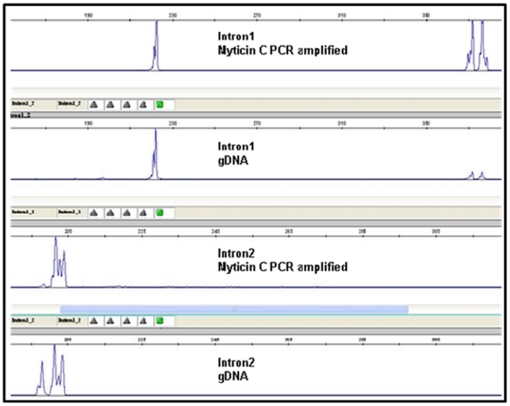
Myticin-C is a highly variable antimicrobial peptide associated to immune response in Mediterranean mussel (Mytilus galloprovincialis). In this study, we tried to ascertain the genetic organization and the mechanisms underlying myticin-C variation and evolution of this gene family. We took advantage of the large intron size variation to find out the number of myticin-C genes. Using fragment analysis a maximum of four alleles was detected per individual at both introns in a large mussel sample suggesting a minimum of two myticin-C genes. The transmission pattern of size variants in two full-sib families was also used to ascertain the number of myticin-C genes underlying the variability observed. Results in both families were in accordance with two myticin-C genes organized in tandem. A more detailed analysis of myticin-C variation was carried out by sequencing a large sample of complementary (cDNA) and genomic DNA (gDNA) in 10 individuals. Two basic sequences were detected at most individuals and several sequences were constituted by combination of two different basic sequences, strongly suggesting somatic recombination or gene conversion. Slight within-basic sequence variation detected in all individuals was attributed to somatic mutation. Such mutations were more frequently at the C-terminal domain and mostly determined non-synonymous substitutions. The mature peptide domain showed the highest variation both in the whole cDNA and in the basic-sequence samples, which is in accordance with the pathogen recognition function associated to this domain. Although most tests suggested neutrality for myticin-C variation, evidence indicated positive selection in the mature peptide and C-terminal region. Three main highly supported clusters were observed when reconstructing phylogeny on basic sequences, meiotic recombination playing a relevant role on myticin-C evolution. This study demonstrates that mechanisms to generate molecular variation similar to that observed in vertebrates are also operating in molluscs.
Myticin-C 是一种高度多变的抗菌肽,与地中海贻贝(Mytilus galloprovincialis)的免疫反应有关。在这项研究中,我们试图确定 myticin-C 变异的遗传组织和机制,以及这个基因家族的进化。我们利用大的内含子大小变化来确定 myticin-C 基因的数量。使用片段分析,在一个大型贻贝样本中,每个个体在两个内含子中最多检测到四个等位基因,这表明至少有两个 myticin-C 基因。在两个全同胞家族中大小变异的传递模式也被用来确定观察到的变异性所涉及的 myticin-C 基因数量。这两个家族的结果都与串联排列的两个 myticin-C 基因一致。通过对 10 个个体的大量互补(cDNA)和基因组 DNA(gDNA)进行测序,对 myticin-C 变异进行了更详细的分析。在大多数个体中检测到最多两种基本序列,并且一些序列是由两种不同的基本序列组合而成,这强烈表明体细胞重组或基因转换。在所有个体中检测到的微小的基本序列内变异归因于体细胞突变。这种突变在 C 末端结构域更为常见,主要导致非同义替换。成熟肽结构域在整个 cDNA 和基本序列样本中显示出最高的变异性,这与该结构域与病原体识别功能相关。尽管大多数测试表明 myticin-C 变异为中性,但有证据表明成熟肽和 C 末端区域存在正选择。在基于基本序列重建系统发育时,观察到三个主要的高度支持的聚类,减数分裂重组在 myticin-C 进化中发挥了重要作用。这项研究表明,在脊椎动物中观察到的产生分子变异的机制也在软体动物中起作用。