Drewniak Elizabeth I, Jay Gregory D, Fleming Braden C, Zhang Ling, Warman Matthew L, Crisco Joseph J
Alpert Medical School of Brown University, Rhode Island Hospital Providence, Rhode Island 02903, USA.
Arthritis Rheum. 2012 Feb;64(2):465-73. doi: 10.1002/art.33337.
To investigate the effects of lubricin gene dosage and cyclic loading on whole joint coefficient of friction and articular cartilage surface integrity in mouse knee joints.
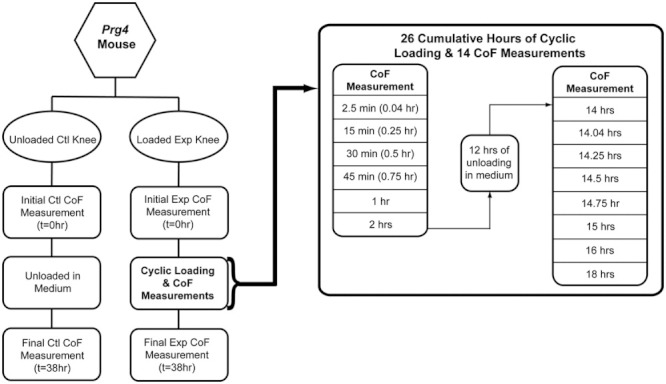
Joints from mice with 2 (Prg4(+/+)), 1 (Prg4(+/-)), or no (Prg4(-/-)) functioning lubricin alleles were subjected to 26 hours of cyclic loading using a custom-built pendulum. Coefficient of friction values were measured at multiple time points. Contralateral control joints were left unloaded. Following testing, joints were examined for histologic evidence of damage and cell viability.
At baseline, the coefficient of friction values in Prg4(-/-) mice were significantly higher than those in Prg4(+/+) and Prg4(+/-) mice (P < 0.001). Cyclic loading continuously increased the coefficient of friction in Prg4(-/-) mouse joints. In contrast, Prg4(+/-) and Prg4(+/+) mouse joints had no coefficient of friction increases during the first 4 hours of loading. After 26 hours of loading, joints from all genotypes had increased coefficient of friction values compared to baseline and unloaded controls. Significantly greater increases occurred in Prg4(-/-) and Prg4(+/-) mouse joints compared to Prg4(+/+) mouse joints. The coefficient of friction values were not significantly associated with histologic evidence of damage or loss of cell viability.
Our findings indicate that mice lacking lubricin have increased baseline coefficient of friction values and are not protected against further increases caused by loading. Prg4(+/-) mice are indistinguishable from Prg4(+/+) mice at baseline, but have significantly greater coefficient of friction values following 26 hours of loading. Lubricin dosage affects joint properties during loading, and may have clinical implications in patients for whom injury or illness alters lubricin abundance.
研究润滑素基因剂量和循环加载对小鼠膝关节全关节摩擦系数及关节软骨表面完整性的影响。
使用定制摆锤对具有2个(Prg4(+/+))、1个(Prg4(+/-))或无(Prg4(-/-))功能性润滑素等位基因的小鼠关节进行26小时的循环加载。在多个时间点测量摩擦系数值。对侧对照关节不进行加载。测试后,检查关节是否有损伤的组织学证据和细胞活力。
在基线时,Prg4(-/-)小鼠的摩擦系数值显著高于Prg4(+/+)和Prg4(+/-)小鼠(P < 0.001)。循环加载使Prg4(-/-)小鼠关节的摩擦系数持续增加。相比之下,Prg4(+/-)和Prg4(+/+)小鼠关节在加载的前4小时内摩擦系数没有增加。加载26小时后,与基线和未加载的对照相比,所有基因型的关节摩擦系数值均增加。与Prg4(+/+)小鼠关节相比,Prg4(-/-)和Prg4(+/-)小鼠关节的增加幅度明显更大。摩擦系数值与损伤的组织学证据或细胞活力丧失无显著相关性。
我们的研究结果表明,缺乏润滑素的小鼠基线摩擦系数值增加,并且不能防止因加载导致的进一步增加。Prg4(+/-)小鼠在基线时与Prg4(+/+)小鼠无法区分,但在加载26小时后摩擦系数值显著更高。润滑素剂量在加载过程中影响关节特性,对于因损伤或疾病改变润滑素丰度的患者可能具有临床意义。