National Public Health Laboratory Services, Ministry of Health, PO Box 20750-00202, Nairobi, Kenya.
BMC Public Health. 2011 Sep 9;11:696. doi: 10.1186/1471-2458-11-696.
Successful treatment of tuberculosis (TB) involves taking anti-tuberculosis drugs for at least six months. Poor adherence to treatment means patients remain infectious for longer, are more likely to relapse or succumb to tuberculosis and could result in treatment failure as well as foster emergence of drug resistant tuberculosis. Kenya is among countries with high tuberculosis burden globally. The purpose of this study was to determine the duration tuberculosis patients stay in treatment before defaulting and factors associated with default in Nairobi.
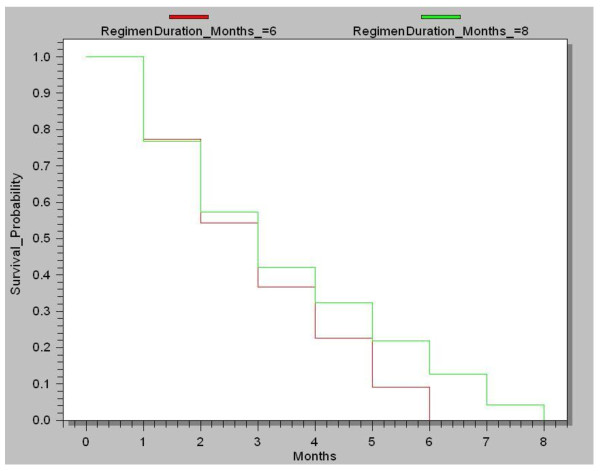
A Case-Control study; Cases were those who defaulted from treatment and Controls those who completed treatment course between January 2006 and March 2008. All (945) defaulters and 1033 randomly selected controls from among 5659 patients who completed treatment course in 30 high volume sites were enrolled. Secondary data was collected using a facility questionnaire. From among the enrolled, 120 cases and 154 controls were randomly selected and interviewed to obtain primary data not routinely collected. Data was analyzed using SPSS and Epi Info statistical software. Univariate and multivariate logistic regression analysis to determine association and Kaplan-Meier method to determine probability of staying in treatment over time were applied.
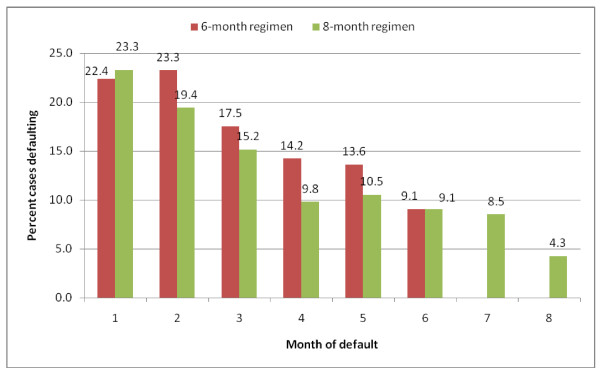
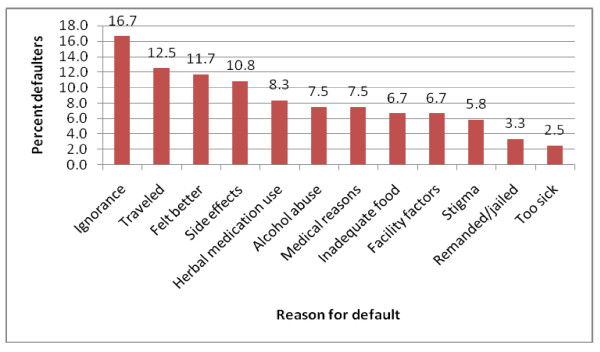
Of 945 defaulters, 22.7% (215) and 20.4% (193) abandoned treatment within first and second months (intensive phase) of treatment respectively. Among 120 defaulters interviewed, 16.7% (20) attributed their default to ignorance, 12.5% (15) to traveling away from treatment site, 11.7% (14) to feeling better and 10.8% (13) to side-effects. On multivariate analysis, inadequate knowledge on tuberculosis (OR 8.67; 95% CI 1.47-51.3), herbal medication use (OR 5.7; 95% CI 1.37-23.7), low income (OR 5.57, CI 1.07-30.0), alcohol abuse (OR 4.97; 95% CI 1.56-15.9), previous default (OR 2.33; 95% CI 1.16-4.68), co-infection with Human immune-deficient Virus (HIV) (OR 1.56; 95% CI 1.25-1.94) and male gender (OR 1.43; 95% CI 1.15-1.78) were independently associated with default.
The rate of defaulting was highest during initial two months, the intensive phase of treatment. Multiple factors were attributed by defaulting patients as cause for abandoning treatment whereas several were independently associated with default. Enhanced patient pre-treatment counseling and education about TB is recommended.
结核病(TB)的成功治疗需要至少六个月的抗结核药物治疗。治疗依从性差意味着患者的传染性持续时间更长,更有可能复发或死于结核病,并且可能导致治疗失败,并促进耐药结核病的出现。肯尼亚是全球结核病负担较高的国家之一。本研究的目的是确定内罗毕结核病患者在违约前接受治疗的时间以及与违约相关的因素。
病例对照研究;病例是那些从治疗中违约的患者,对照是那些在 2006 年 1 月至 2008 年 3 月期间完成治疗过程的患者。所有(945)违约者和从 5659 名完成治疗过程的患者中随机抽取的 1033 名对照者(30 个高容量站点)均被纳入研究。使用设施问卷收集二级数据。从登记的患者中,随机选择 120 例病例和 154 例对照进行访谈,以获取常规收集不到的主要数据。使用 SPSS 和 Epi Info 统计软件进行数据分析。应用单变量和多变量逻辑回归分析来确定关联,应用 Kaplan-Meier 方法来确定随时间推移的治疗保留概率。
在 945 名违约者中,分别有 22.7%(215 人)和 20.4%(193 人)在治疗的第一个和第二个月(强化期)放弃了治疗。在接受访谈的 120 名违约者中,16.7%(20 人)将违约归因于无知,12.5%(15 人)归因于远离治疗地点,11.7%(14 人)归因于感觉好转,10.8%(13 人)归因于副作用。多变量分析显示,结核病知识不足(OR 8.67;95%CI 1.47-51.3)、草药用药(OR 5.7;95%CI 1.37-23.7)、收入低(OR 5.57,CI 1.07-30.0)、酗酒(OR 4.97;95%CI 1.56-15.9)、既往违约(OR 2.33;95%CI 1.16-4.68)、人类免疫缺陷病毒(HIV)合并感染(OR 1.56;95%CI 1.25-1.94)和男性(OR 1.43;95%CI 1.15-1.78)与违约独立相关。
违约率在最初两个月(强化期)最高。违约患者将多种因素归因于放弃治疗,而多个因素与违约独立相关。建议加强患者治疗前咨询和结核病教育。