Virologie Humaine, INSERM-U758, Lyon, France.
PLoS Pathog. 2011 Sep;7(9):e1002231. doi: 10.1371/journal.ppat.1002231. Epub 2011 Sep 1.
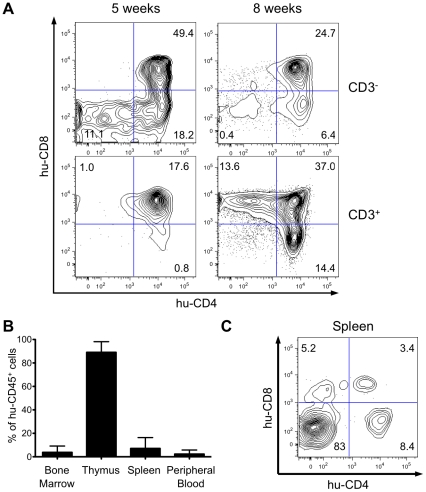
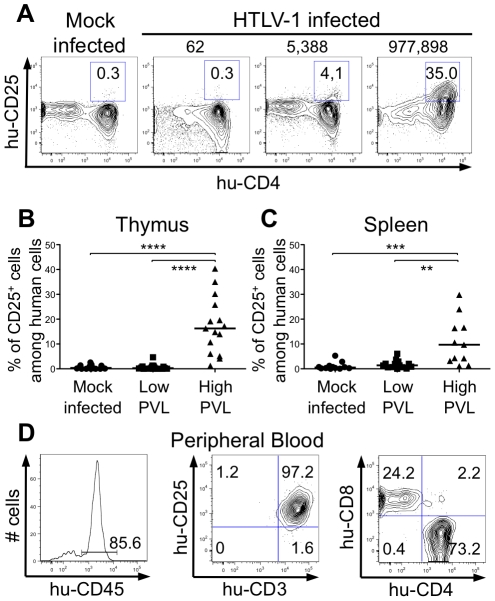
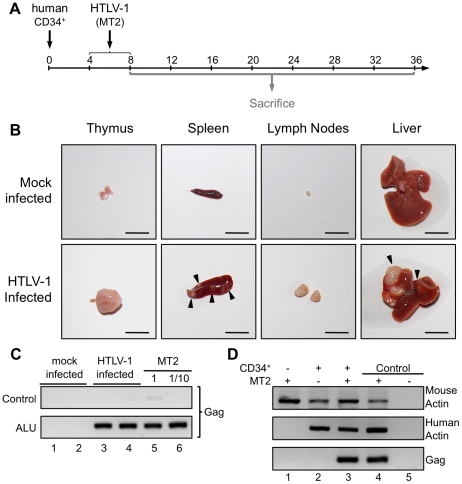
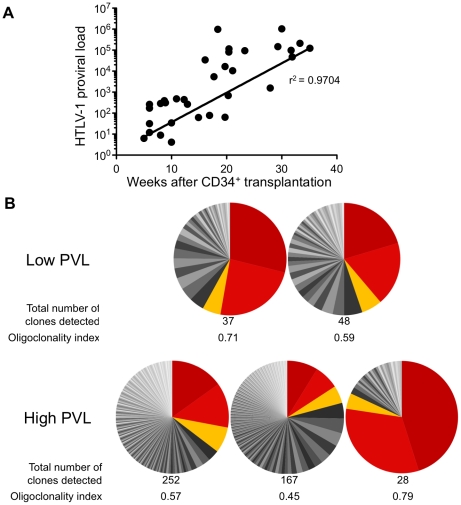
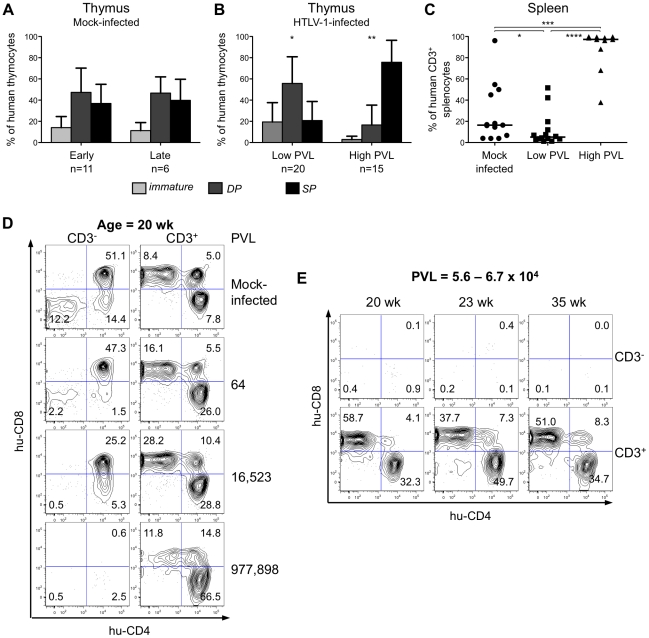
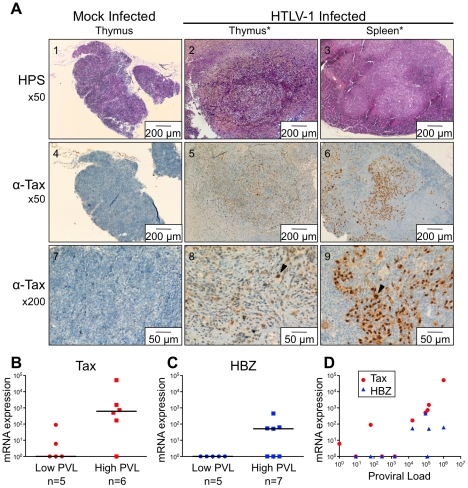
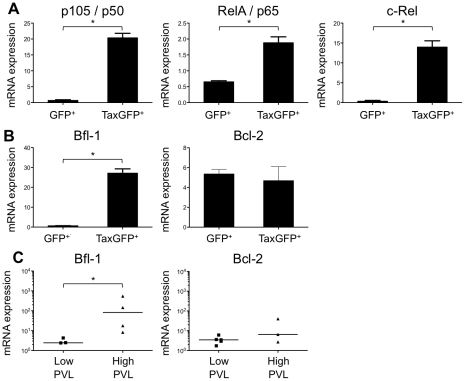
Alteration of early haematopoietic development is thought to be responsible for the onset of immature leukemias and lymphomas. We have previously demonstrated that Tax(HTLV-1) interferes with ß-selection, an important checkpoint of early thymopoiesis, indicating that human T-cell leukemia virus type 1 (HTLV-1) infection has the potential to perturb thymic human αβ T-cell development. To verify that inference and to clarify the impact of HTLV-1 infection on human T-cell development, we investigated the in vivo effects of HTLV-1 infection in a "Human Immune System" (HIS) Rag2⁻/⁻γ(c)⁻/⁻ mouse model. These mice were infected with HTLV-1, at a time when the three main subpopulations of human thymocytes have been detected. In all but two inoculated mice, the HTLV-1 provirus was found integrated in thymocytes; the proviral load increased with the length of the infection period. In the HTLV-1-infected mice we observed alterations in human T-cell development, the extent of which correlated with the proviral load. Thus, in the thymus of HTLV-1-infected HIS Rag2⁻/⁻γc⁻/⁻ mice, mature single-positive (SP) CD4⁺ and CD8⁺ cells were most numerous, at the expense of immature and double-positive (DP) thymocytes. These SP cells also accumulated in the spleen. Human lymphocytes from thymus and spleen were activated, as shown by the expression of CD25: this activation was correlated with the presence of tax mRNA and with increased expression of NF-kB dependent genes such as bfl-1, an anti-apoptotic gene, in thymocytes. Finally, hepato-splenomegaly, lymphadenopathy and lymphoma/thymoma, in which Tax was detected, were observed in HTLV-1-infected mice, several months after HTLV-1 infection. These results demonstrate the potential of the HIS Rag2⁻/⁻γ(c)⁻/⁻ animal model to elucidate the initial steps of the leukemogenic process induced by HTLV-1.
早期造血发育的改变被认为是不成熟白血病和淋巴瘤发病的原因。我们之前已经证明 Tax(HTLV-1)干扰β选择,这是早期胸腺发生的一个重要检查点,表明人类 T 细胞白血病病毒 1 型(HTLV-1)感染有可能扰乱胸腺人αβ T 细胞的发育。为了验证这一推断,并阐明 HTLV-1 感染对人 T 细胞发育的影响,我们在“人免疫系统”(HIS) Rag2⁻/⁻γ(c)⁻/⁻小鼠模型中研究了 HTLV-1 感染的体内效应。这些小鼠在已经检测到三种主要人胸腺细胞亚群时被 HTLV-1 感染。除了两只接种的小鼠外,所有小鼠的 HTLV-1 前病毒都被发现整合在胸腺细胞中;前病毒载量随着感染时间的延长而增加。在 HTLV-1 感染的小鼠中,我们观察到人类 T 细胞发育发生改变,其程度与前病毒载量相关。因此,在 HTLV-1 感染的 HIS Rag2⁻/⁻γ(c)⁻/⁻小鼠的胸腺中,成熟的单阳性(SP)CD4⁺和 CD8⁺细胞数量最多,而不成熟的双阳性(DP)胸腺细胞则减少。这些 SP 细胞也在脾脏中积累。胸腺和脾脏中的人类淋巴细胞被激活,这表现为 CD25 的表达:这种激活与 tax mRNA 的存在以及 NF-kB 依赖性基因(如 bfl-1,一种抗凋亡基因)的表达增加相关,在胸腺细胞中。最后,在 HTLV-1 感染几个月后,在 HTLV-1 感染的小鼠中观察到肝脾肿大、淋巴结病和淋巴瘤/胸腺瘤,其中检测到 Tax。这些结果表明,HIS Rag2⁻/⁻γ(c)⁻/⁻动物模型有潜力阐明 HTLV-1 诱导的白血病发生过程的初始步骤。