Laboratory of Neuroendocrinology, Department of Integrative Biology and Physiology, Brain Research Institute, University of California Los Angeles Los Angeles, CA, USA.
Front Neuroanat. 2011 Sep 1;5:57. doi: 10.3389/fnana.2011.00057. eCollection 2011.
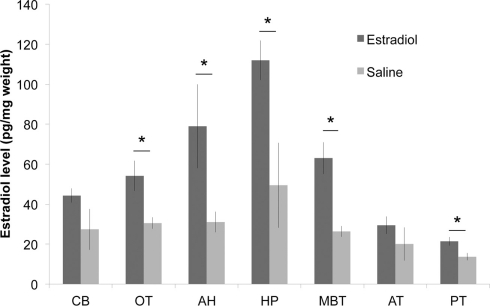
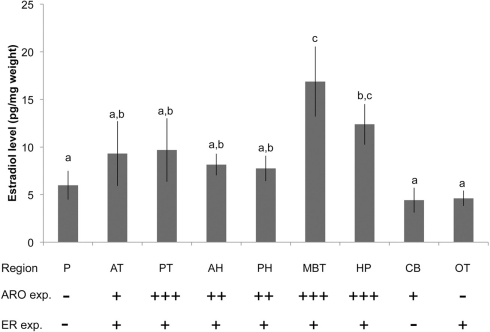
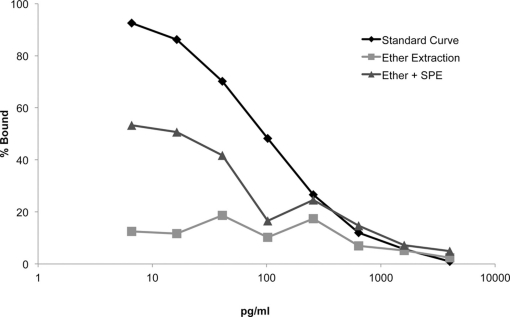
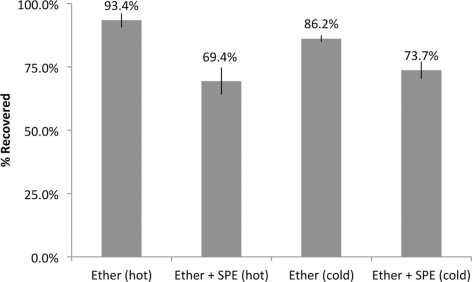
Accuracy in quantifying brain-derived steroid hormones ("neurosteroids") has become increasingly important for understanding the modulation of neuronal activity, development, and physiology. Relative to other neuroactive compounds and classical neurotransmitters, steroids pose particular challenges with regard to isolation and analysis, owing to their lipid solubility. Consequently, anatomical studies of the distribution of neurosteroids have relied primarily on the expression of neurosteroid synthesis enzymes. To evaluate the distribution of synthesis enzymes vis-à-vis the actual steroids themselves, traditional steroid quantification assays, including radioimmunoassays, have successfully employed liquid extraction methods (e.g., ether, dichloromethane, or methanol) to isolate steroids from microdissected brain tissue. Due to their sensitivity, safety, and reliability, the use of commercial enzyme-immunoassays (EIA) for laboratory quantification of steroids in plasma and brain has become increasingly widespread. However, EIAs rely on enzymatic reactions in vitro, making them sensitive to interfering substances in brain tissue and thus producing unreliable results. Here, we evaluate the effectiveness of a protocol for combined, two-stage liquid/solid-phase extraction (SPE) as compared to conventional liquid extraction alone for the isolation of estradiol (E(2)) from brain tissue. We employ the songbird model system, in which brain steroid production is pronounced and linked to neural mechanisms of learning and plasticity. This study outlines a combined liquid-SPE protocol that improves the performance of a commercial EIA for the quantification of brain E(2) content. We demonstrate the effectiveness of our optimized method for evaluating the region specificity of brain E(2) content, compare these results to established anatomy of the estrogen synthesis enzyme and estrogen receptor, and discuss the nature of potential EIA interfering substances.
定量测定脑源性类固醇激素(“神经甾体”)的准确性对于理解神经元活动、发育和生理的调节变得越来越重要。与其他神经活性化合物和经典神经递质相比,由于其脂溶性,类固醇在分离和分析方面带来了特殊的挑战。因此,神经甾体分布的解剖学研究主要依赖于神经甾体合成酶的表达。为了评估合成酶的分布与实际类固醇本身的分布,传统的类固醇定量测定法,包括放射免疫测定法,成功地采用了液体提取方法(例如乙醚、二氯甲烷或甲醇)从微切割脑组织中分离类固醇。由于其灵敏度、安全性和可靠性,商业酶联免疫吸附测定(EIA)用于实验室中血浆和大脑中类固醇的定量已变得越来越广泛。然而,EIA 依赖于体外的酶反应,因此容易受到脑组织中干扰物质的影响,从而产生不可靠的结果。在这里,我们评估了联合两步液体/固相萃取(SPE)方案的有效性,与单独的传统液体萃取相比,该方案用于从脑组织中分离雌二醇(E(2))。我们采用鸣禽模型系统,其中大脑类固醇的产生明显,并与学习和可塑性的神经机制相关。本研究概述了一种联合液体 SPE 方案,该方案可提高商业 EIA 定量测定大脑 E(2)含量的性能。我们展示了我们优化方法用于评估大脑 E(2)含量的区域特异性的有效性,将这些结果与已建立的雌激素合成酶和雌激素受体解剖学进行比较,并讨论了潜在的 EIA 干扰物质的性质。