van den Hurk Paul A M, Wingens Tom, Giommi Fabio, Barendregt Henk P, Speckens Anne E M, van Schie Hein T
Mindfulness (N Y). 2011 Sep;2(3):194-200. doi: 10.1007/s12671-011-0060-7. Epub 2011 Jun 18.
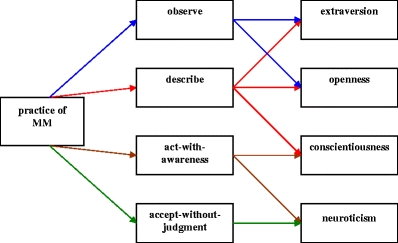
Mindfulness meditation (MM) has often been suggested to induce fundamental changes in the way events in life are experienced and dealt with, presumably leading to alterations in personality. However, the relationship between the practice of MM and personality has not been systematically studied. The aim of this study was to explore this relationship and to investigate the mediating role of mindfulness skills. Thirty-five experienced mindfulness meditators (age range, 31-75 years; meditation experience range, 0.25-35 years; mean, ∼13 years) and 35 age-, gender-, and ethnicity-matched controls (age range, 27-63 years) without any meditation experience completed a personality (NEO-FFI) and mindfulness (KIMS) questionnaire. The practice of MM was positively related to openness and extraversion and negatively related to neuroticism and conscientiousness. Thus, the results of the current study associate the practice of MM with higher levels of curiosity and receptivity to new experiences and experience of positive affect and with less proneness toward negative emotions and worrying and a reduced focus on achievements. Furthermore, the mediating role of specific mindfulness skills in the relationship between the practice of MM and personality traits was shown.
正念冥想(MM)常被认为会引发人们体验和应对生活中各种事件的方式发生根本性变化,据推测这会导致人格改变。然而,MM练习与人格之间的关系尚未得到系统研究。本研究的目的是探讨这种关系,并研究正念技能的中介作用。35名有经验的正念冥想者(年龄范围为31至75岁;冥想经验范围为0.25至35年;平均约13年)和35名年龄、性别和种族匹配的无任何冥想经验的对照组(年龄范围为27至63岁)完成了一份人格问卷(NEO-FFI)和一份正念问卷(KIMS)。MM练习与开放性和外向性呈正相关,与神经质和尽责性呈负相关。因此,本研究结果表明,MM练习与对新体验的更高好奇心和接受度、积极情绪体验相关,且负面情绪和担忧倾向较低,对成就的关注度降低。此外,还显示了特定正念技能在MM练习与人格特质关系中的中介作用。