Centre for Ecological Sciences, Indian Institute of Science, Bangalore, India.
PLoS One. 2011;6(8):e23642. doi: 10.1371/journal.pone.0023642. Epub 2011 Aug 31.
Resource partitioning is facilitated by adaptations along niche dimensions that range from morphology to behaviour. The exploitation of hidden resources may require specially adapted morphological or sensory tools for resource location and utilisation. Differences in tool diversity and complexity can determine not only how many species can utilize these hidden resources but also how they do so.
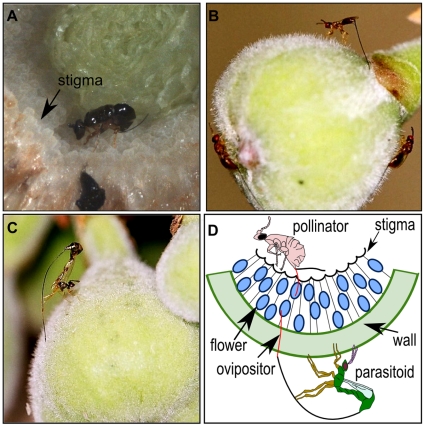
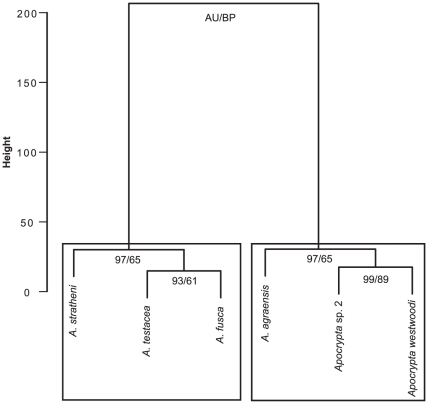
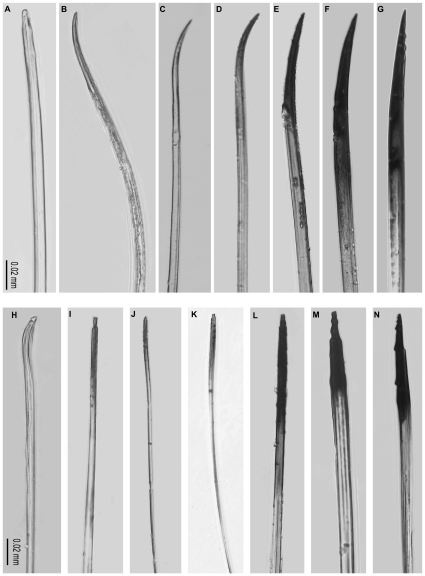
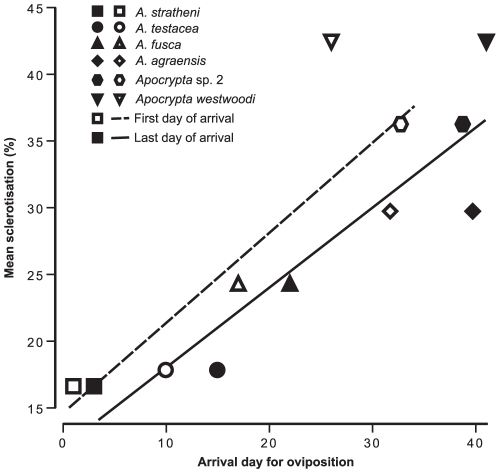
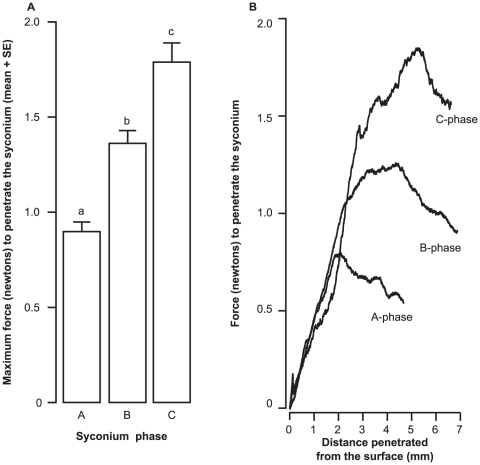
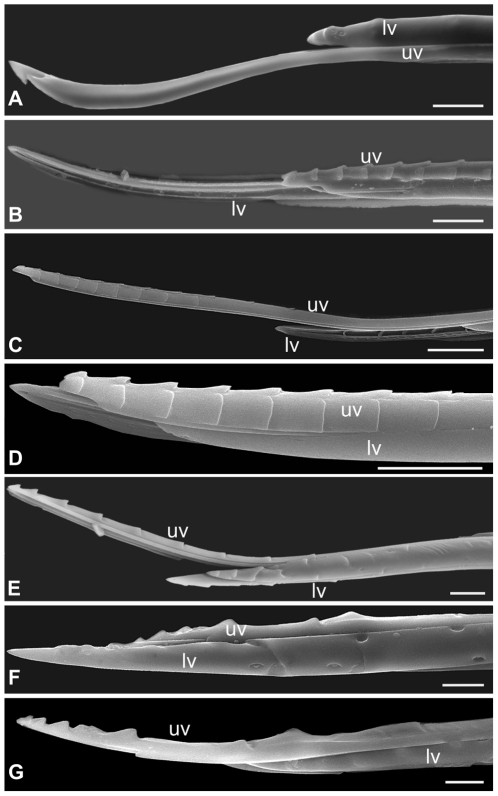
The sclerotisation, gross morphology and ultrastructure of the ovipositors of a seven-member community of parasitic wasps comprising of gallers and parasitoids developing within the globular syconia (closed inflorescences) of Ficus racemosa (Moraceae) was investigated. These wasps also differ in their parasitism mode (external versus internal oviposition) and their timing of oviposition into the expanding syconium during its development. The number and diversity of sensilla, as well as ovipositor teeth, increased from internally ovipositing to externally ovipositing species and from gallers to parasitoids. The extent of sclerotisation of the ovipositor tip matched the force required to penetrate the syconium at the time of oviposition of each species. The internally ovipositing pollinator had only one type of sensillum and a single notch on the ovipositor tip. Externally ovipositing species had multiple sensilla types and teeth on their ovipositors. Chemosensilla were most concentrated at ovipositor tips while mechanoreceptors were more widely distributed, facilitating the precise location of hidden hosts in these wasps which lack larval host-seeking behaviour. Ovipositor traits of one parasitoid differed from those of its syntopic galler congeners and clustered with those of parasitoids within a different wasp subfamily. Thus ovipositor tools can show lability based on adaptive necessity, and are not constrained by phylogeny.
CONCLUSIONS/SIGNIFICANCE: Ovipositor structure mirrored the increasingly complex trophic ecology and requirements for host accessibility in this parasite community. Ovipositor structure could be a useful surrogate for predicting the biology of parasites in other communities.
资源分割是通过适应生态位维度来实现的,这些维度从形态到行为都有。对于隐藏资源的开发可能需要专门适应的形态或感官工具来定位和利用资源。工具多样性和复杂性的差异不仅决定了有多少物种可以利用这些隐藏资源,还决定了它们如何利用这些资源。
研究了七种寄生蜂社区的产卵器的骨化、大体形态和超微结构,这些寄生蜂在榕属植物的球状聚花果(封闭花序)内发育,包括瘿蜂和寄生蜂。这些蜂类在寄生方式(内部或外部产卵)和在聚花果发育过程中产卵进入扩张聚花果的时间上也存在差异。感觉毛和产卵器牙齿的数量和多样性从内部产卵的物种增加到外部产卵的物种,从瘿蜂增加到寄生蜂。产卵器尖端的骨化程度与每种物种产卵时穿透聚花果所需的力相匹配。内部产卵的传粉者只有一种感觉毛和产卵器尖端的一个缺口。外部产卵的物种在其产卵器上有多种感觉毛类型和牙齿。化学感受器最集中在产卵器尖端,而机械感受器分布更广,这有助于这些缺乏幼虫寻找宿主行为的蜂类准确定位隐藏的宿主。一种寄生蜂的产卵器特征与其同域瘿蜂近缘种不同,与不同蜂亚科的寄生蜂聚类。因此,产卵器工具可以根据适应性的需要表现出不稳定性,而不受系统发育的限制。
结论/意义:产卵器结构反映了这个寄生虫群落中日益复杂的营养生态学和宿主可及性要求。产卵器结构可以成为预测其他群落中寄生虫生物学的有用替代物。