School of Natural Sciences, University of California Merced, Merced, California, United States of America.
PLoS One. 2011;6(9):e23810. doi: 10.1371/journal.pone.0023810. Epub 2011 Sep 6.
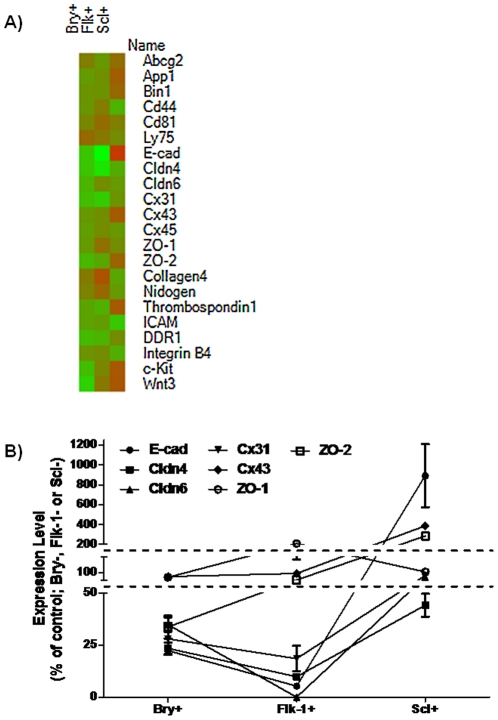
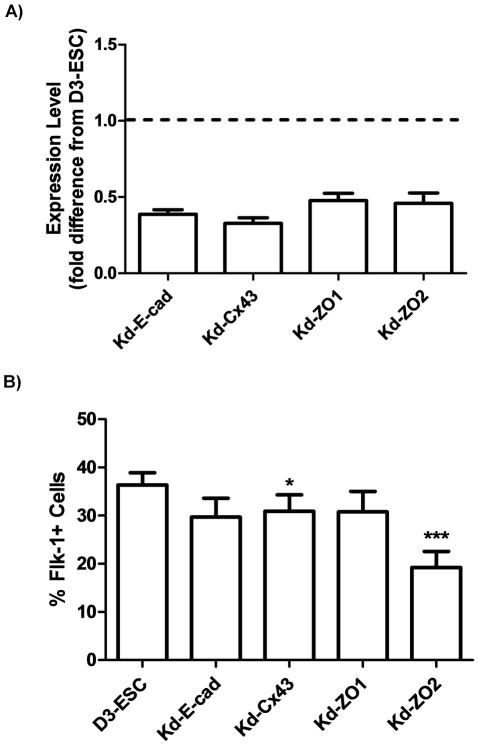
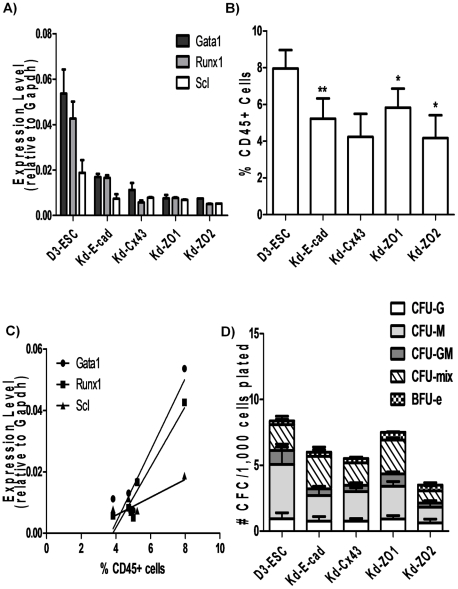
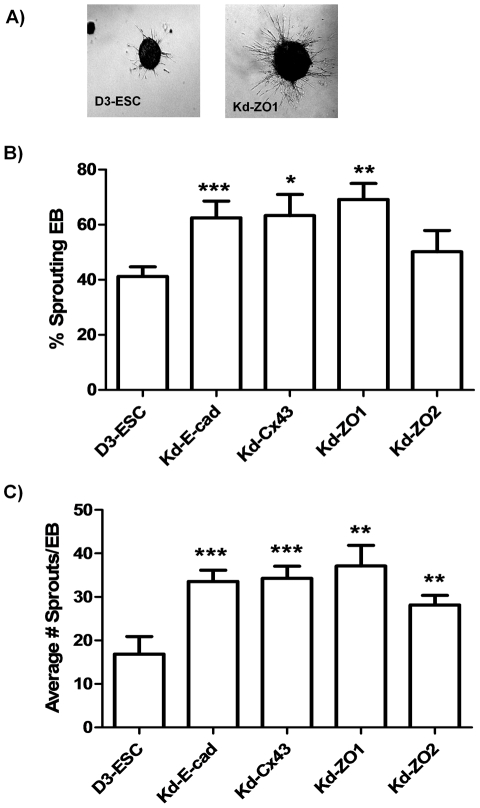
Mouse embryonic stem cells (ESC) make cell fate decisions based on intrinsic and extrinsic factors. The decision of ESC to differentiate to multiple lineages in vitro occurs during the formation of embryoid bodies (EB) and is influenced by cell-environment interactions. However, molecular mechanisms underlying cell-environmental modulation of ESC fate decisions are incompletely understood. Since adhesion molecules (AM) influence proliferation and differentiation in developing and adult tissues, we hypothesized that specific AM interactions influence ESC commitment toward hematopoietic and endothelial lineages. Expression of AM in the adherens, tight and gap junction pathways in ESC subpopulations were quantified. E-cadherin (E-cad), Claudin-4 (Cldn4), Connexin-43 (Cx43), Zona Occludens-1 (ZO-1) and Zona Occludens-2 (ZO-2) transcript levels were differentially expressed during early stages of hematopoietic/endothelial commitment. Stable ESC lines were generated with reduced expression of E-cad, Cldn4, Cx43, ZO-1 and ZO-2 using shRNA technology. Functional and phenotypic consequences of modulating AM expression were assessed using hematopoietic colony forming assays, endothelial sprouting assays and surface protein expression. A decrease in E-cad, Cldn4, Cx43 and ZO-1 expression was associated with less commitment to the hematopoietic lineage and increased endothelial differentiation as evidenced by functional and phenotypic analysis. A reduction in ZO-2 expression did not influence endothelial differentiation, but decreased hematopoietic commitment two-fold. These data indicate that a subset of AM influence ESC decisions to commit to endothelial and hematopoietic lineages. Furthermore, differentially expressed AM may provide novel markers to delineate early stages of ESC commitment to hematopoietic/endothelial lineages.
小鼠胚胎干细胞 (ESC) 根据内在和外在因素做出细胞命运决定。ESC 在体外分化为多个谱系的决定发生在胚状体 (EB) 的形成过程中,并受到细胞-环境相互作用的影响。然而,细胞-环境调节 ESC 命运决定的分子机制尚不完全清楚。由于粘附分子 (AM) 影响发育和成年组织中的增殖和分化,我们假设特定的 AM 相互作用影响 ESC 向造血和内皮谱系的承诺。定量分析 ESC 亚群中粘附、紧密和间隙连接途径中的 AM 表达。E-钙粘蛋白 (E-cad)、Claudin-4 (Cldn4)、Connexin-43 (Cx43)、Zona Occludens-1 (ZO-1) 和 Zona Occludens-2 (ZO-2) 的转录水平在造血/内皮承诺的早期阶段差异表达。使用 shRNA 技术生成了 E-cad、Cldn4、Cx43、ZO-1 和 ZO-2 表达降低的稳定 ESC 系。通过造血集落形成测定、内皮发芽测定和表面蛋白表达评估 AM 表达调节的功能和表型后果。AM 表达减少与造血谱系的承诺减少和内皮分化增加相关,这可以通过功能和表型分析来证明。ZO-2 表达减少不影响内皮分化,但造血承诺减少两倍。这些数据表明,一组 AM 影响 ESC 决定承诺内皮和造血谱系。此外,差异表达的 AM 可能为描绘 ESC 向造血/内皮谱系承诺的早期阶段提供新的标记。