Laboratory of Experimental Virology, Department of Medical Microbiology, Centre for Infection and Immunity Amsterdam, Academic Medical Centre, University of Amsterdam, Meibergdreef 15, 1105 AZ Amsterdam, the Netherlands.
Retrovirology. 2011 Sep 16;8:73. doi: 10.1186/1742-4690-8-73.
HIV-1 transcription initiation depends on cellular transcription factors that bind to promoter sequences in the Long Terminal Repeat (LTR). Each HIV-1 subtype has a specific LTR promoter configuration and even minor sequence changes in the transcription factor binding sites (TFBS) or their arrangement can impact transcriptional activity. Most latency studies have focused on HIV-1 subtype B strains, and the degree to which LTR promoter variation contributes to differences in proviral latency is therefore largely unknown. Latency differences may influence establishment and size of viral reservoirs as well as the possibility to clear the virus by therapeutic intervention.
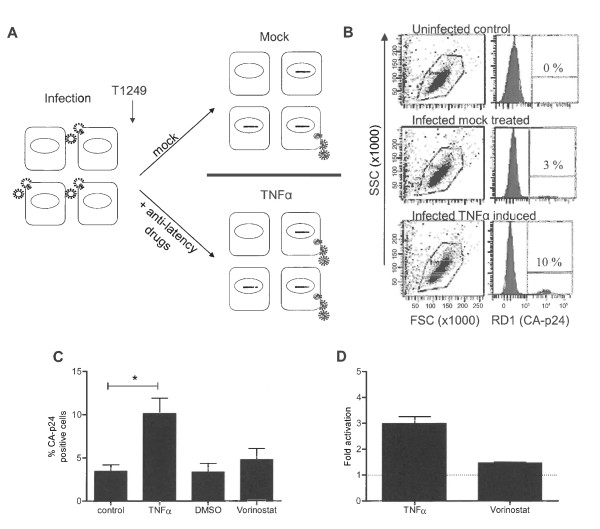
We investigated the proviral transcriptional latency properties of different HIV-1 subtypes as their LTRs have unique assemblies of transcription factor binding sites. We constructed recombinant viral genomes with the subtype-specific promoters inserted in the common backbone of the subtype B LAI isolate. The recombinant viruses are isogenic, except for the core promoter region that encodes all major TFBS, including NFκB and Sp1 sites. We developed and optimized an assay to investigate HIV-1 proviral latency in T cell lines. Our data show that the majority of HIV-1 infected T cells only start viral gene expression after TNFα activation.
There were no gross differences among the subtypes, both in the initial latency level and the activation response, except for subtype AE that combines an increased level of basal transcription with a reduced TNFα response. This subtype AE property is related to the presence of a GABP instead of NFκB binding site in the LTR.
HIV-1 的转录起始依赖于细胞转录因子,这些转录因子与长末端重复序列(LTR)中的启动子序列结合。每个 HIV-1 亚型都有特定的 LTR 启动子结构,即使转录因子结合位点(TFBS)或其排列的微小序列变化也会影响转录活性。大多数潜伏研究都集中在 HIV-1 亚型 B 株上,因此,LTR 启动子变异对前病毒潜伏的影响程度在很大程度上尚不清楚。潜伏差异可能会影响病毒储存库的建立和大小,以及通过治疗干预清除病毒的可能性。
我们研究了不同 HIV-1 亚型的前病毒转录潜伏特性,因为它们的 LTR 具有独特的转录因子结合位点组装。我们构建了带有亚型特异性启动子的重组病毒基因组,这些启动子插入了亚型 B LAI 分离株的共同骨干中。重组病毒是同基因的,除了核心启动子区域,该区域编码所有主要的 TFBS,包括 NFκB 和 Sp1 位点。我们开发并优化了一种用于研究 T 细胞系中 HIV-1 前病毒潜伏的检测方法。我们的数据表明,大多数 HIV-1 感染的 T 细胞只有在 TNFα 激活后才开始病毒基因表达。
除了亚型 AE 外,所有亚型在初始潜伏水平和激活反应方面都没有明显差异,亚型 AE 表现出基础转录水平增加,TNFα 反应降低的特征。这种亚型 AE 的特性与 LTR 中存在 GABP 而不是 NFκB 结合位点有关。