Unit of Public Health, Epidemiology & Biostatistics, Public Health Building, University of Birmingham, Edgbaston, Birmingham, UK.
BMC Public Health. 2011 Sep 19;11:707. doi: 10.1186/1471-2458-11-707.
Telephone-based care management programmes have been shown to improve health outcomes in some chronic diseases. Birmingham Own Health is a telephone-based care service (nurse-delivered motivational coaching and support for self-management and lifestyle change) for patients with poorly controlled diabetes, delivered in Birmingham, UK. We used a novel method to evaluate its effectiveness in a real-life setting.
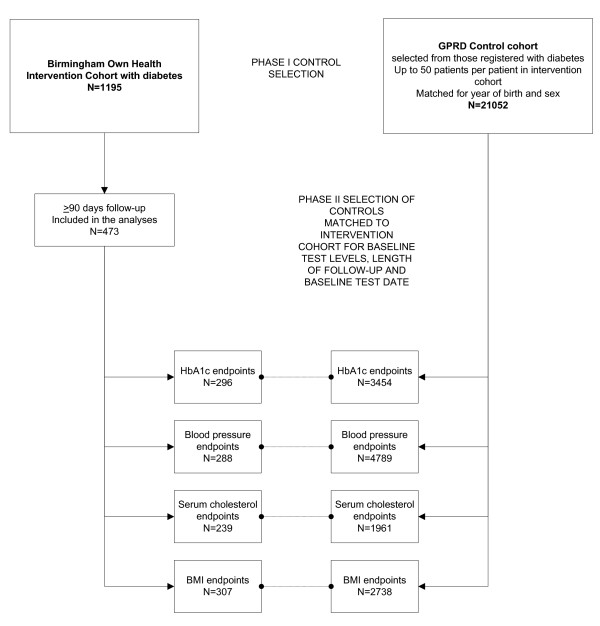
Retrospective cohort study in the UK. 473 patients aged ≥ 18 years with diabetes enrolled onto Birmingham Own Health (intervention cohort) and with > 90 days follow-up, were each matched by age and sex to up to 50 patients with diabetes registered with the General Practice Research Database (GPRD) to create a pool of 21,052 controls (control cohort). Controls were further selected from the main control cohort, matching as close as possible to the cases for baseline test levels, followed by as close as possible length of follow-up (within +/- 30 days limits) and within +/- 90 days baseline test date. The aim was to identify a control group with as similar distribution of prognostic factors to the cases as possible. Effect sizes were computed using linear regression analysis adjusting for age, sex, deprivation quintile, length of follow-up and baseline test levels.
After adjusting for baseline values and other potential confounders, the intervention showed significant mean reductions among people with diabetes of 0.3% (95% CI 0.1, 0.4%) in HbA1c; 3.5 mmHg (1.5, 5.5) in systolic blood pressure, 1.6 mmHg (0.4, 2.7) in diastolic blood pressure and 0.7 unit reduction (0.3, 1.0) in BMI, over a mean follow-up of around 10 months. Only small effects were seen on average on serum cholesterol levels (0.1 mmol/l reduction (0.1, 0.2)). More marked effects were seen for each clinical outcome among patients with worse baseline levels.
Despite the limitations of the study design, the results are consistent with the Birmingham Own Health telephone care management intervention being effective in reducing HbA1c levels, blood pressure and BMI in people with diabetes, to a degree comparable with randomised controlled trials of similar interventions and clinically important. The effects appear to be greater in patients with poorer baseline levels and the intervention is effective in the most deprived populations.
基于电话的护理管理方案已被证明可改善某些慢性病的健康结果。伯明翰自有健康是一种基于电话的护理服务(护士提供动机咨询和支持,以进行自我管理和生活方式改变),适用于英国伯明翰控制不佳的糖尿病患者。我们使用一种新方法在真实环境中评估其效果。
这是英国的一项回顾性队列研究。共有 473 名年龄≥18 岁的糖尿病患者参加了伯明翰自有健康计划(干预组),随访时间超过 90 天。每位患者均按年龄和性别与一般实践研究数据库(GPRD)中登记的 50 名糖尿病患者进行匹配,创建了一个由 21,052 名对照组成的池(对照组)。从主要对照组中进一步选择对照,尽可能接近病例的基线测试水平进行匹配,然后尽可能接近随访时间(在+/- 30 天的范围内)和+/- 90 天的基线测试日期。目的是为病例尽可能匹配具有相似预后因素分布的对照组。使用线性回归分析调整年龄、性别、贫困五分位数、随访时间和基线测试水平来计算效应大小。
调整基线值和其他潜在混杂因素后,与糖尿病患者相比,干预组的糖化血红蛋白(HbA1c)平均降低 0.3%(95%CI 0.1,0.4%);收缩压降低 3.5mmHg(1.5,5.5);舒张压降低 1.6mmHg(0.4,2.7);体重指数(BMI)降低 0.7 个单位(0.3,1.0),平均随访时间约为 10 个月。血清胆固醇水平平均降低 0.1mmol/l(0.1,0.2)。基线水平较差的患者,每个临床结果的效果更为明显。
尽管研究设计存在局限性,但结果与伯明翰自有健康电话护理管理干预在降低糖尿病患者的 HbA1c 水平、血压和 BMI 方面的有效性一致,与类似干预措施的随机对照试验相当,且具有临床意义。在基线水平较差的患者中,效果似乎更大,该干预措施在最贫困人群中有效。