Department of Pathology and Immunology, Baylor College of Medicine, Houston, Texas, United States of America.
PLoS Biol. 2011 Sep;9(9):e1001148. doi: 10.1371/journal.pbio.1001148. Epub 2011 Sep 13.
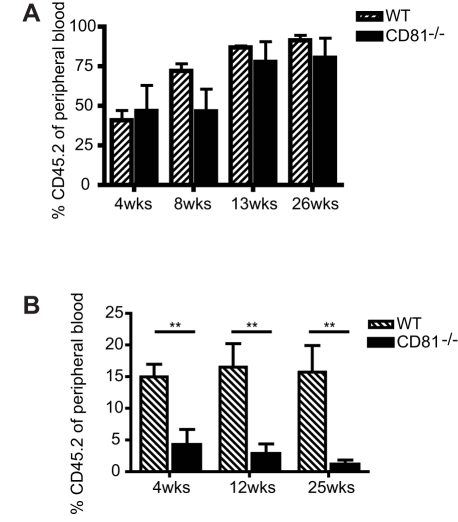
The regulatory mechanisms governing the cell cycle progression of hematopoietic stem cells (HSCs) are well characterized, but those responsible for the return of proliferating HSCs to a quiescent state remain largely unknown. Here, we present evidence that CD81, a tetraspanin molecule acutely responsive to proliferative stress, is essential for the maintenance of long-term repopulating HSCs. Cd81(-/-) HSCs showed a marked engraftment defect when transplanted into secondary recipient mice and a significantly delayed return to quiescence when stimulated to proliferate with 5-fluorouracil (5FU). In addition, we found that CD81 proteins form a polarized patch when HSCs are returning to quiescence. Thus, we propose that the spatial distribution of CD81 during the HSC recovery phase drives proliferative HSC to quiescence, and is important to preserve the self-renewal properties. Here, we show that lack of CD81 leads to loss of HSC self-renewal, and the clustering of CD81 on HSC membrane results in deactivation of Akt, which subsequently leads to nuclear translocation of FoxO1a. Thus, CD81 functions as part of a previously undefined mechanism that prohibits excessive proliferation of HSCs exposed to environmental stress.
调控造血干细胞(HSCs)细胞周期进程的机制已得到很好的描述,但负责增殖的 HSCs 恢复静息状态的机制在很大程度上仍是未知的。在这里,我们提供的证据表明,四跨膜蛋白 CD81 是对增殖应激的急性反应分子,对于维持长期重建造血干细胞是必需的。与野生型小鼠相比,Cd81(-/-) HSCs 在二次受体小鼠中移植时表现出明显的植入缺陷,并且在用 5-氟尿嘧啶(5FU)刺激增殖时恢复静息的时间明显延迟。此外,我们发现 CD81 蛋白在 HSCs 恢复静息时形成极化斑块。因此,我们提出 CD81 在 HSC 恢复阶段的空间分布驱动增殖的 HSC 进入静息状态,这对于保持自我更新特性很重要。在这里,我们表明缺乏 CD81 会导致 HSC 自我更新能力的丧失,并且 CD81 在 HSC 膜上的聚集导致 Akt 的失活,从而导致 FoxO1a 的核转位。因此,CD81 作为一个以前未定义的机制的一部分发挥作用,该机制可防止暴露于环境应激的 HSCs 过度增殖。