Medizinische Klinik und Poliklinik D, Universitätsklinikum Münster, Münster, Germany.
PLoS One. 2011;6(9):e24046. doi: 10.1371/journal.pone.0024046. Epub 2011 Sep 8.
Kidney transplantation (RTx) leads to amelioration of endothelial function in patients with advanced renal failure. Endothelial progenitor cells (EPCs) may play a key role in this repair process. The aim of this study was to determine the impact of RTx and immunosuppressive therapy on the number of circulating EPCs.
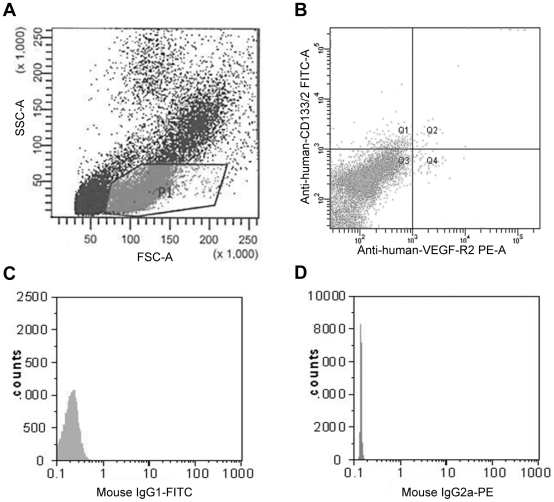
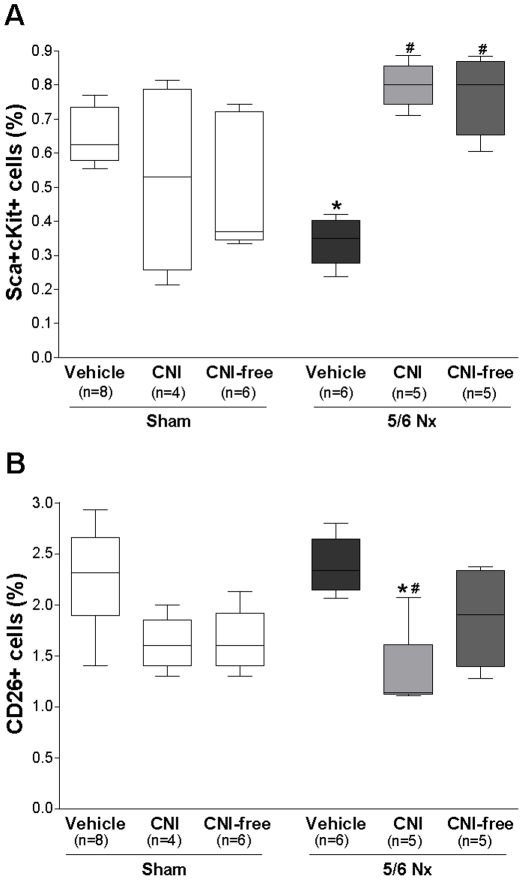
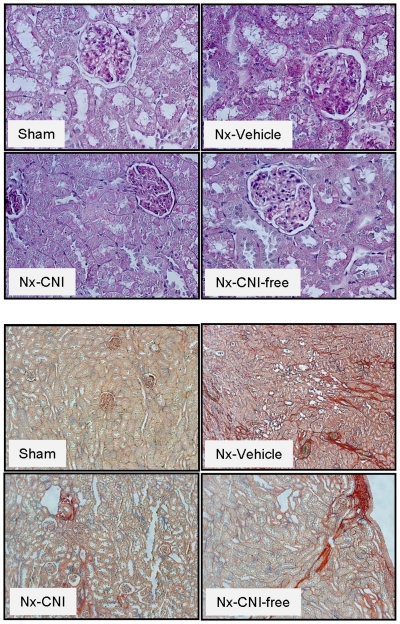
We analyzed 52 RTx patients (58±13 years; 33 males, mean ± SD) and 16 age- and gender-matched subjects with normal kidney function (57±17; 10 males). RTx patients received a calcineurin inhibitor (CNI)-based (65%) or a CNI-free therapy (35%) and steroids. EPC number was determined by double positive staining for CD133/VEGFR2 and CD34/VEGFR2 by flow cytometry. Stromal cell-derived factor 1 alpha (SDF-1) levels were assessed by ELISA. Experimentally, to dissociate the impact of RTx from the impact of immunosuppressants, we used the 5/6 nephrectomy model. The animals were treated with a CNI-based or a CNI-free therapy, and EPCs (Sca+cKit+) and CD26+ cells were determined by flow cytometry.
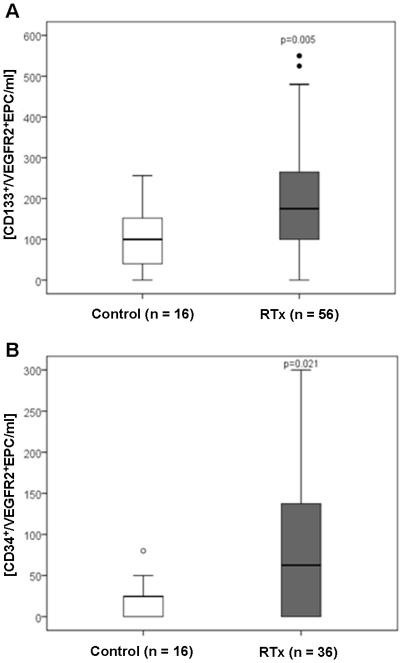
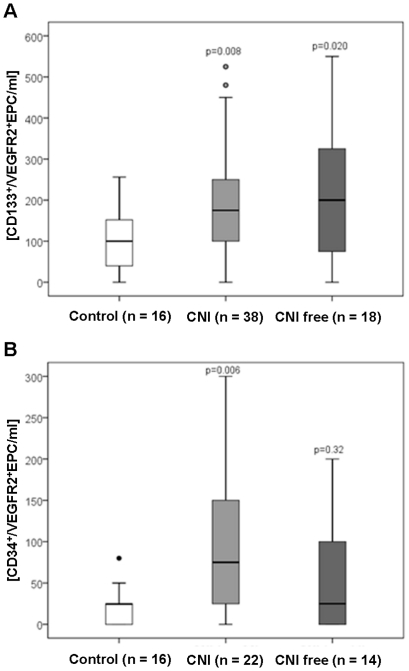
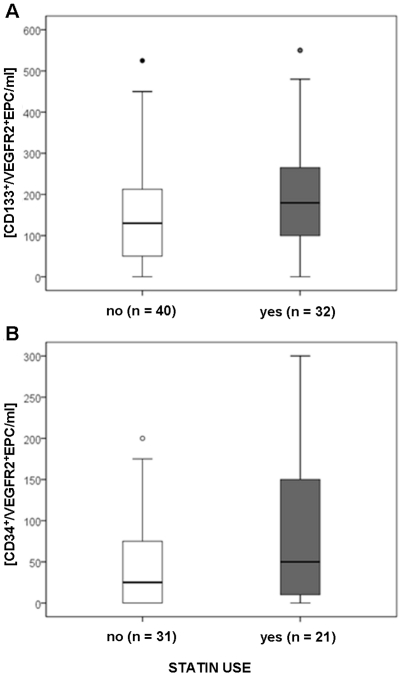
Compared to controls, circulating number of CD34+/VEGFR2+ and CD133+/VEGFR2+ EPCs increased in RTx patients. There were no correlations between EPC levels and statin, erythropoietin or use of renin angiotensin system blockers in our study. Indeed, multivariate analysis showed that SDF-1--a cytokine responsible for EPC mobilization--is independently associated with the EPC number. 5/6 rats presented decreased EPC counts in comparison to control animals. Immunosuppressive therapy was able to restore normal EPC values in 5/6 rats. These effects on EPC number were associated with reduced number of CD26+ cells, which might be related to consequent accumulation of SDF-1.
We conclude that kidney transplantation and its associated use of immunosuppressive drugs increases the number of circulating EPCs via the manipulation of the CD26/SDF-1 axis. Increased EPC count may be associated to endothelial repair and function in these patients.
肾移植(RTx)可改善晚期肾衰竭患者的内皮功能。内皮祖细胞(EPCs)可能在这一修复过程中发挥关键作用。本研究旨在确定 RTx 和免疫抑制治疗对循环 EPC 数量的影响。
我们分析了 52 例 RTx 患者(58±13 岁;33 名男性,平均值±标准差)和 16 名年龄和性别匹配的肾功能正常患者(57±17 岁;10 名男性)。RTx 患者接受钙调神经磷酸酶抑制剂(CNI)为基础(65%)或 CNI 免费治疗(35%)和类固醇治疗。通过流式细胞术双阳性染色 CD133/VEGFR2 和 CD34/VEGFR2 来确定 EPC 数量。基质细胞衍生因子 1α(SDF-1)水平通过 ELISA 评估。实验中,为了将 RTx 的影响与免疫抑制剂的影响分开,我们使用了 5/6 肾切除术模型。这些动物接受 CNI 为基础或 CNI 免费治疗,通过流式细胞术确定 EPC(Sca+cKit+)和 CD26+细胞。
与对照组相比,RTx 患者循环中 CD34+/VEGFR2+和 CD133+/VEGFR2+EPC 数量增加。在我们的研究中,EPC 水平与他汀类药物、促红细胞生成素或肾素-血管紧张素系统阻滞剂的使用之间没有相关性。事实上,多变量分析表明,SDF-1-一种负责 EPC 动员的细胞因子-与 EPC 数量独立相关。5/6 大鼠与对照动物相比,EPC 计数减少。免疫抑制治疗能够使 5/6 大鼠的 EPC 值恢复正常。这些对 EPC 数量的影响与 CD26+细胞数量减少有关,这可能与 SDF-1 的累积有关。
我们得出结论,肾移植及其相关免疫抑制药物的使用通过操纵 CD26/SDF-1 轴增加循环 EPC 的数量。这些患者内皮修复和功能的增加可能与 EPC 计数的增加有关。