Department of Clinical Pharmacology, University Medical Center Groningen, University of Groningen, Groningen, The Netherlands.
PLoS One. 2011;6(9):e24278. doi: 10.1371/journal.pone.0024278. Epub 2011 Sep 8.
Performance indicators assessing quality of diabetes care often look at single processes, e.g. whether an HbA1c test was conducted. Adequate care, however, consists of consecutive processes which should be taken in time (clinical pathways). We assessed quality of diabetes care by looking at single processes versus clinical pathways. In addition, we evaluated the impact of time period definitions on this quality assessment.
We conducted a cohort study in 2007-2008 using the GIANTT (Groningen Initiative to Analyse type 2 diabetes Treatment) database. Proportions of patients adequately managed for HbA1c, systolic blood pressure (SBP), LDL-cholesterol (LDL-C), and albumin/creatinine ratio (ACR) were calculated for the pathway of (1) risk factor level testing, (2) treatment intensification when indicated, (3) response to treatment evaluation. Strict and wide time periods for each step were defined. Proportions of patients adequately managed regarding the overall pathway and single steps, using strict or wide time periods were compared using odds ratios (OR) with 95% confidence intervals.
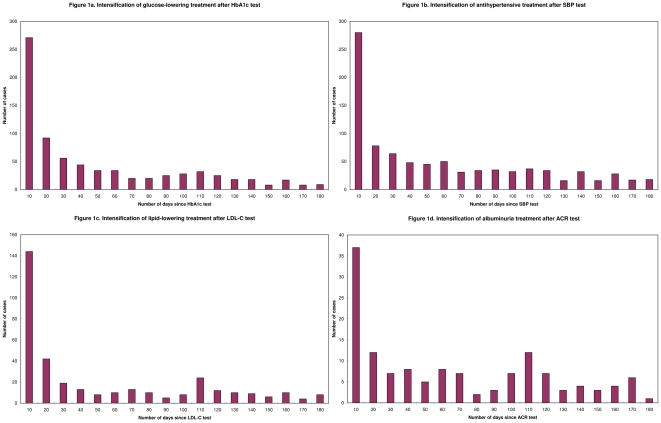
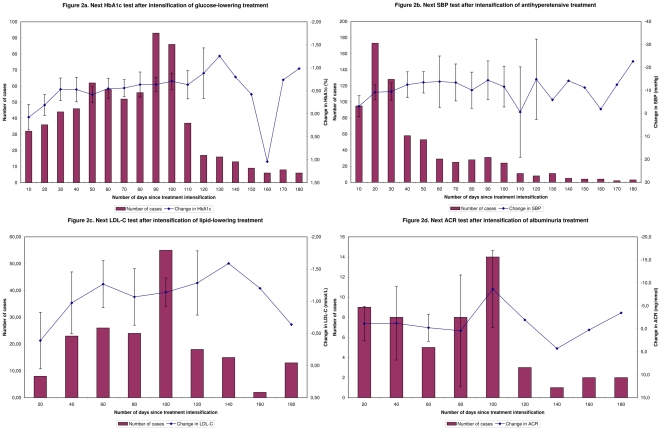
Of 11,176 patients diagnosed with type 2 diabetes, 9439 with complete follow-up were included. The majority received annual examination of HbA1c (86%) and SBP (86%), whereas this was 67% for LDL-C and 49% for ACR. Adequate management regarding the three-step pathway was observed in 73%, 53%, 46%, 41% of patients for HbA1c, SBP, LDL-C, and ACR respectively. Quality scores reduced significantly due to the second step (OR 0.43, 0.18, 0.44, 0.74), but were not much further reduced by the third step. Timely treatment evaluation occurred in 88% for HbA1c, 87% for SBP, 83% for LDL-C, and 76% for ACR. The overall score was not significantly changed by using strict time windows.
Quality estimates of glycemic, blood pressure and cholesterol management are substantially reduced when looking at clinical pathways as compared to estimates based on commonly used simple process measures.
评估糖尿病护理质量的绩效指标通常着眼于单一流程,例如是否进行了 HbA1c 检测。然而,充分的护理由应及时采取的连续流程组成(临床路径)。我们通过观察单一流程与临床路径来评估糖尿病护理质量。此外,我们还评估了时间段定义对这种质量评估的影响。
我们使用 GIANTT(格罗宁根分析 2 型糖尿病治疗倡议)数据库进行了 2007-2008 年的队列研究。对于 HbA1c、收缩压(SBP)、低密度脂蛋白胆固醇(LDL-C)和白蛋白/肌酐比值(ACR)的路径,计算了适当管理的患者比例(1)风险因素水平检测,(2)有指征时的治疗强化,(3)治疗反应评估。为每个步骤定义了严格和广泛的时间段。使用严格或广泛的时间段,比较了关于整个路径和单一步骤的适当管理的患者比例,使用比值比(OR)及其 95%置信区间。
在诊断为 2 型糖尿病的 11176 名患者中,纳入了 9439 名具有完整随访的患者。大多数患者每年接受 HbA1c(86%)和 SBP(86%)检查,而 LDL-C 为 67%,ACR 为 49%。对于 HbA1c、SBP、LDL-C 和 ACR,三步骤路径的适当管理比例分别为 73%、53%、46%和 41%。由于第二步(OR 0.43、0.18、0.44、0.74),质量评分显著降低,但由于第三步,评分并没有进一步降低。对于 HbA1c、SBP、LDL-C 和 ACR,及时治疗评估的比例分别为 88%、87%、83%和 76%。使用严格的时间窗口并没有显著改变整体评分。
与基于常用的简单流程测量的估计相比,当观察临床路径时,血糖、血压和胆固醇管理的质量估计会大大降低。