James Graham Brown Cancer Center, University of Louisville, Louisville, KY 40202, USA.
J Ovarian Res. 2011 Sep 22;4(1):17. doi: 10.1186/1757-2215-4-17.
Ovarian cancer is the leading cause of death from gynecologic cancer in women worldwide. According to the National Cancer Institute, ovarian cancer has the highest mortality rate among all the reproductive cancers in women. Advanced stage diagnosis and chemo/radio-resistance is a major obstacle in treating advanced ovarian cancer. The most commonly employed chemotherapeutic drug for ovarian cancer treatment is cis-platin. As with most chemotherapeutic drugs, many patients eventually become resistant to cis-platin and therefore, diminishing its effect. The efficacy of current treatments may be improved by increasing the sensitivity of cancer cells to chemo/radiation therapies.
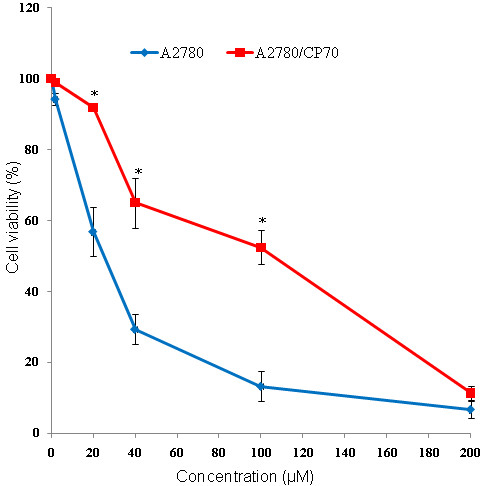
The present study is focused on identifying the differential expression of regulatory microRNAs (miRNAs) between cis-platin sensitive (A2780), and cis-platin resistant (A2780/CP70) cell lines. Cell proliferation assays were conducted to test the sensitivity of the two cell lines to cis-platin. Differential expression patterns of miRNA between cis-platin sensitive and cis-platin resistant cell lines were analyzed using novel LNA technology.
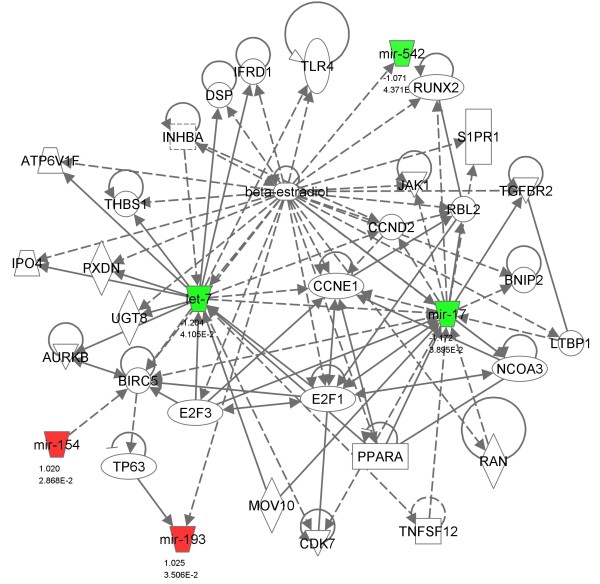
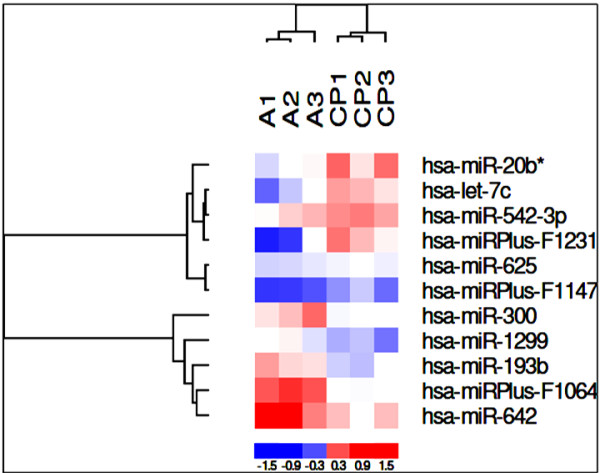
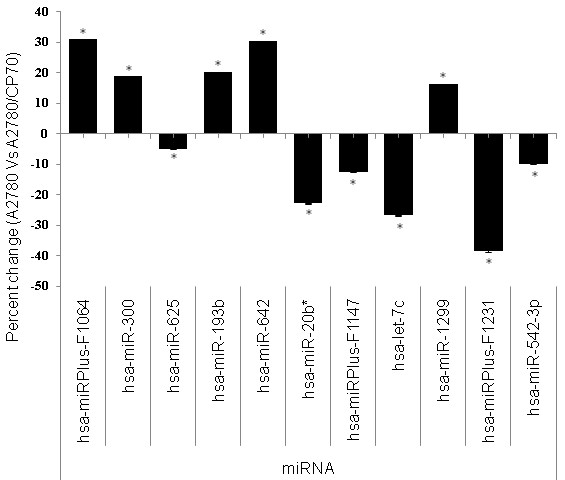
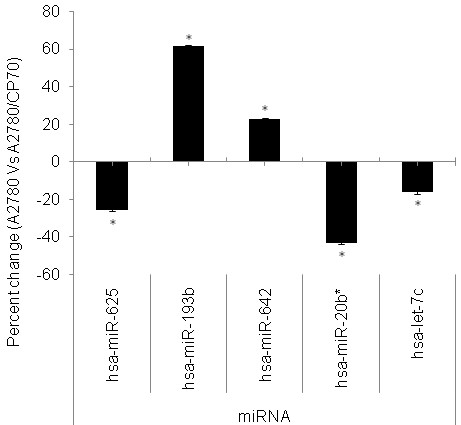
Our results revealed changes in expression of 11 miRNAs out of 1,500 miRNAs analyzed. Out of the 11 miRNAs identified, 5 were up-regulated in the A2780/CP70 cell line and 6 were down regulated as compared to cis-platin sensitive A2780 cells. Our microRNA data was further validated by quantitative real-time PCR for these selected miRNAs. Ingenuity Pathway Analysis (IPA) and Kyoto Encyclopedia of Genes and Genomes (KEGG) analysis was performed for the selected miRNAs and their putative targets to identify the potential pathways and networks involved in cis-platin resistance.
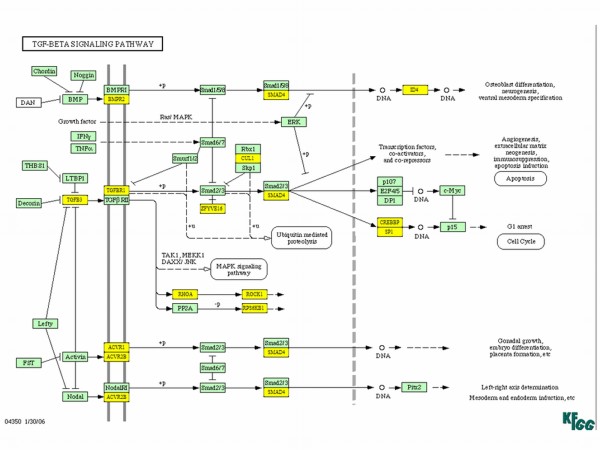
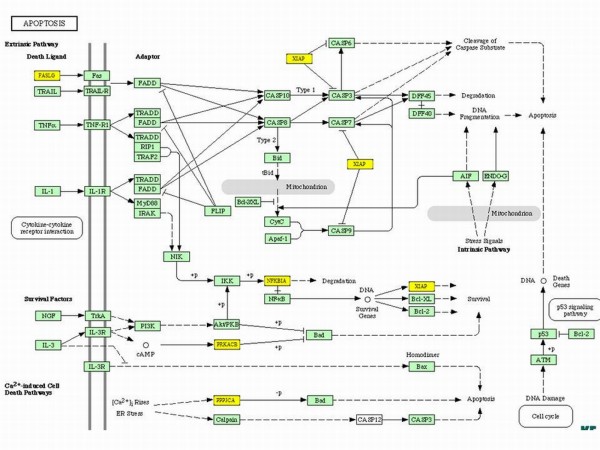
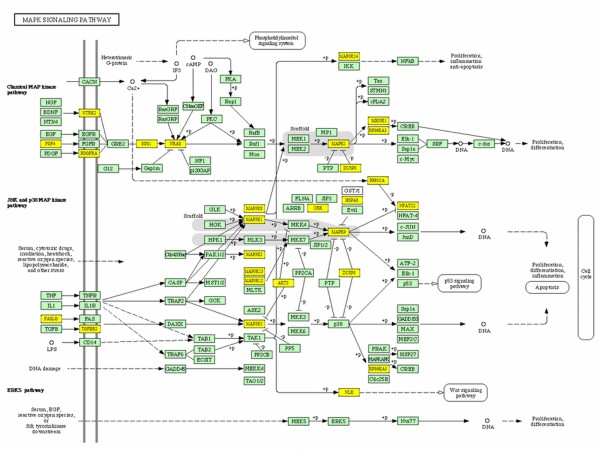
Our data clearly showed the differential expression of 11 miRNAs in cis-platin resistant cells, which could potentially target many important pathways including MAPK, TGF-β signaling, actin cytoskeleton, ubiquitin mediated proteasomal pathway, Wnt signaling, mTOR signaling, Notch signaling, apoptosis, and many other signaling pathways. Manipulation of one or more of these miRNAs could be an important approach for ovarian cancer chemotherapy.
卵巢癌是全球女性妇科癌症死亡的主要原因。根据美国国家癌症研究所的数据,卵巢癌在女性生殖系统癌症中的死亡率最高。晚期诊断和化疗/放疗耐药是治疗晚期卵巢癌的主要障碍。目前用于卵巢癌治疗的最常用化疗药物是顺铂。与大多数化疗药物一样,许多患者最终对顺铂产生耐药性,从而降低了其疗效。通过提高癌细胞对化疗/放疗的敏感性,可以提高现有治疗方法的疗效。
本研究旨在鉴定顺铂敏感(A2780)和耐药(A2780/CP70)细胞系之间调节 microRNA(miRNA)的差异表达。通过细胞增殖试验测试两种细胞系对顺铂的敏感性。使用新型 LNA 技术分析顺铂敏感和耐药细胞系之间 miRNA 的差异表达模式。
我们的结果显示,在分析的 1500 个 miRNA 中,有 11 个 miRNA 的表达发生了变化。在鉴定出的 11 个 miRNA 中,有 5 个在 A2780/CP70 细胞系中上调,6 个与顺铂敏感的 A2780 细胞相比下调。我们的 miRNA 数据进一步通过定量实时 PCR 对这些选定的 miRNA 进行了验证。对选定的 miRNA 及其潜在靶标进行了 IPA(Ingenuity Pathway Analysis)和 KEGG(京都基因与基因组百科全书)分析,以鉴定参与顺铂耐药的潜在途径和网络。
我们的数据清楚地显示了耐药细胞中 11 个 miRNA 的差异表达,这些 miRNA 可能靶向许多重要途径,包括 MAPK、TGF-β 信号通路、肌动蛋白细胞骨架、泛素介导的蛋白酶体途径、Wnt 信号通路、mTOR 信号通路、Notch 信号通路、细胞凋亡和许多其他信号通路。对这些 miRNA 中的一个或多个进行操作可能是卵巢癌化疗的重要方法。