MRC Centre for Reproductive Health/MRC Human Reproductive Sciences Unit, Queens Medical Research Institute, University of Edinburgh, 47 Little France Crescent, Edinburgh EH16 4TJ, UK.
J Cell Sci. 2011 Oct 1;124(Pt 19):3344-55. doi: 10.1242/jcs.087692.
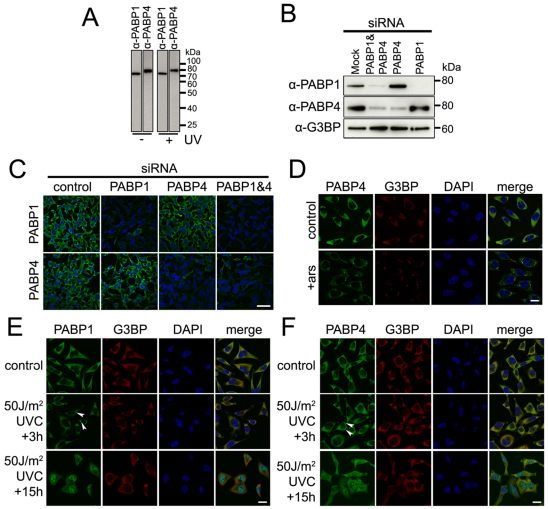
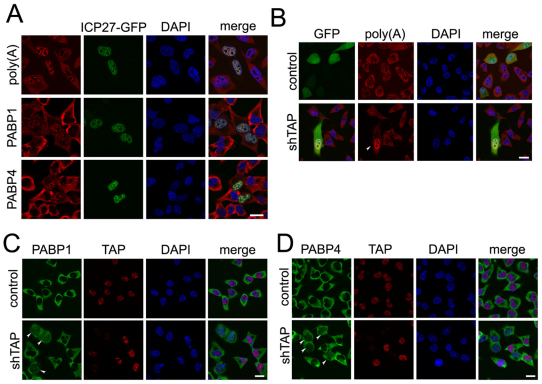
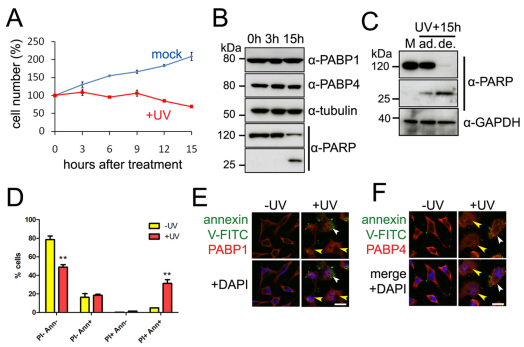
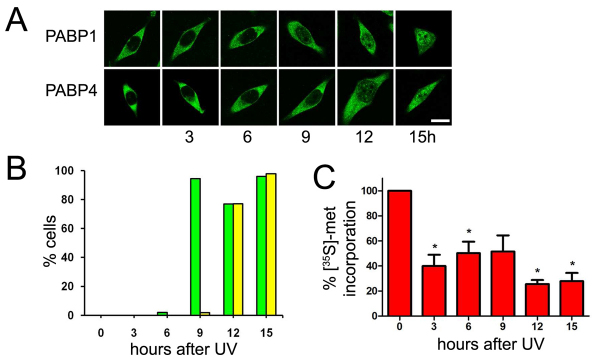
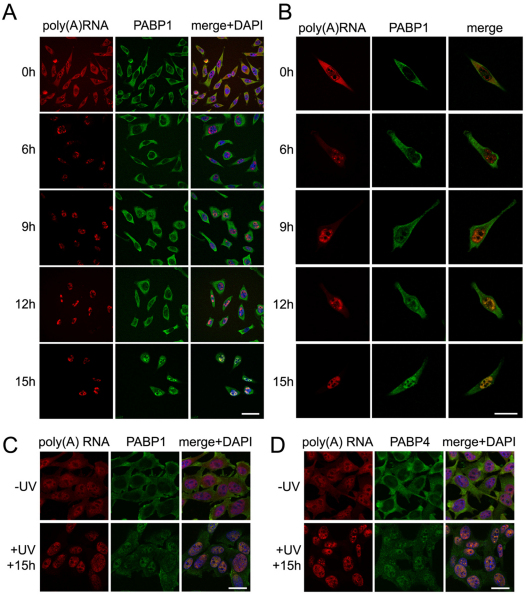
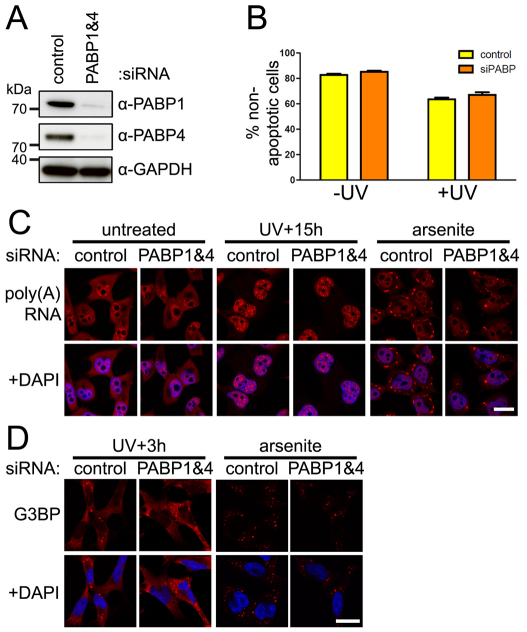
Poly(A)-binding protein 1 (PABP1) has a fundamental role in the regulation of mRNA translation and stability, both of which are crucial for a wide variety of cellular processes. Although generally a diffuse cytoplasmic protein, it can be found in discrete foci such as stress and neuronal granules. Mammals encode several additional cytoplasmic PABPs that remain poorly characterised, and with the exception of PABP4, appear to be restricted in their expression to a small number of cell types. We have found that PABP4, similarly to PABP1, is a diffusely cytoplasmic protein that can be localised to stress granules. However, UV exposure unexpectedly relocalised both proteins to the nucleus. Nuclear relocalisation of PABPs was accompanied by a reduction in protein synthesis but was not linked to apoptosis. In examining the mechanism of PABP relocalisation, we found that it was related to a change in the distribution of poly(A) RNA within cells. Further investigation revealed that this change in RNA distribution was not affected by PABP knockdown but that perturbations that block mRNA export recapitulate PABP relocalisation. Our results support a model in which nuclear export of PABPs is dependent on ongoing mRNA export, and that a block in this process following UV exposure leads to accumulation of cytoplasmic PABPs in the nucleus. These data also provide mechanistic insight into reports that transcriptional inhibitors and expression of certain viral proteins cause relocation of PABP to the nucleus.
多聚(A)结合蛋白 1(PABP1)在调节 mRNA 翻译和稳定性方面起着至关重要的作用,而这两者对多种细胞过程都至关重要。尽管它通常是一种弥散的细胞质蛋白,但它可以在应激和神经元颗粒等离散焦点中找到。哺乳动物编码几种其他的细胞质 PABP,它们的特征仍然很差,除了 PABP4 之外,它们似乎只在少数几种细胞类型中表达。我们发现 PABP4 与 PABP1 相似,是一种弥散的细胞质蛋白,可以定位于应激颗粒中。然而,出乎意料的是,紫外线照射会将这两种蛋白重新定位到细胞核中。PABP 重新定位到细胞核伴随着蛋白质合成的减少,但与细胞凋亡无关。在研究 PABP 重新定位的机制时,我们发现它与细胞内 poly(A) RNA 分布的变化有关。进一步的研究表明,这种 RNA 分布的变化不受 PABP 敲低的影响,但阻止 mRNA 输出的干扰会重现 PABP 重新定位。我们的结果支持这样一种模型,即 PABP 的核输出依赖于正在进行的 mRNA 输出,而紫外线照射后这一过程的阻断会导致细胞质 PABP 在细胞核中积累。这些数据还为转录抑制剂和某些病毒蛋白表达导致 PABP 向细胞核重新定位的报道提供了机制上的见解。