CESP INSERM-UVSQ UMRS 1018, Villejuif, France.
BMC Infect Dis. 2011 Sep 26;11:253. doi: 10.1186/1471-2334-11-253.
To evaluate the knowledge, attitudes and beliefs about adult male circumcision (AMC), assess the association of AMC with HIV incidence and prevalence, and estimate AMC uptake in a Southern African community.
A cross-sectional biomedical survey (ANRS-12126) conducted in 2007-2008 among a random sample of 1198 men aged 15 to 49 from Orange Farm (South Africa). Face-to-face interviews were conducted by structured questionnaire. Recent HIV infections were evaluated using the BED incidence assay. Circumcision status was self-reported and clinically assessed. Adjusted HIV incidence rate ratios (aIRR) and prevalence ratios (aPR) were calculated using Poisson regression.
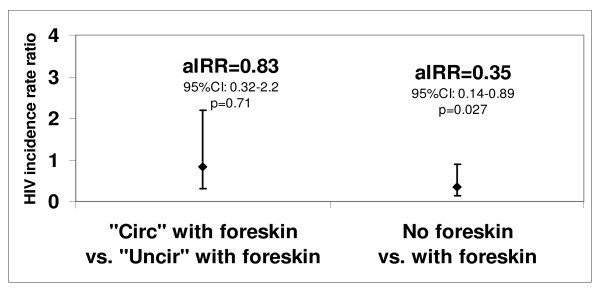
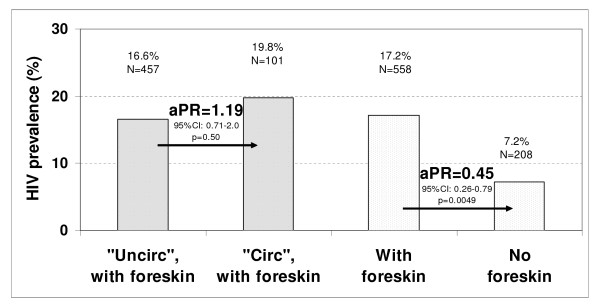
The response rate was 73.9%. Most respondents agreed that circumcised men could become HIV infected and needed to use condoms, although 19.3% (95%CI: 17.1% to 21.6%) asserted that AMC protected fully against HIV. Among self-reported circumcised men, 44.9% (95%CI: 39.6% to 50.3%) had intact foreskins. Men without foreskins had lower HIV incidence and prevalence than men with foreskins (aIRR = 0.35; 95%CI: 0.14 to 0.88; aPR = 0.45, 95%CI: 0.26 to 0.79). No significant difference was found between self-reported circumcised men with foreskins and other uncircumcised men. Intention to undergo AMC was associated with ethnic group and partner and family support of AMC. Uptake of AMC was 58.8% (95%CI: 55.4% to 62.0%).
AMC uptake in this community is high but communication and counseling should emphasize what clinical AMC is and its effect on HIV acquisition. These findings suggest that AMC roll-out is promising but requires careful implementation strategies to be successful against the African HIV epidemic.
评估成人男性割礼(AMC)的知识、态度和信念,评估 AMC 与 HIV 发病率和流行率的关联,并估计南非一个社区 AMC 的采用率。
2007-2008 年,在奥兰多农场(南非)进行了一项横断面生物医学调查(ANRS-12126),对 1198 名 15 至 49 岁的男性进行了随机抽样。通过结构化问卷进行面对面访谈。使用 BED 发病率检测评估最近的 HIV 感染情况。割礼状况由自我报告和临床评估。使用泊松回归计算调整后的 HIV 发病率比值(aIRR)和流行率比值(aPR)。
响应率为 73.9%。大多数受访者认为,割礼后的男性也可能感染 HIV,需要使用避孕套,尽管 19.3%(95%CI:17.1%至 21.6%)认为 AMC 能完全预防 HIV。在自我报告的割礼男性中,44.9%(95%CI:39.6%至 50.3%)的男性仍有完整的包皮。没有包皮的男性的 HIV 发病率和流行率低于有包皮的男性(aIRR=0.35;95%CI:0.14 至 0.88;aPR=0.45,95%CI:0.26 至 0.79)。自我报告的有包皮的割礼男性与其他未割礼的男性之间没有显著差异。进行 AMC 的意愿与族裔群体以及伴侣和家庭对 AMC 的支持有关。 AMC 的采用率为 58.8%(95%CI:55.4%至 62.0%)。
在这个社区, AMC 的采用率很高,但沟通和咨询应强调什么是临床 AMC 及其对 HIV 感染的影响。这些发现表明,AMC 的推广是有希望的,但需要谨慎实施策略才能成功应对非洲 HIV 流行。