Women's College Hospital, 76 Grenville Street, Toronto, ON, Canada M5S 1B2.
BMJ. 2011 Sep 26;343:d5886. doi: 10.1136/bmj.d5886.
To assess the impact of the 2004 extension of the CONSORT guidelines on the reporting and methodological quality of cluster randomised trials.
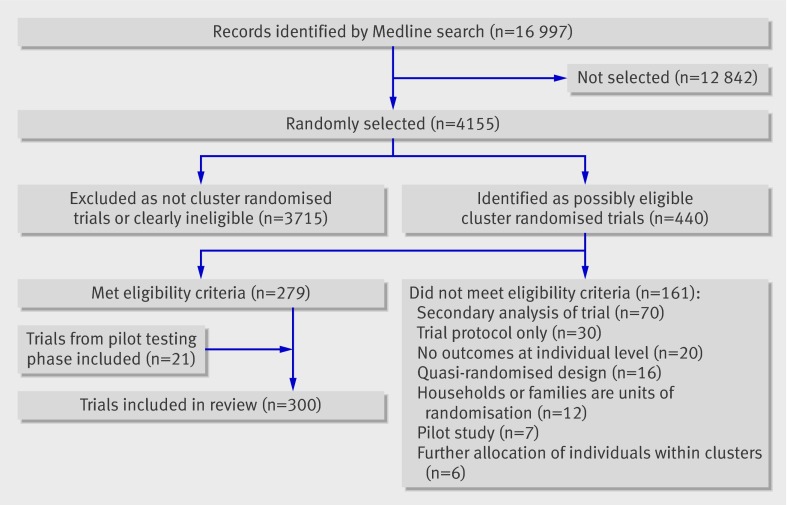
Methodological review of 300 randomly sampled cluster randomised trials. Two reviewers independently abstracted 14 criteria related to quality of reporting and four methodological criteria specific to cluster randomised trials. We compared manuscripts published before CONSORT (2000-4) with those published after CONSORT (2005-8). We also investigated differences by journal impact factor, type of journal, and trial setting.
A validated Medline search strategy. Eligibility criteria for selecting studies Cluster randomised trials published in English language journals, 2000-8.
There were significant improvements in five of 14 reporting criteria: identification as cluster randomised; justification for cluster randomisation; reporting whether outcome assessments were blind; reporting the number of clusters randomised; and reporting the number of clusters lost to follow-up. No significant improvements were found in adherence to methodological criteria. Trials conducted in clinical rather than non-clinical settings and studies published in medical journals with higher impact factor or general medical journals were more likely to adhere to recommended reporting and methodological criteria overall, but there was no evidence that improvements after publication of the CONSORT extension for cluster trials were more likely in trials conducted in clinical settings nor in trials published in either general medical journals or in higher impact factor journals.
The quality of reporting of cluster randomised trials improved in only a few aspects since the publication of the extension of CONSORT for cluster randomised trials, and no improvements at all were observed in essential methodological features. Overall, the adherence to reporting and methodological guidelines for cluster randomised trials remains suboptimal, and further efforts are needed to improve both reporting and methodology.
评估 CONSORT 指南 2004 年扩展版对群组随机试验报告和方法学质量的影响。
对 300 篇随机抽样群组随机试验的方法学回顾。两名评审员独立提取了 14 项与报告质量相关的标准和 4 项特定于群组随机试验的方法学标准。我们将 CONSORT 前(2000-4 年)发表的手稿与 CONSORT 后(2005-8 年)发表的手稿进行了比较。我们还调查了期刊影响因子、期刊类型和试验设置的差异。
经过验证的 Medline 搜索策略。研究选择标准:2000-8 年以英文发表的群组随机试验。
在 14 项报告标准中有 5 项有显著改善:确定为群组随机;群组随机的理由;报告结果评估是否盲法;报告随机化的群组数量;以及报告失随访的群组数量。在遵守方法学标准方面没有发现显著改善。在临床而非非临床环境中进行的试验以及发表在高影响因子医学期刊或一般医学期刊上的研究总体上更有可能遵守建议的报告和方法学标准,但没有证据表明,在发布 CONSORT 群组试验扩展版后,在临床环境中进行的试验或在一般医学期刊或高影响因子期刊上发表的试验更有可能改进。
自 CONSORT 群组随机试验扩展版发布以来,群组随机试验的报告质量仅在几个方面有所改善,而在基本方法学特征方面则没有任何改进。总体而言,群组随机试验的报告和方法学指南的遵守情况仍不理想,需要进一步努力改善报告和方法。