Department of Pharmacology, The University of North Carolina at Chapel Hill, 120 Mason Farm Road, Chapel Hill, NC 27599, USA.
Breast Cancer Res. 2011 Sep 27;13(5):R94. doi: 10.1186/bcr3019.
Tumor-initiating cells (TIC) are being extensively studied for their role in tumor etiology, maintenance and resistance to treatment. The isolation of TICs has been limited by the scarcity of this population in the tissue of origin and because the molecular signatures that characterize these cells are not well understood. Herein, we describe the generation of TIC-like cell lines by ectopic expression of the OCT4 transcription factor (TF) in primary breast cell preparations.
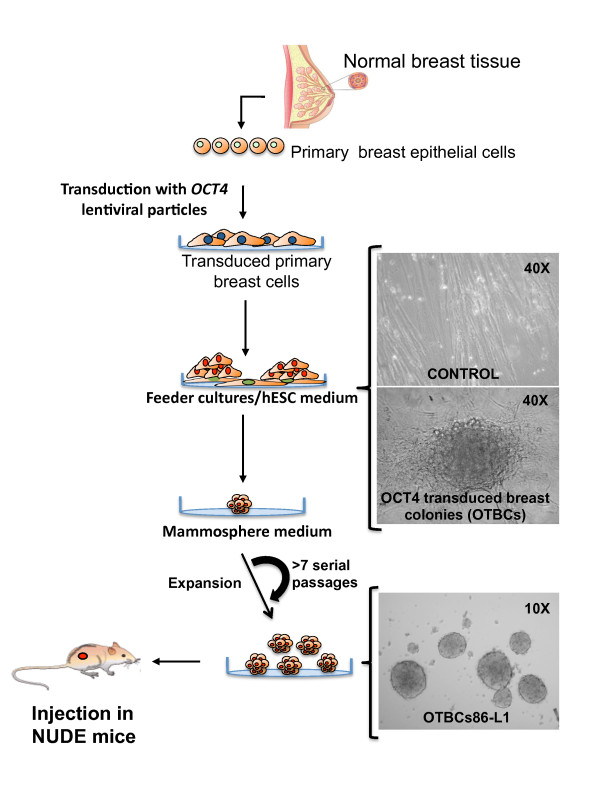
OCT4 cDNA was over-expressed in four different primary human mammary epithelial (HMEC) breast cell preparations from reduction mammoplasty donors. OCT4-transduced breast cells (OTBCs) generated colonies (frequency ~0.01%) in self-renewal conditions (feeder cultures in human embryonic stem cell media). Differentiation assays, immunofluorescence, immunohistochemistry, and flow cytometry were performed to investigate the cell of origin of OTBCs. Serial dilutions of OTBCs were injected in nude mice to address their tumorigenic capabilities. Gene expression microarrays were performed in OTBCs, and the role of downstream targets of OCT4 in maintaining self-renewal was investigated by knock-down experiments.
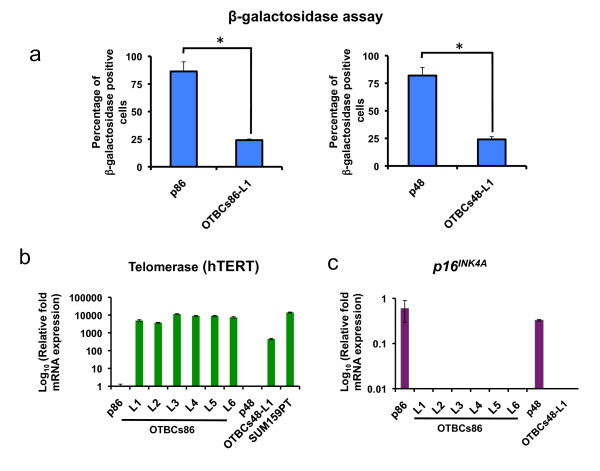
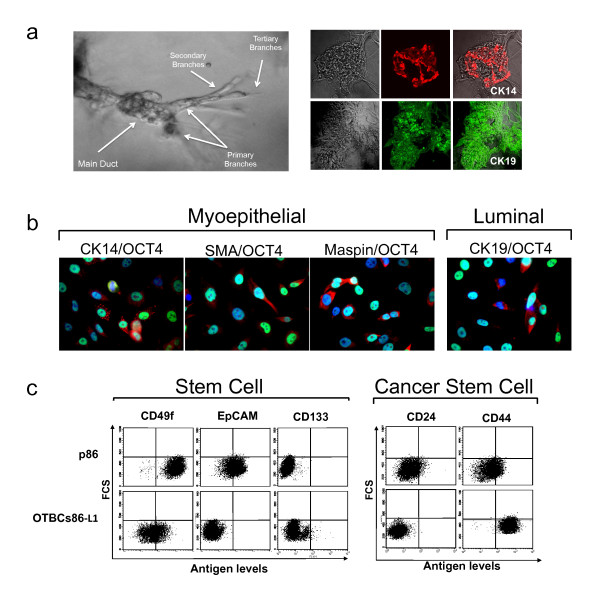
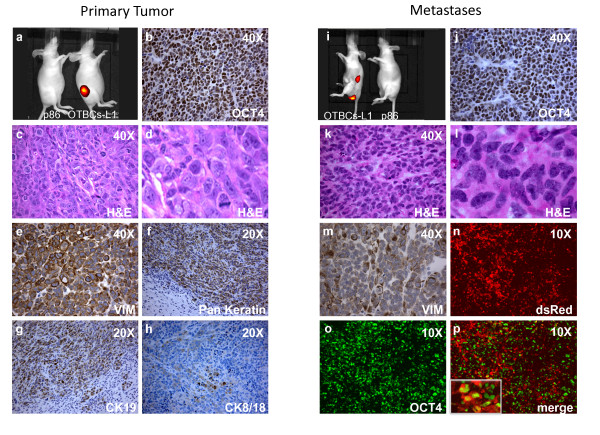
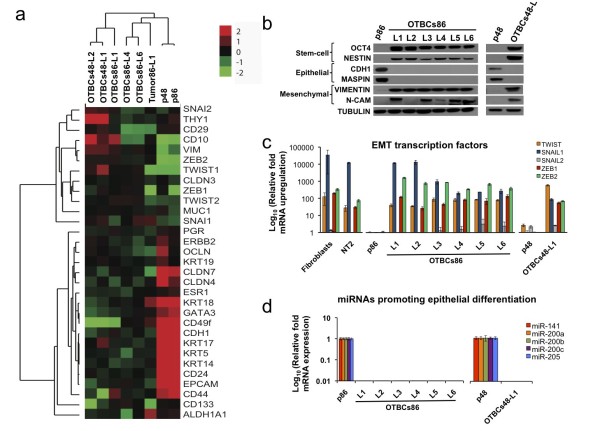
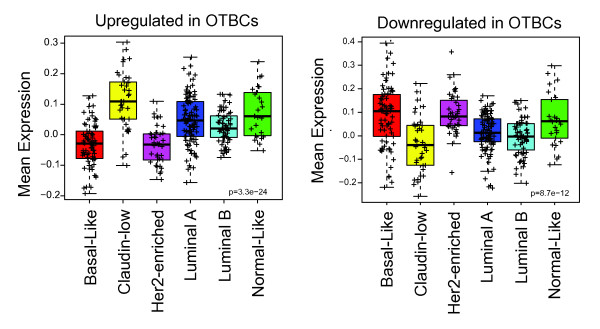
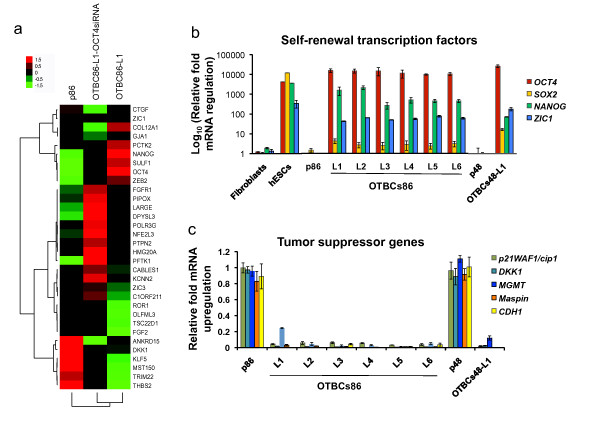
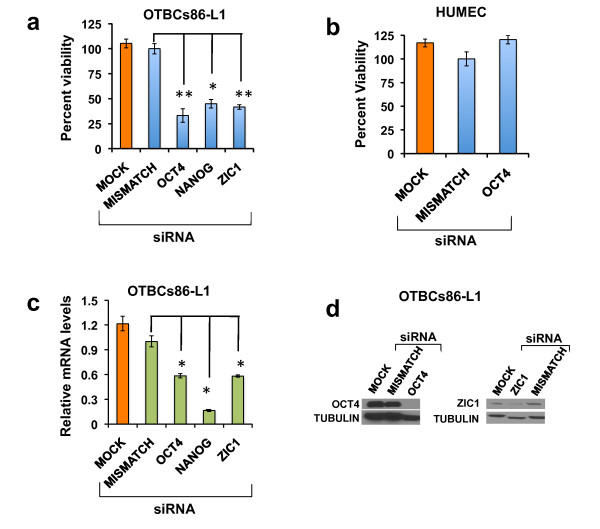
OTBCs overcame senescence, overexpressed telomerase, and down-regulated p16INK4A. In differentiation conditions, OTBCs generated populations of both myoepithelial and luminal cells at low frequency, suggesting that the cell of origin of some OTBCs was a bi-potent stem cell. Injection of OTBCs in nude mice generated poorly differentiated breast carcinomas with colonization capabilities. Gene expression microarrays of OTBC lines revealed a gene signature that was over-represented in the claudin-low molecular subtype of breast cancer. Lastly, siRNA-mediated knockdown of OCT4 or downstream embryonic targets of OCT4, such as NANOG and ZIC1, suppressed the ability of OTBCs to self-renew.
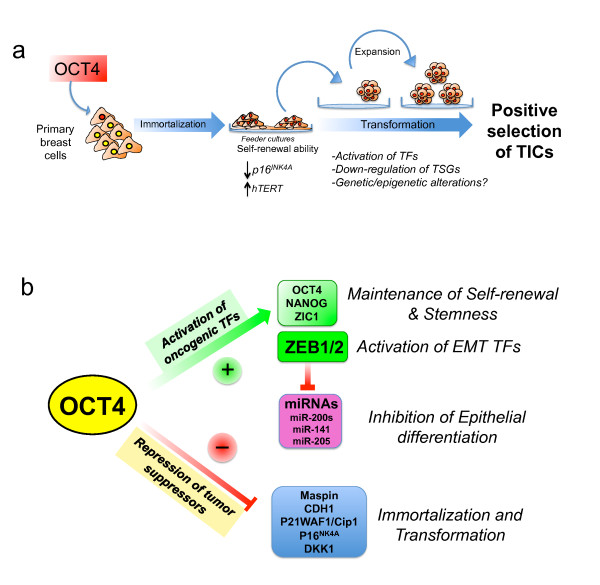
Transduction of OCT4 in normal breast preparations led to the generation of cell lines possessing tumor-initiating and colonization capabilities. These cells developed high-grade, poorly differentiated breast carcinomas in nude mice. Genome-wide analysis of OTBCs outlined an embryonic TF circuitry that could be operative in TICs, resulting in up-regulation of oncogenes and loss of tumor suppressive functions. These OTBCs represent a patient-specific model system for the discovery of novel oncogenic targets in claudin-low tumors.
肿瘤起始细胞(TIC)因其在肿瘤发生、维持和治疗抵抗中的作用而受到广泛研究。由于 TIC 在起源组织中的数量稀少,并且尚未充分了解其特征性的分子特征,因此其分离受到限制。在此,我们通过在原代乳腺细胞制剂中过表达 OCT4 转录因子(TF)来描述 TIC 样细胞系的产生。
将 OCT4 cDNA 在来自乳房缩小术供体的四种不同的原代人乳腺上皮(HMEC)乳腺细胞制剂中过表达。在自我更新条件下(在人胚胎干细胞培养基中的饲养细胞),OCT4 转导的乳腺细胞(OTBC)生成集落(频率约为 0.01%)。进行分化实验、免疫荧光、免疫组化和流式细胞术以研究 OTBC 的起源细胞。进行 OTBC 的连续稀释液注射以评估其致瘤能力。在 OTBC 中进行基因表达微阵列,并通过敲低实验研究 OCT4 的下游靶标在维持自我更新中的作用。
OTBC 克服了衰老,过度表达端粒酶,并下调了 p16INK4A。在分化条件下,OTBC 以低频率生成肌上皮细胞和腔细胞的群体,这表明一些 OTBC 的起源细胞是多能干细胞。OTBC 在裸鼠中的注射生成了具有定植能力的低分化乳腺癌。OTBC 系的基因表达微阵列显示了在乳腺癌的 Claudin-low 分子亚型中过表达的基因特征。最后,siRNA 介导的 OCT4 或 OCT4 的下游胚胎靶标(如 NANOG 和 ZIC1)的敲低抑制了 OTBC 自我更新的能力。
在正常乳腺制剂中转导 OCT4 导致生成具有肿瘤起始和定植能力的细胞系。这些细胞在裸鼠中发展为高级别、低分化的乳腺癌。OTBC 的全基因组分析概述了一个胚胎 TF 电路,该电路可能在 TIC 中起作用,导致致癌基因的上调和肿瘤抑制功能的丧失。这些 OTBC 代表了 Claudin-low 肿瘤中新型致癌靶标的发现的患者特异性模型系统。