INRA, UMR AGAP, Equipe Architecture et Fonctionnement des Espèces Fruitières, Avenue Agropolis-TA-A-108/03, 34398 Montpellier Cedex 01, France.
J Exp Bot. 2012 Jan;63(1):131-49. doi: 10.1093/jxb/err261. Epub 2011 Sep 30.
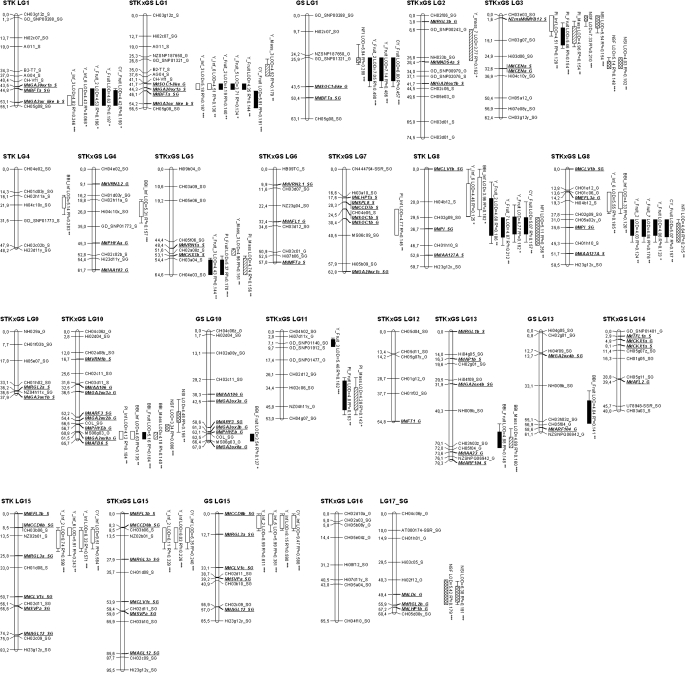
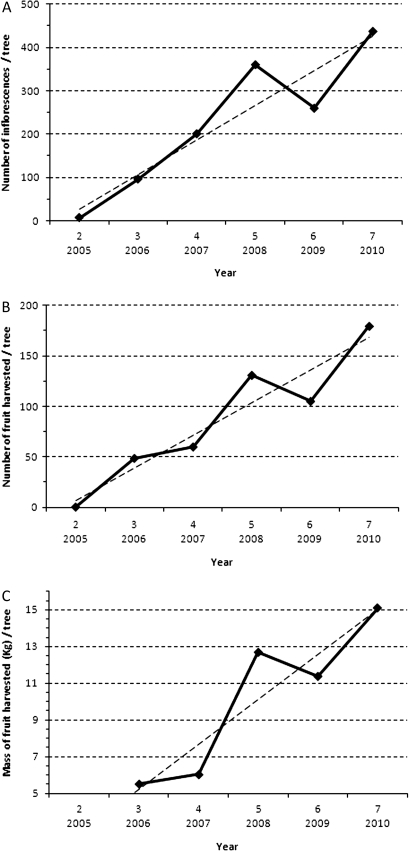
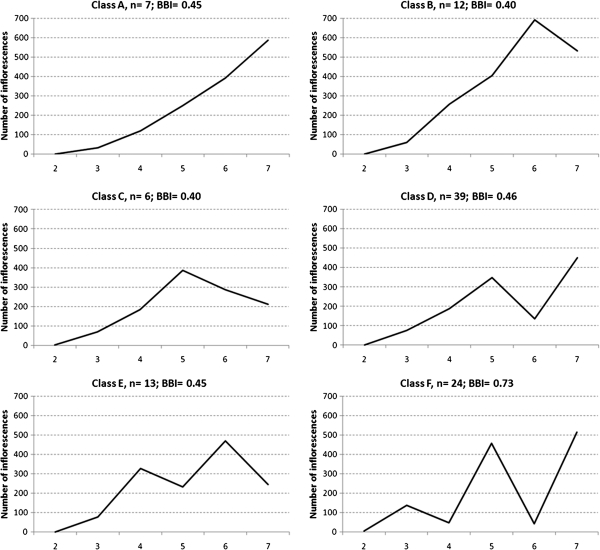
Although flowering in mature fruit trees is recurrent, floral induction can be strongly inhibited by concurrent fruiting, leading to a pattern of irregular fruiting across consecutive years referred to as biennial bearing. The genetic determinants of biennial bearing in apple were investigated using the 114 flowering individuals from an F(1) population of 122 genotypes, from a 'Starkrimson' (strong biennial bearer)×'Granny Smith' (regular bearer) cross. The number of inflorescences, and the number and the mass of harvested fruit were recorded over 6 years and used to calculate 26 variables and indices quantifying yield, precocity of production, and biennial bearing. Inflorescence traits exhibited the highest genotypic effect, and three quantitative trait loci (QTLs) on linkage group (LG) 4, LG8, and LG10 explained 50% of the phenotypic variability for biennial bearing. Apple orthologues of flowering and hormone-related genes were retrieved from the whole-genome assembly of 'Golden Delicious' and their position was compared with QTLs. Four main genomic regions that contain floral integrator genes, meristem identity genes, and gibberellin oxidase genes co-located with QTLs. The results indicated that flowering genes are less likely to be responsible for biennial bearing than hormone-related genes. New hypotheses for the control of biennial bearing emerged from QTL and candidate gene co-locations and suggest the involvement of different physiological processes such as the regulation of flowering genes by hormones. The correlation between tree architecture and biennial bearing is also discussed.
尽管成熟果树上的开花具有周期性,但同期结实会强烈抑制花的诱导,导致连续几年出现不规则结实的模式,即隔年结果。本研究使用来自‘Starkrimson’(强隔年结果品种)בGranny Smith’(规则结果品种)杂交后代的 114 个开花个体的 F1 群体,调查了苹果隔年结果的遗传决定因素。在 6 年内记录了花序数量、收获果实的数量和质量,并用于计算 26 个变量和指数,以量化产量、早期产量和隔年结果。花序性状表现出最高的基因型效应,连锁群 4、8 和 10 上的三个数量性状位点(QTL)解释了隔年结果的 50%表型变异。从‘金冠’的全基因组组装中检索到与开花和激素相关的基因的苹果同源物,并比较了它们的位置与 QTL 的关系。四个主要的基因组区域包含花整合基因、分生组织身份基因和赤霉素氧化酶基因,与 QTL 共定位。结果表明,与激素相关基因相比,开花基因不太可能是隔年结果的原因。来自 QTL 和候选基因共定位的新假说表明,不同的生理过程可能参与了对隔年结果的控制,例如激素对开花基因的调节。还讨论了树木结构与隔年结果的相关性。