Division of Life Science, State Key Laboratory of Molecular Neuroscience, Molecular Neuroscience Center, Kowloon, Hong Kong, China.
Mol Biol Cell. 2011 Nov;22(22):4268-78. doi: 10.1091/mbc.E11-04-0354. Epub 2011 Sep 30.
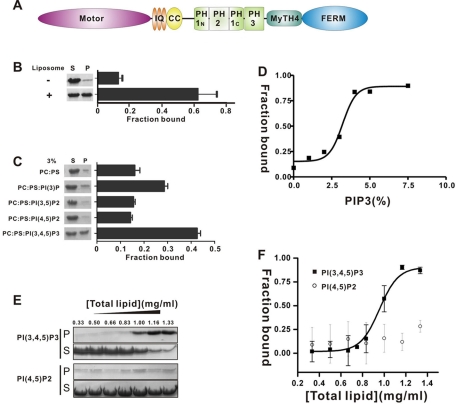
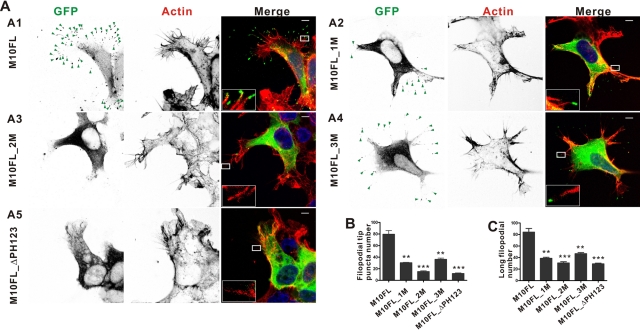
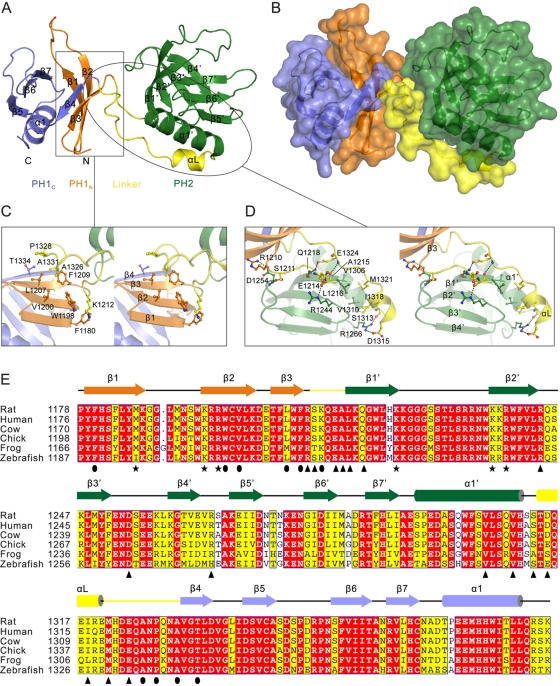
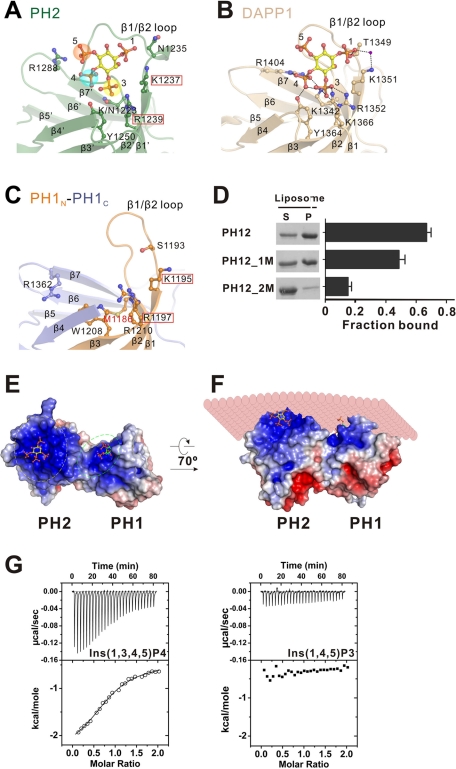
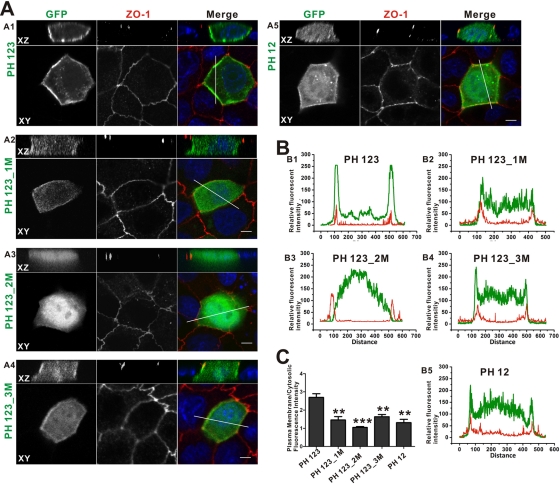
Myosin X (MyoX) is an unconventional myosin that is known to induce the formation and elongation of filopodia in many cell types. MyoX-induced filopodial induction requires the three PH domains in its tail region, although with unknown underlying molecular mechanisms. MyoX's first PH domain is split into halves by its second PH domain. We show here that the PH1(N)-PH2-PH1(C) tandem allows MyoX to bind to phosphatidylinositol (3,4,5)-triphosphate [PI(3,4,5)P(3)] with high specificity and cooperativity. We further show that PH2 is responsible for the specificity of the PI(3,4,5)P(3) interaction, whereas PH1 functions to enhance the lipid membrane-binding avidity of the tandem. The structure of the MyoX PH1(N)-PH2-PH1(C) tandem reveals that the split PH1, PH2, and the highly conserved interdomain linker sequences together form a rigid supramodule with two lipid-binding pockets positioned side by side for binding to phosphoinositide membrane bilayers with cooperativity. Finally, we demonstrate that disruption of PH2-mediated binding to PI(3,4,5)P(3) abolishes MyoX's function in inducing filopodial formation and elongation.
肌球蛋白 X(MyoX)是一种非常规的肌球蛋白,已知它能在许多细胞类型中诱导丝状伪足的形成和伸长。MyoX 诱导的丝状伪足诱导需要其尾部区域的三个 PH 结构域,但具体的分子机制尚不清楚。MyoX 的第一个 PH 结构域被其第二个 PH 结构域一分为二。我们在这里表明,PH1(N)-PH2-PH1(C)串联允许 MyoX 以高特异性和协同性结合到磷脂酰肌醇(3,4,5)-三磷酸 [PI(3,4,5)P(3)]。我们进一步表明,PH2 负责 PI(3,4,5)P(3)相互作用的特异性,而 PH1 则增强串联对脂质膜的结合亲和力。MyoX PH1(N)-PH2-PH1(C)串联的结构表明,分裂的 PH1、PH2 和高度保守的结构域间连接序列一起形成一个刚性超模块,两个脂质结合口袋并排排列,用于与磷酸肌醇膜双层协同结合。最后,我们证明了 PH2 介导的与 PI(3,4,5)P(3)结合的破坏会使 MyoX 丧失诱导丝状伪足形成和伸长的功能。