Section of Ecology and Genetics, Department of Bioscience, Aarhus University, Aarhus, Denmark.
PLoS One. 2011;6(9):e25172. doi: 10.1371/journal.pone.0025172. Epub 2011 Sep 26.
Flower visiting insects provide a vitally important pollination service for many crops and wild plants. Recent decline of pollinating insects due to anthropogenic modification of habitats and climate, in particular from 1950's onwards, is a major and widespread concern. However, few studies document the extent of declines in species diversity, and no studies have previously quantified local abundance declines. We here make a quantitative assessment of recent historical changes in bumblebee assemblages by comparing contemporary and historical survey data.
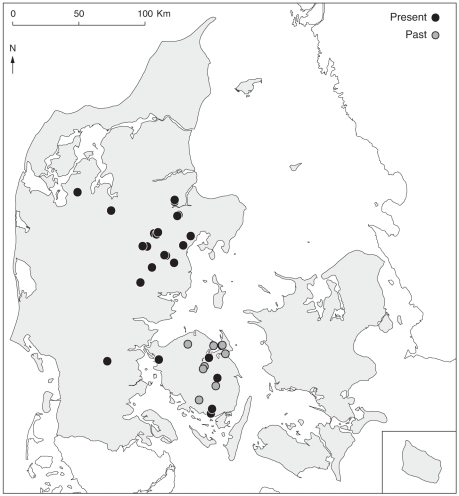
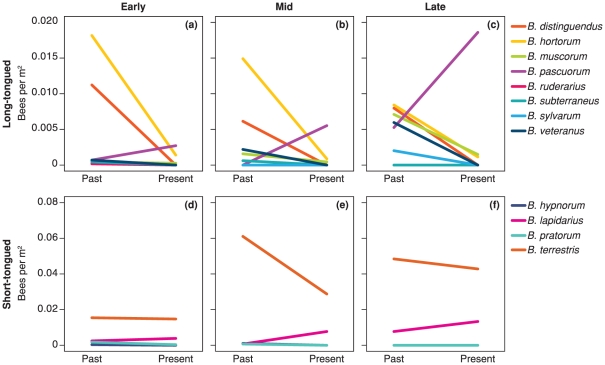
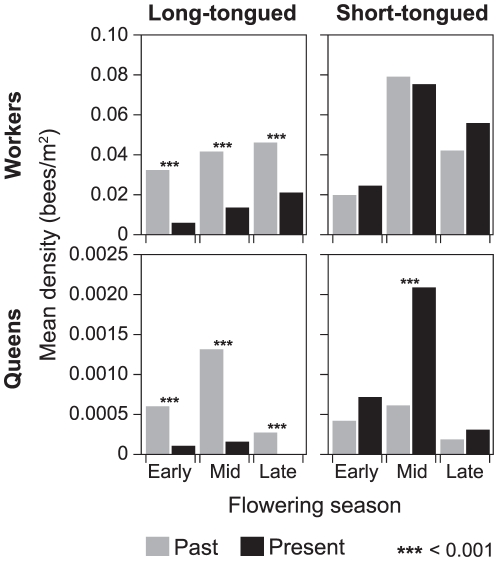
METHODOLOGY/PRINCIPAL FINDINGS: We take advantage of detailed, quantitative historical survey data from the 1930's on bumblebee (Bombus spp.) abundances and species composition in red clover (Trifolium pratense) fields, an important floral resource and an attractant of all bumblebee species. We used the historical survey data as a pre-industrialization baseline, and repeated the same sampling protocol at nearly the same localities at present, hence setting up a historical experiment. We detected historical changes in abundances (bees/m(2)) of both workers (the "pollinatory units") and queens (effective population size), in addition to species composition. In particular, long-tongued bumblebee species showed consistent and dramatic declines in species richness and abundances throughout the flowering season of red clover, while short-tongued species were largely unaffected. Of 12 Bombus species observed in the 1930's, five species were not observed at present. The latter were all long-tongued, late-emerging species.
CONCLUSIONS/SIGNIFICANCE: Because bumblebees are important pollinators, historical changes in local bumblebee assemblages are expected to severely affect plant reproduction, in particular long-tubed species, which are pollinated by long-tongued bumblebees.
访花昆虫为许多作物和野生植物提供了至关重要的授粉服务。由于人类对栖息地和气候的改造,授粉昆虫最近出现了衰退,尤其是自 20 世纪 50 年代以来,这是一个主要的、广泛存在的问题。然而,很少有研究记录物种多样性的下降程度,也没有研究以前量化过当地丰度的下降。我们通过比较当代和历史调查数据,对熊蜂类群最近的历史变化进行了定量评估。
方法/主要发现:我们利用详细的、定量的历史调查数据,这些数据来自 20 世纪 30 年代在红三叶草(Trifolium pratense)田中的熊蜂(Bombus spp.)丰度和物种组成,红三叶草是一种重要的花卉资源,也是所有熊蜂物种的吸引物。我们将历史调查数据作为工业化前的基线,并在现在几乎相同的地点重复相同的采样方案,从而建立了一个历史实验。我们检测到了工人(“授粉单位”)和蜂王(有效种群大小)的数量以及物种组成的历史变化。特别是,长舌熊蜂物种在红三叶草的整个花期内表现出物种丰富度和数量的持续和显著下降,而短舌物种则基本不受影响。在 20 世纪 30 年代观察到的 12 种熊蜂中,有 5 种目前没有观察到。后者都是长舌、晚出现的物种。
结论/意义:由于熊蜂是重要的传粉者,因此当地熊蜂类群的历史变化预计会严重影响植物繁殖,特别是长管物种,它们是由长舌熊蜂授粉的。