Department of Ecoscience, Aarhus University, Aarhus, Denmark.
UK Centre for Ecology and Hydrology, Bangor, UK.
Biol Lett. 2022 Jul;18(7):20220187. doi: 10.1098/rsbl.2022.0187. Epub 2022 Jul 13.
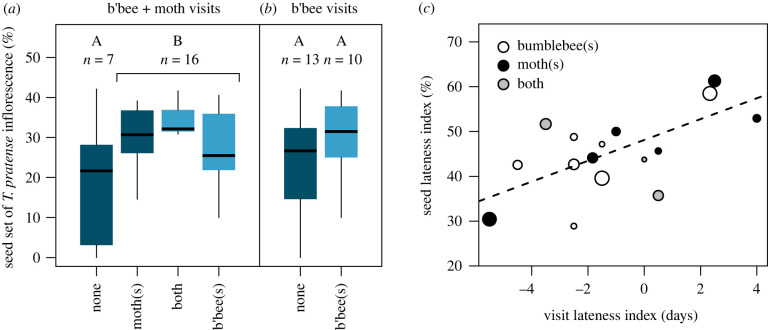
Recent decades have seen a surge in awareness about insect pollinator declines. Social bees receive the most attention, but most flower-visiting species are lesser known, non-bee insects. Nocturnal flower visitors, e.g. moths, are especially difficult to observe and largely ignored in pollination studies. Clearly, achieving balanced monitoring of all pollinator taxa represents a major scientific challenge. Here, we use time-lapse cameras for season-wide, day-and-night pollinator surveillance of (L.; red clover) in an alpine grassland. We reveal the first evidence to suggest that moths, mainly (L.; large yellow underwing), pollinate this important wildflower and forage crop, providing 34% of visits (bumblebees: 61%). This is a remarkable finding; moths have received no recognition throughout a century of pollinator research. We conclude that despite a non-negligible frequency and duration of nocturnal flower visits, nocturnal pollinators of have been systematically overlooked. We further show how the relationship between visitation and seed set may only become clear after accounting for moth visits. As such, population trends in moths, as well as bees, could profoundly affect seed yield. Ultimately, camera surveillance gives fair representation to non-bee pollinators and lays a foundation for automated monitoring of species interactions in future.
近几十年来,人们对昆虫传粉媒介减少的认识不断提高。社会性蜜蜂受到了最多的关注,但大多数访花物种都是不太知名的、非蜜蜂类昆虫。夜间访花者,例如蛾类,尤其难以观察到,在传粉研究中也被大量忽视。显然,实现对所有传粉媒介类群的平衡监测代表着一项重大的科学挑战。在这里,我们使用延时摄像机对高山草原上的 (L.;红三叶草)进行了全季节、昼夜不停的传粉媒介监测。我们首次发现证据表明,蛾类,主要是 (L.;大黄花翅夜蛾),为这种重要的野生花卉和饲料作物授粉,其访问量占 34%(熊蜂:61%)。这是一个惊人的发现;在一个世纪的传粉媒介研究中,蛾类从未得到过认可。我们得出结论,尽管夜间花朵访问的频率和持续时间不可忽视,但 的夜间传粉者一直被系统地忽视了。我们进一步展示了如何在考虑到蛾类访问量后,访问量和结实率之间的关系才变得清晰。因此,蛾类以及蜜蜂的数量趋势可能会深刻影响 的种子产量。最终,摄像机监测公正地代表了非蜜蜂传粉媒介,并为未来自动监测物种相互作用奠定了基础。