Division of Neurology, Department of Pediatrics, Cincinnati Children's Research Foundation and University of Cincinnati College of Medicine, 3333 Burnet Ave, Cincinnati, OH 45229, USA.
Behav Brain Funct. 2011 Oct 5;7:41. doi: 10.1186/1744-9081-7-41.
Whether selective serotonin reuptake inhibitors (SSRIs) exposure during adolescent brain development causes lasting effects remains unresolved.
Assess the effects of fluoxetine and paroxetine 60 days after adolescent exposure compared with when on-drug.
Male Sprague-Dawley littermates (41 litters) were gavaged on postnatal days 33-53 with fluoxetine (3 or 10 mg/kg/day), paroxetine (3, 10 or, 17 mg/kg/day), or water; half were tested while on-drug (21 litters) and half after 60 days off-drug (20 litters).
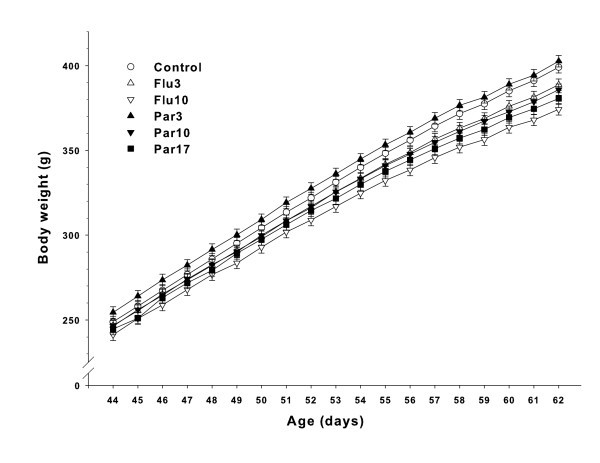
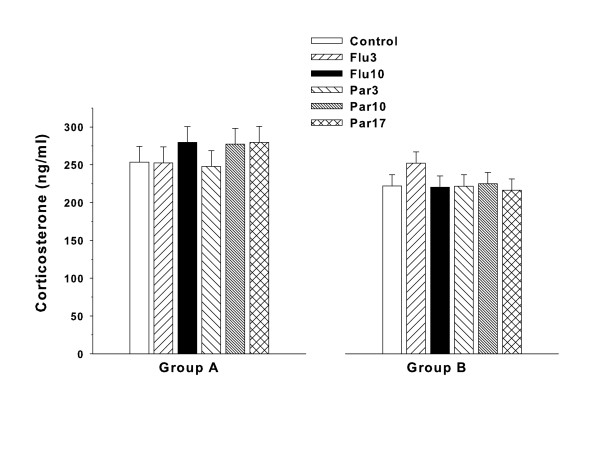
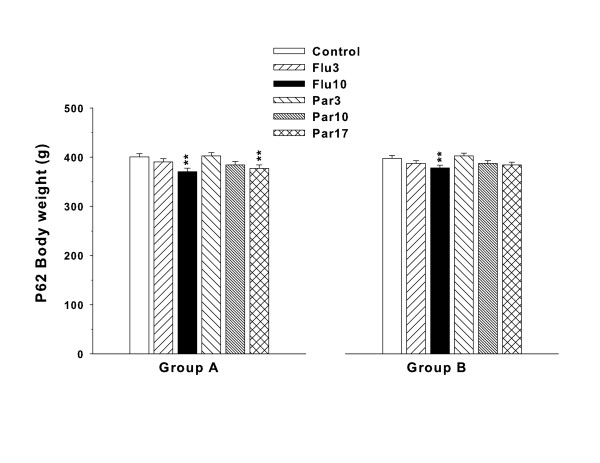
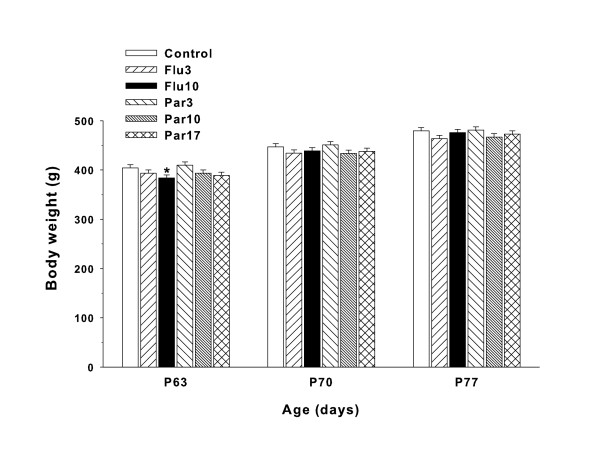
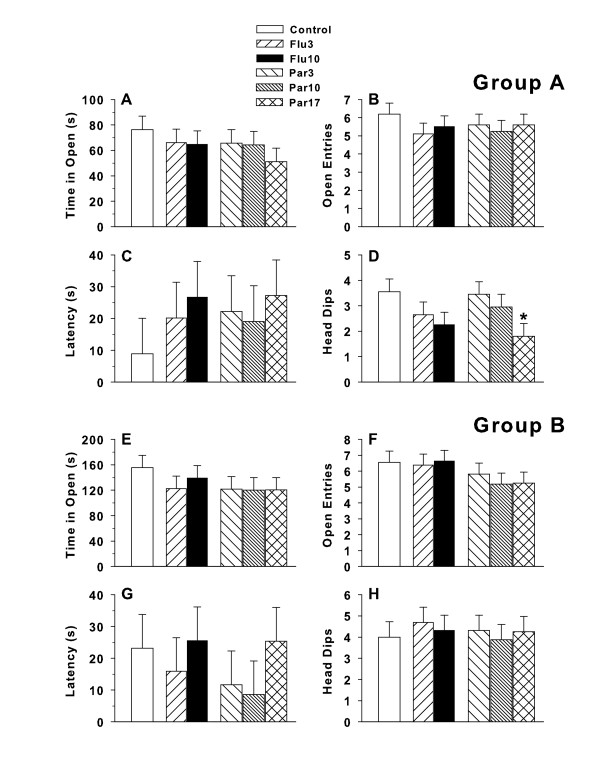
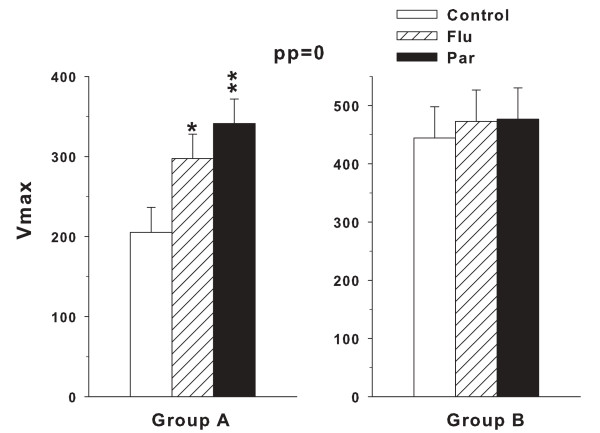
The highest dose of the drugs reduced body weight gain during treatment that rebounded 1 week post-treatment. On-drug, no significant group differences were found on elevated plus maze time-in-open, zone entries, or latency to first open entry; however, the high dose of paroxetine significantly reduced head-dips (N=20/group). No significant effects were found on-drug for acoustic startle response/prepulse inhibition (ASR/PPI) although a trend (p<0.10) was seen, which after combining dose levels, showed a significant increase in ASR amplitude for both fluoxetine and paroxetine (N=20-21/group). No differences on immobility time were seen in the Porsolt forced swim test or in plasma corticosterone at the end of forced swim (N-19-21/group). Off-drug, no effects were seen in the elevated plus maze (N=16/group), ASR/PPI (N=20/group), forced swim (N=19-20/group), or plasma corticosterone (N=19/group). At the doses tested, fluoxetine and paroxetine induced minor effects with drug on-board but no residual, long-term adverse effects in rats 60 days after drug discontinuation.
The data provide no evidence that fluoxetine or paroxetine have long-term adverse effects on the behaviors measured here after adolescent to young adult exposure.
选择性 5-羟色胺再摄取抑制剂(SSRIs)在青少年大脑发育期间暴露是否会产生持久影响仍未解决。
评估氟西汀和帕罗西汀在青少年暴露后 60 天与用药时的作用。
雄性 Sprague-Dawley 同窝仔(41 窝)在生后第 33-53 天灌胃给予氟西汀(3 或 10mg/kg/天)、帕罗西汀(3、10 或 17mg/kg/天)或水;一半在用药时进行测试(21 窝),另一半在停药 60 天后进行测试(20 窝)。
药物的最高剂量在治疗期间减少了体重增加,停药后 1 周体重增加恢复。在用药时,在高架十字迷宫的开臂时间、进入次数或首次进入开臂的潜伏期上,各实验组间无显著差异;然而,帕罗西汀的高剂量显著减少了摇头(每组 N=20)。在声爆反应/预脉冲抑制(ASR/PPI)方面,在用药时未发现显著影响,尽管存在趋势(p<0.10),但在合并剂量水平后,氟西汀和帕罗西汀的 ASR 幅度均显著增加(每组 N=20-21)。在强迫游泳试验中的不动时间或强迫游泳结束时的血浆皮质酮上,各组间无差异。停药后,在高架十字迷宫(每组 N=16)、ASR/PPI(每组 N=20)、强迫游泳(每组 N=19-20)或血浆皮质酮(每组 N=19)上均未观察到影响。在测试剂量下,氟西汀和帕罗西汀在用药时引起轻微影响,但在停药 60 天后,在大鼠中未观察到长期的、不良的残留影响。
数据表明,氟西汀或帕罗西汀在青少年至成年早期暴露后,不会对这里测量的行为产生长期的不良影响。