School of Pharmacy, University of East Anglia, Norwich Research Park, Norwich, Norfolk, NR4 7TJ, UK.
Trials. 2011 Oct 5;12:218. doi: 10.1186/1745-6215-12-218.
Evidence demonstrates that measures are needed to optimise therapy and improve administration of medicines in care homes for older people. The aim of this study is to determine the clinical and cost effectiveness of a novel model of multi-professional medication review.
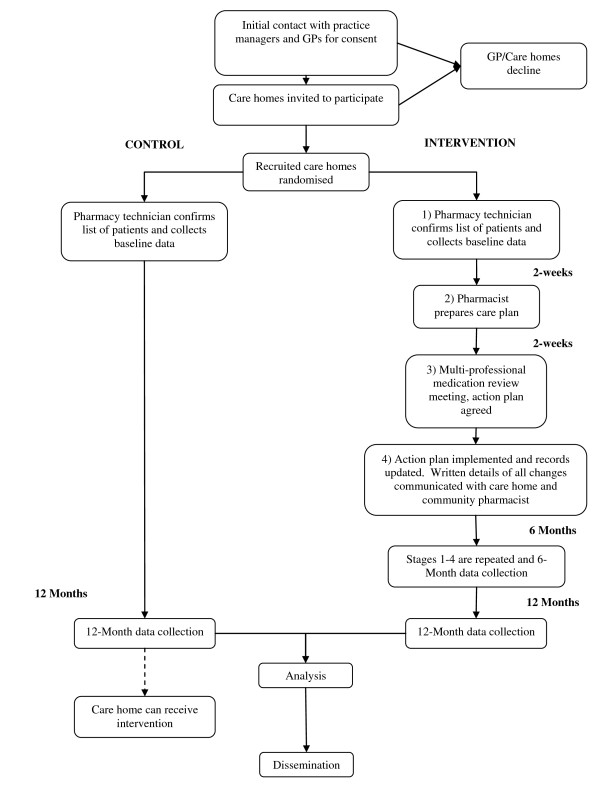
A cluster randomised controlled trial design, involving thirty care homes. In line with current practice in medication reviews, recruitment and consent will be sought from general practitioners and care homes, rather than individual residents. Care homes will be segmented according to size and resident mix and allocated to the intervention arm (15 homes) or control arm (15 homes) sequentially using minimisation. Intervention homes will receive a multi-professional medication review at baseline and at 6 months, with follow-up at 12 months. Control homes will receive usual care (support they currently receive from the National Health Service), with data collection at baseline and 12 months. The novelty of the intervention is a review of medications by a multi-disciplinary team. Primary outcome measures are number of falls and potentially inappropriate prescribing. Secondary outcome measures include medication costs, health care resource use, hospitalisations and mortality. The null hypothesis proposes no difference in primary outcomes between intervention and control patients. The primary outcome variable (number of falls) will be analysed using a linear mixed model, with the intervention specified as a fixed effect and care homes included as a random effect. Analyses will be at the level of the care home. The economic evaluation will estimate the cost-effectiveness of the intervention compared to usual care from a National Health Service and personal social services perspective.The study is not measuring the impact of the intervention on professional working relationships, the medicines culture in care homes or the generic health-related quality of life of residents.
This study will establish the effectiveness of a new model of multi-professional clinical medication reviews in care homes, using novel approaches to recruitment and consent. It is the first study to undertake an examination of direct patient outcomes, together with an economic analysis.
ISRCTN: ISRCTN90761620.
有证据表明,需要采取措施优化治疗方法并改进养老院老年人的药物管理。本研究的目的是确定一种新型多专业药物审查模式的临床和成本效益。
采用整群随机对照试验设计,涉及 30 家养老院。根据药物审查的现行做法,将从全科医生和养老院而不是个别居民那里寻求招募和同意。养老院将根据规模和居民构成进行细分,并使用最小化方法按顺序分配到干预组(15 家)或对照组(15 家)。干预组将在基线和 6 个月时接受多专业药物审查,并在 12 个月时进行随访。对照组将接受常规护理(他们目前从国民保健服务中获得的支持),并在基线和 12 个月时收集数据。干预措施的新颖之处在于多学科团队对药物进行审查。主要结局指标是跌倒次数和潜在不适当的处方。次要结局指标包括药物费用、医疗保健资源利用、住院和死亡率。零假设假设干预组和对照组患者的主要结局无差异。主要结局变量(跌倒次数)将使用线性混合模型进行分析,干预措施指定为固定效应,养老院包括为随机效应。分析将在养老院层面进行。经济评估将从国民保健服务和个人社会服务的角度评估干预措施与常规护理相比的成本效益。该研究不测量干预对专业工作关系、养老院药物文化或居民一般健康相关生活质量的影响。
本研究将采用新的招募和同意方法,确定新型多专业临床药物审查模式在养老院中的有效性。这是第一项研究,同时考察了直接患者结局和经济分析。
ISRCTN:ISRCTN90761620。