Anrys Pauline, Strauven Goedele, Boland Benoit, Dalleur Olivia, Declercq Anja, Degryse Jean-Marie, De Lepeleire Jan, Henrard Séverine, Lacour Valérie, Simoens Steven, Speybroeck Niko, Vanhaecht Kris, Spinewine Anne, Foulon Veerle
Louvain Drug Research Institute, Clinical Pharmacy Research Group, Université catholique de Louvain, Brussels, Belgium.
Department of Pharmaceutical and Pharmacological Sciences, KU Leuven, Leuven, Belgium.
Implement Sci. 2016 Mar 11;11:35. doi: 10.1186/s13012-016-0394-6.
Ageing has become a worldwide reality and presents new challenges for the health-care system. Research has shown that potentially inappropriate prescribing, both potentially inappropriate medications and potentially prescribing omissions, is highly prevalent in older people, especially in the nursing home setting. The presence of potentially inappropriate medications/potentially prescribing omissions is associated with adverse drug events, hospitalisations, mortality and health-care costs. The Collaborative approach to Optimise MEdication use for Older people in Nursing homes (COME-ON) study aims to evaluate the effect of a complex, multifaceted intervention, including interdisciplinary case conferences, on the appropriateness of prescribing of medicines for older people in Belgian nursing homes.
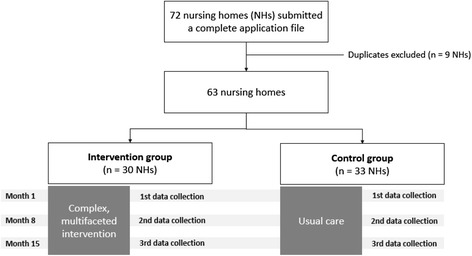
METHODS/DESIGN: A multicentre cluster-controlled trial is set up in 63 Belgian nursing homes (30 intervention; 33 control). In each of these nursing homes, 35 residents (≥65 years) are selected for participation. The complex, multifaceted intervention comprises (i) health-care professional education and training, (ii) local concertation (discussion on the appropriate use of at least one medication class at the level of the nursing home) and (iii) repeated interdisciplinary case conferences between general practitioner, nurse and pharmacist to perform medication review for each included nursing home resident. The control group works as usual. The study period lasts 15 months. The primary outcome measures relate to the appropriateness of prescribing and are defined as (1) among residents who had at least one potentially inappropriate medication/potentially prescribing omission at baseline, the proportion of them for whom there is a decrease of at least one of these potentially inappropriate medications/potentially prescribing omissions at the end of study, and (2) among all residents, the proportion of them for whom at least one new potentially inappropriate medication/potentially prescribing omission is present at the end of the study, compared to baseline. The secondary outcome measures include individual components of appropriateness of prescribing, medication use, outcomes of the case conferences, clinical outcomes and costs. A process evaluation (focusing on implementation, causal mechanisms and contextual factors) will be conducted alongside the study.
The COME-ON study will contribute to a growing body of knowledge concerning the effect of complex interventions on the use of medicines in the nursing home setting, and on factors influencing their effect. The results will inform policymakers on strategies to implement in the near future.
Current Controlled Trials ISRCTN66138978.
老龄化已成为全球现实,给医疗保健系统带来了新挑战。研究表明,潜在不适当处方,包括潜在不适当用药和潜在处方遗漏,在老年人中非常普遍,尤其是在养老院环境中。潜在不适当用药/潜在处方遗漏的存在与药物不良事件、住院、死亡率和医疗保健成本相关。养老院老年人用药优化协作研究(COME-ON)旨在评估一种复杂的、多方面的干预措施,包括跨学科病例讨论会,对比利时养老院老年人用药合理性的影响。
方法/设计:在63家比利时养老院(30家干预组;33家对照组)开展一项多中心整群对照试验。在每家养老院中,选取35名居民(≥65岁)参与。这种复杂的、多方面的干预措施包括:(i)医护专业人员教育与培训;(ii)本地协调(在养老院层面讨论至少一类药物的合理使用);(iii)全科医生、护士和药剂师之间反复进行跨学科病例讨论会,为每位纳入研究的养老院居民进行用药审查。对照组照常工作。研究期持续15个月。主要结局指标与处方合理性相关,定义为:(1)在基线时有至少一种潜在不适当用药/潜在处方遗漏的居民中,在研究结束时这些潜在不适当用药/潜在处方遗漏中至少有一种减少的居民所占比例;(2)在所有居民中,与基线相比,在研究结束时出现至少一种新的潜在不适当用药/潜在处方遗漏的居民所占比例。次要结局指标包括处方合理性的各个组成部分、用药情况、病例讨论会结果、临床结局和成本。将在研究过程中同时进行一项过程评估(关注实施情况、因果机制和背景因素)。
COME-ON研究将为有关复杂干预措施对养老院用药影响以及影响其效果的因素的知识体系增添内容。研究结果将为政策制定者提供近期实施策略的参考依据。
当前受控试验ISRCTN66138978。