Department of Molecular and Cell Biology, Faculty of Science, University of Cape Town, University Ave, Rondebosch 7701, South Africa.
Virol J. 2011 Oct 6;8:462. doi: 10.1186/1743-422X-8-462.
HIV-1 Gag virus like particles (VLPs) used as candidate vaccines are regarded as inert particles as they contain no replicative nucleic acid, although they do encapsidate cellular RNAs. During HIV-1 Gag VLP production in baculovirus-based expression systems, VLPs incorporate the baculovirus Gp64 envelope glycoprotein, which facilitates their entry into mammalian cells. This suggests that HIV-1 Gag VLPs produced using this system facilitate uptake and subsequent expression of encapsidated RNA in mammalian cells - an unfavourable characteristic for a vaccine.
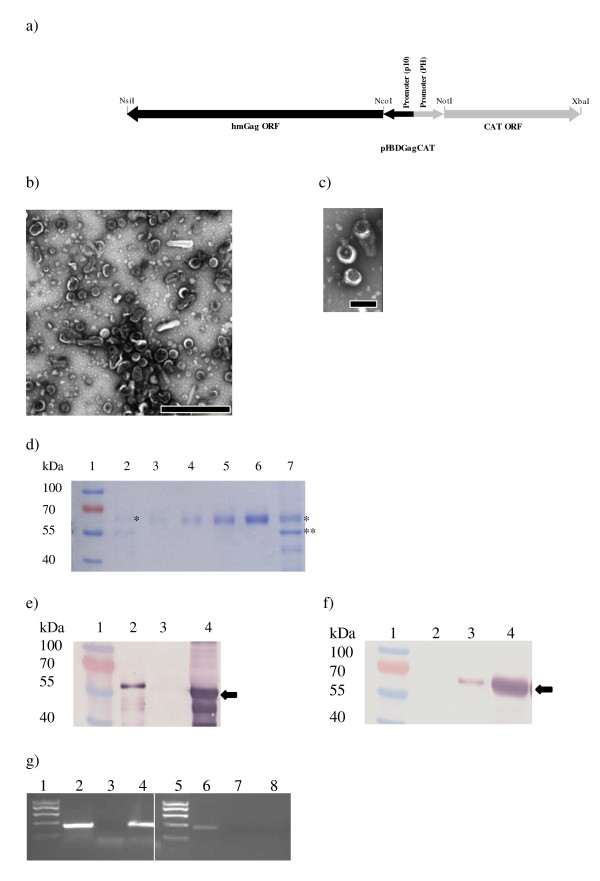
HIV-1 Gag VLPs encapsidating reporter chloramphenicol acetyl transferase (CAT) RNA, were made in insect cells using the baculovirus expression system. The presence of Gp64 on the VLPs was verified by western blotting and RT-PCR used to detect and quantitate encapsidated CAT RNA. VLP samples were heated to inactivate CAT RNA. Unheated and heated VLPs incubated with selected mammalian cell lines and cell lysates tested for the presence of CAT protein by ELISA. Mice were inoculated with heated and unheated VLPs using a DNA prime VLP boost regimen.
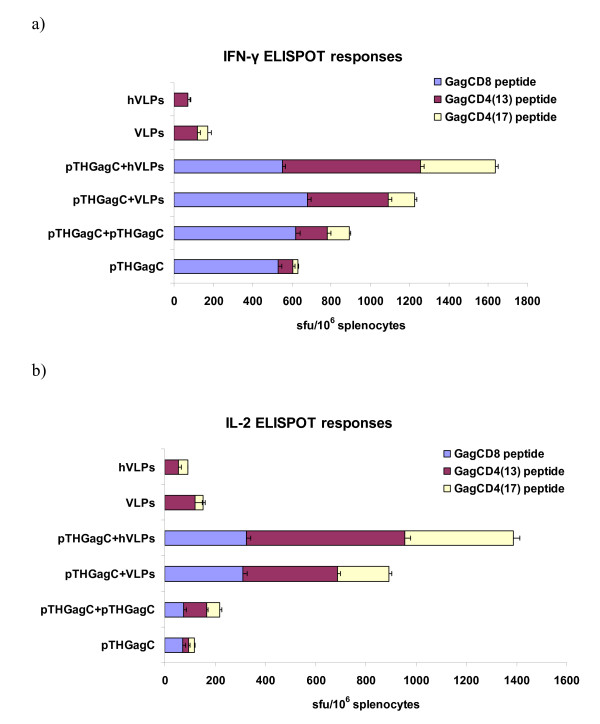
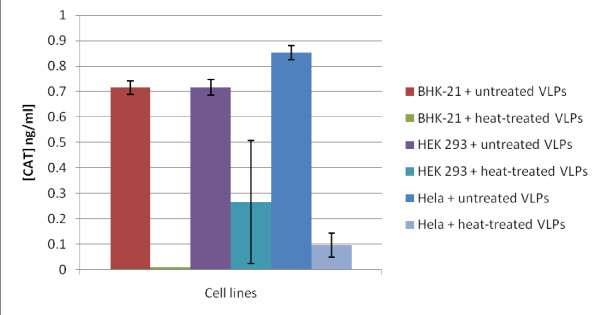
HIV-1 Gag VLPs produced had significantly high levels of Gp64 (~1650 Gp64 molecules/VLP) on their surfaces. The amount of encapsidated CAT RNA/μg Gag VLPs ranged between 0.1 to 7 ng. CAT protein was detected in 3 of the 4 mammalian cell lines incubated with VLPs. Incubation with heated VLPs resulted in BHK-21 and HeLa cell lysates showing reduced CAT protein levels compared with unheated VLPs and HEK-293 cells. Mice inoculated with a DNA prime VLP boost regimen developed Gag CD8 and CD4 T cell responses to GagCAT VLPs which also boosted a primary DNA response. Heating VLPs did not abrogate these immune responses but enhanced the Gag CD4 T cell responses by two-fold.
Baculovirus-produced HIV-1 Gag VLPs encapsidating CAT RNA were taken up by selected mammalian cell lines. The presence of CAT protein indicates that encapsidated RNA was expressed in the mammalian cells. Heat-treatment of the VLPs altered the ability of protein to be expressed in some cell lines tested but did not affect the ability of the VLPs to stimulate an immune response when inoculated into mice.
HIV-1 Gag 病毒样颗粒(VLPs)被用作候选疫苗,被认为是无活性颗粒,因为它们不含复制性核酸,尽管它们确实包裹了细胞 RNA。在基于杆状病毒的表达系统中生产 HIV-1 Gag VLP 时,VLPs 会结合杆状病毒 Gp64 包膜糖蛋白,这有助于它们进入哺乳动物细胞。这表明使用该系统生产的 HIV-1 Gag VLPs 促进了包裹 RNA 在哺乳动物细胞中的摄取和随后的表达 - 这是疫苗的不利特征。
使用杆状病毒表达系统在昆虫细胞中制备包裹报告氯霉素乙酰转移酶(CAT)RNA 的 HIV-1 Gag VLPs。通过 Western blot 验证 VLPs 上 Gp64 的存在,并使用 RT-PCR 检测和定量包裹的 CAT RNA。将 VLP 样品加热以失活 CAT RNA。用选定的哺乳动物细胞系孵育未加热和加热的 VLPs,并通过 ELISA 检测 CAT 蛋白的存在。用 DNA 初级 VLP 增强方案对加热和未加热的 VLPs 进行小鼠接种。
HIV-1 Gag VLPs 表面具有显著高水平的 Gp64(~1650 Gp64 分子/VLP)。每微克 Gag VLPs 中包裹的 CAT RNA 量在 0.1 到 7 ng 之间。在与 VLPs 孵育的 4 种哺乳动物细胞系中的 3 种中检测到 CAT 蛋白。与未加热的 VLPs 相比,加热的 VLPs 孵育的 BHK-21 和 HeLa 细胞裂解物中的 CAT 蛋白水平降低,而 HEK-293 细胞则没有。用 DNA 初级 VLP 增强方案接种的小鼠对 GagCAT VLPs 产生了 Gag CD8 和 CD4 T 细胞反应,这些反应也增强了原发性 DNA 反应。加热 VLPs 并没有消除这些免疫反应,但将 Gag CD4 T 细胞反应增强了两倍。
杆状病毒产生的 HIV-1 Gag VLPs 包裹 CAT RNA 被选定的哺乳动物细胞系摄取。CAT 蛋白的存在表明包裹的 RNA 在哺乳动物细胞中表达。VLPs 的热处理改变了在一些测试细胞系中表达蛋白的能力,但不影响将 VLPs 接种到小鼠中刺激免疫反应的能力。