Novel Drug Delivery Systems Lab, Tehran University of Medical Sciences, Tehran, Iran.
Int J Nanomedicine. 2011;6:1963-75. doi: 10.2147/IJN.S22731. Epub 2011 Sep 14.
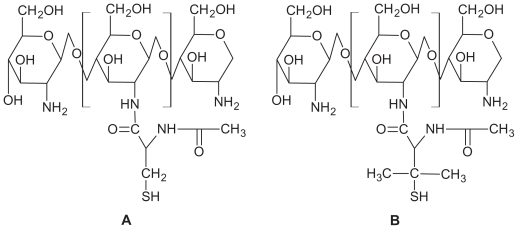
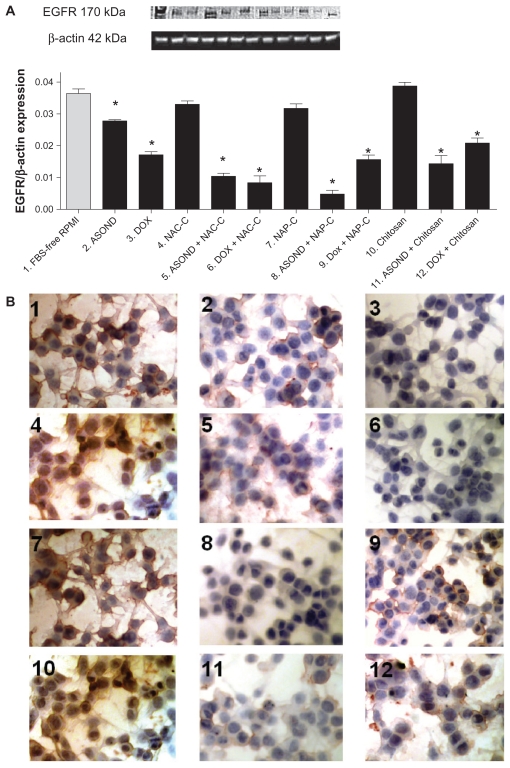
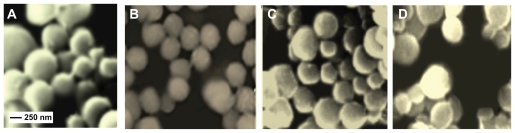
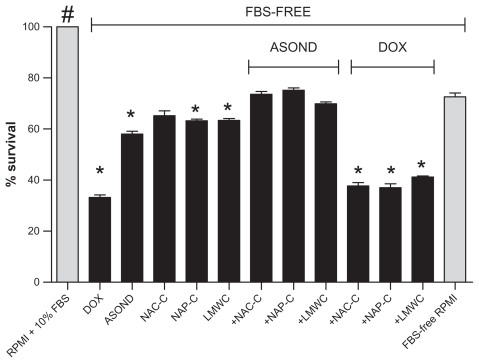
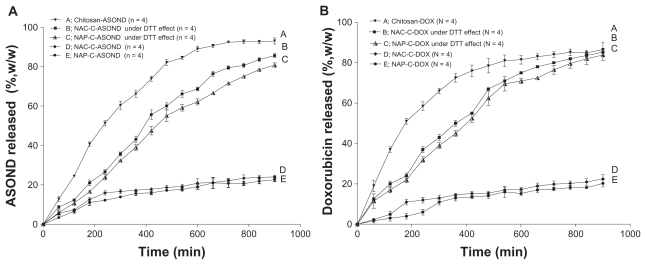
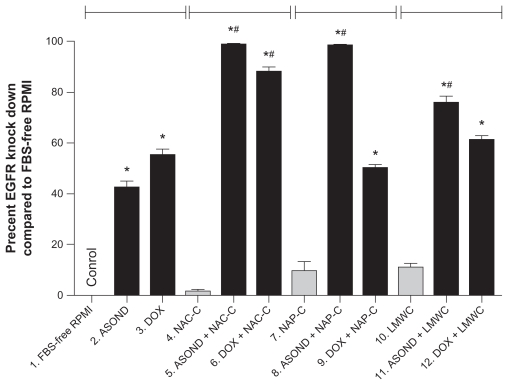
Thiolated chitosan has high transfection and mucoadhesive properties. We investigated the potential of two recently synthesized polymers: NAC-C (N-acetyl cysteine-chitosan) and NAP-C (N-acetyl penicillamine-chitosan) in anticancer drug delivery targeting epidermal growth factor receptor (EGFR). Doxorubicin (DOX) and antisense oligonucleotide (ASOND)-loaded polymer nanoparticles were prepared in water by a gelation process. Particle characterization, drug loading, and drug release were evaluated. To verify drug delivery efficiency in vitro experiments on a breast cancer cell line (T47D) were performed. EGFR gene and protein expression was analyzed by real time quantitative polymerase chain reaction and Western blotting, respectively. A loading percentage of 63% ± 5% for ASOND and 70% ± 5% for DOX was achieved. Drug release data after 15 hours showed that ASOND and DOX were completely released from chitosan-based particles while a lower and more sustained release of only 22% ± 8% was measured for thiolated particles. In a cytosol simulated release medium/reducing environment, such as found intracellularly, polymer-based nanoparticles dissociated, liberating approximately 50% of both active substances within 7 hours. ASOND-loaded polymer nanoparticles had higher stability and high mucoadhesive properties. The ASOND-loaded thiolated particles significantly suppressed EGFR gene expression in T47D cells compared with ASOND-loaded chitosan particles and downregulated EGFR protein expression in cells. This study could facilitate future investigations into the functionality of NAP-C and NAC-C polymers as an efficient ASOND delivery system in vitro and in vivo.
巯基化壳聚糖具有高转染和黏膜黏附特性。我们研究了两种最近合成的聚合物:NAC-C(N-乙酰半胱氨酸-壳聚糖)和 NAP-C(N-乙酰青霉胺-壳聚糖)在针对表皮生长因子受体(EGFR)的抗癌药物传递中的潜力。阿霉素(DOX)和反义寡核苷酸(ASOND)载药聚合物纳米粒在水中通过凝胶化过程制备。对粒子特性、药物载量和药物释放进行了评估。为了验证体外实验的药物输送效率,在乳腺癌细胞系(T47D)上进行了实验。通过实时定量聚合酶链反应和 Western 印迹分别分析 EGFR 基因和蛋白质表达。ASOND 和 DOX 的载药量分别达到 63%±5%和 70%±5%。15 小时后药物释放数据显示,ASOND 和 DOX 完全从壳聚糖基粒子中释放出来,而巯基化粒子仅释放 22%±8%的药物,且释放更为持续。在模拟细胞内胞质释放介质/还原环境中,聚合物基纳米粒会解离,大约 7 小时内释放出两种活性物质的 50%。ASOND 载药聚合物纳米粒具有更高的稳定性和高黏膜黏附特性。与 ASOND 载药壳聚糖颗粒相比,ASOND 载药巯基化颗粒显著抑制了 T47D 细胞中 EGFR 基因的表达,并下调了细胞中 EGFR 蛋白的表达。这项研究可以促进对 NAP-C 和 NAC-C 聚合物作为高效 ASOND 传递系统的功能的未来研究,无论是在体外还是体内。