Cortical Networks Group, Max Planck Institute for Neurological Research Cologne, Germany.
Front Neuroinform. 2011 Sep 23;5:18. doi: 10.3389/fninf.2011.00018. eCollection 2011.
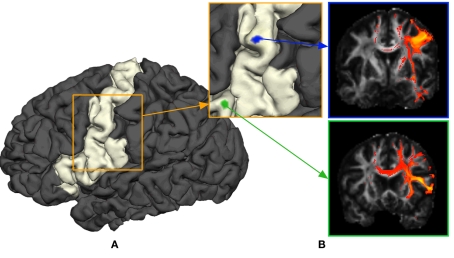
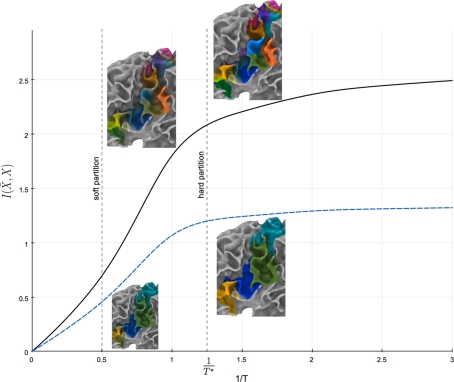
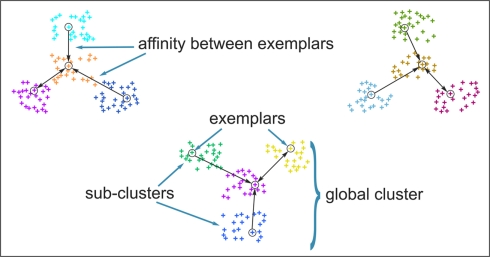
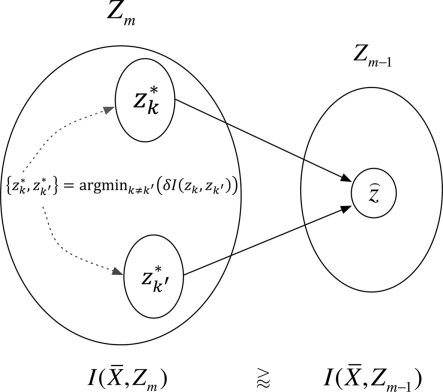
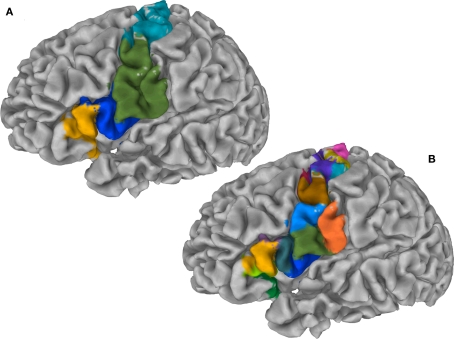
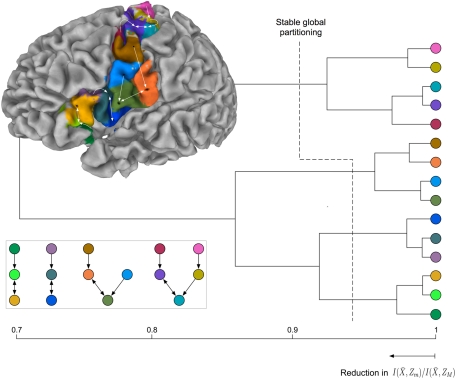
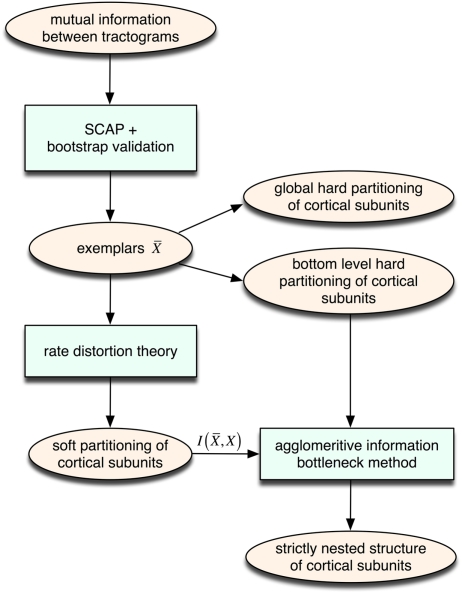
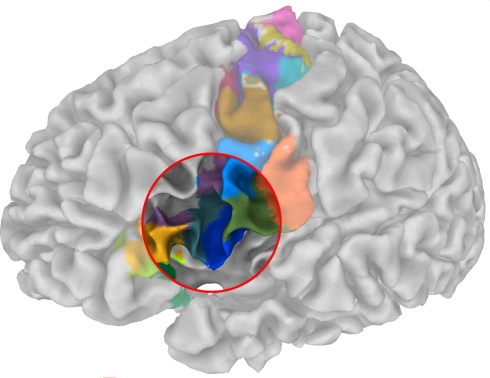
One of the most promising avenues for compiling connectivity data originates from the notion that individual brain regions maintain individual connectivity profiles; the functional repertoire of a cortical area ("the functional fingerprint") is closely related to its anatomical connections ("the connectional fingerprint") and, hence, a segregated cortical area may be characterized by a highly coherent connectivity pattern. Diffusion tractography can be used to identify borders between such cortical areas. Each cortical area is defined based upon a unique probabilistic tractogram and such a tractogram is representative of a group of tractograms, thereby forming the cortical area. The underlying methodology is called connectivity-based cortex parcellation and requires clustering or grouping of similar diffusion tractograms. Despite the relative success of this technique in producing anatomically sensible results, existing clustering techniques in the context of connectivity-based parcellation typically depend on several non-trivial assumptions. In this paper, we embody an unsupervised hierarchical information-based framework to clustering probabilistic tractograms that avoids many drawbacks offered by previous methods. Cortex parcellation of the inferior frontal gyrus together with the precentral gyrus demonstrates a proof of concept of the proposed method: The automatic parcellation reveals cortical subunits consistent with cytoarchitectonic maps and previous studies including connectivity-based parcellation. Further insight into the hierarchically modular architecture of cortical subunits is given by revealing coarser cortical structures that differentiate between primary as well as premotoric areas and those associated with pre-frontal areas.
从个体脑区保持独特的连接模式这一观点出发,整合连接数据的最有前途的途径之一是:皮质区域的功能组合(“功能指纹”)与其解剖连接(“连接指纹”)密切相关,因此,一个分隔的皮质区域可能具有高度一致的连接模式。扩散轨迹技术可用于识别此类皮质区域之间的边界。每个皮质区域都是基于独特的概率轨迹图定义的,而这种轨迹图则代表了一组轨迹图,从而形成了皮质区域。这种方法被称为基于连接的皮质分割,需要对相似的扩散轨迹图进行聚类或分组。尽管这种技术在产生具有解剖意义的结果方面相对成功,但基于连接的分割中现有的聚类技术通常依赖于几个非平凡的假设。在本文中,我们提出了一种基于无监督分层信息的框架来聚类概率轨迹图,该框架避免了以前方法的许多缺点。下额前回和中央前回的皮质分割证明了所提出方法的概念验证:自动分割揭示了与细胞构筑图谱以及基于连接的分割等先前研究一致的皮质亚区。通过揭示区分初级和前运动区以及与前额区相关的更粗的皮质结构,可以进一步了解皮质亚区的分层模块化结构。