Department of Molecular, Cellular, and Developmental Biology, Yale University, New Haven, Connecticut, United States of America.
PLoS Genet. 2011 Sep;7(9):e1002306. doi: 10.1371/journal.pgen.1002306. Epub 2011 Sep 29.
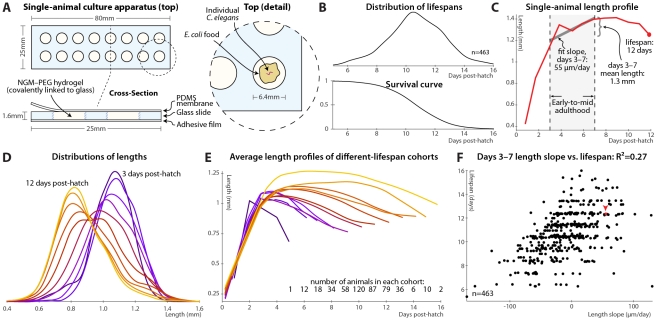
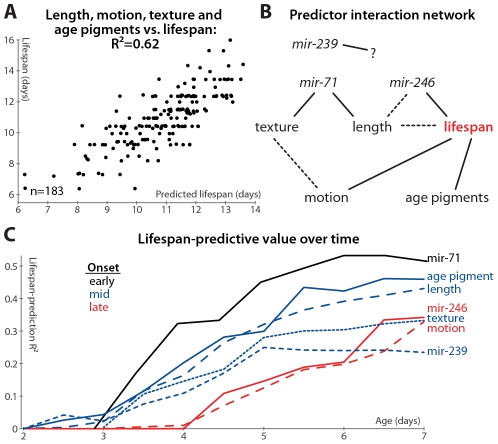
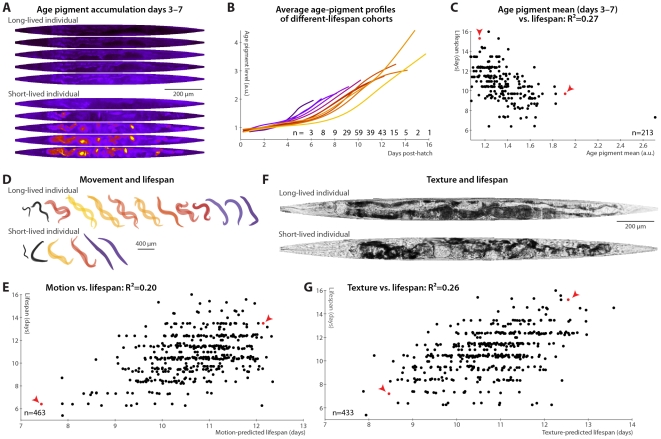
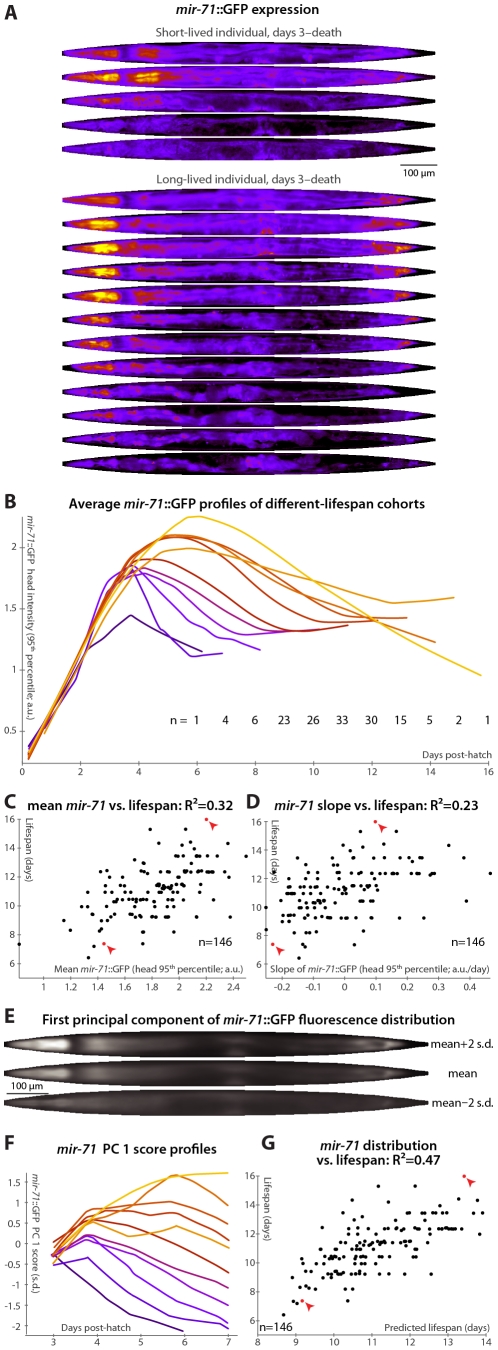
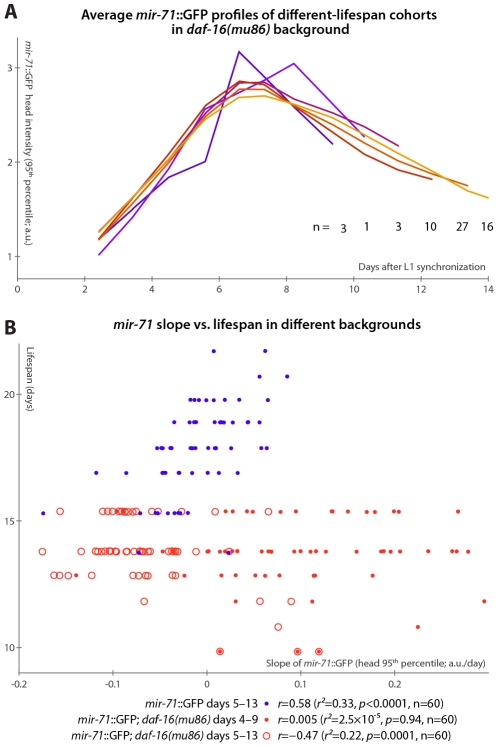
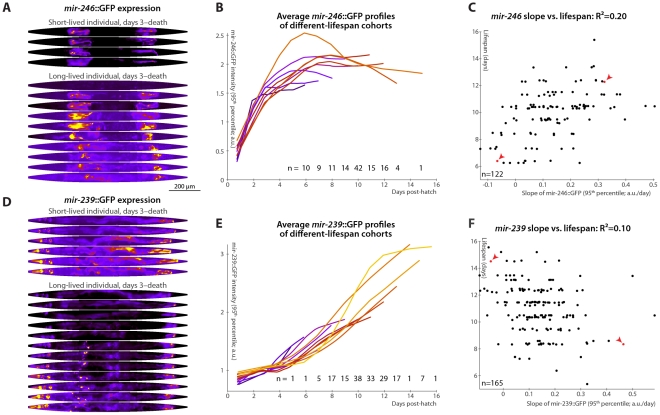
Neither genetic nor environmental factors fully account for variability in individual longevity: genetically identical invertebrates in homogenous environments often experience no less variability in lifespan than outbred human populations. Such variability is often assumed to result from stochasticity in damage accumulation over time; however, the identification of early-life gene expression states that predict future longevity would suggest that lifespan is least in part epigenetically determined. Such "biomarkers of aging," genetic or otherwise, nevertheless remain rare. In this work, we sought early-life differences in organismal robustness in unperturbed individuals and examined the utility of microRNAs, known regulators of lifespan, development, and robustness, as aging biomarkers. We quantitatively examined Caenorhabditis elegans reared individually in a novel apparatus and observed throughout their lives. Early-to-mid-adulthood measures of homeostatic ability jointly predict 62% of longevity variability. Though correlated, markers of growth/muscle maintenance and of metabolic by-products ("age pigments") report independently on lifespan, suggesting that graceful aging is not a single process. We further identified three microRNAs in which early-adulthood expression patterns individually predict up to 47% of lifespan differences. Though expression of each increases throughout this time, mir-71 and mir-246 correlate with lifespan, while mir-239 anti-correlates. Two of these three microRNA "biomarkers of aging" act upstream in insulin/IGF-1-like signaling (IIS) and other known longevity pathways, thus we infer that these microRNAs not only report on but also likely determine longevity. Thus, fluctuations in early-life IIS, due to variation in these microRNAs and from other causes, may determine individual lifespan.
在同质环境中遗传上相同的无脊椎动物,其寿命的变化往往不亚于杂交人群。这种可变性通常被认为是由于随着时间的推移损伤积累的随机性造成的;然而,识别预测未来寿命的早期生命基因表达状态表明,寿命在一定程度上至少是由表观遗传决定的。这种“衰老生物标志物”,无论是遗传的还是其他的,仍然很少。在这项工作中,我们寻求在未受干扰的个体中早期生命的生物体健壮性差异,并研究了已知调节寿命、发育和健壮性的 microRNA 作为衰老生物标志物的效用。我们定量地检查了在一个新装置中单独饲养的秀丽隐杆线虫,并在它们的一生中进行了观察。早期到成年的稳态能力测量共同预测了 62%的寿命变异性。尽管相关,但生长/肌肉维持和代谢副产物(“年龄色素”)的标志物独立报告寿命,这表明优雅的衰老不是一个单一的过程。我们进一步鉴定了三个 microRNA,其中早期成年表达模式各自预测了高达 47%的寿命差异。尽管每个 microRNA 的表达在这段时间内都增加,但 mir-71 和 mir-246 与寿命相关,而 mir-239 则相反。这三个 microRNA“衰老生物标志物”中的两个作用于胰岛素/IGF-1 样信号(IIS)和其他已知的长寿途径的上游,因此我们推断这些 microRNA 不仅报告而且可能决定寿命。因此,由于这些 microRNA 以及其他原因导致的早期生命 IIS 的波动,可能决定了个体的寿命。