Department of Radiology and Biomedical Imaging, University of California San Francisco, San Francisco, California, United States of America.
PLoS One. 2011;6(9):e22973. doi: 10.1371/journal.pone.0022973. Epub 2011 Sep 29.
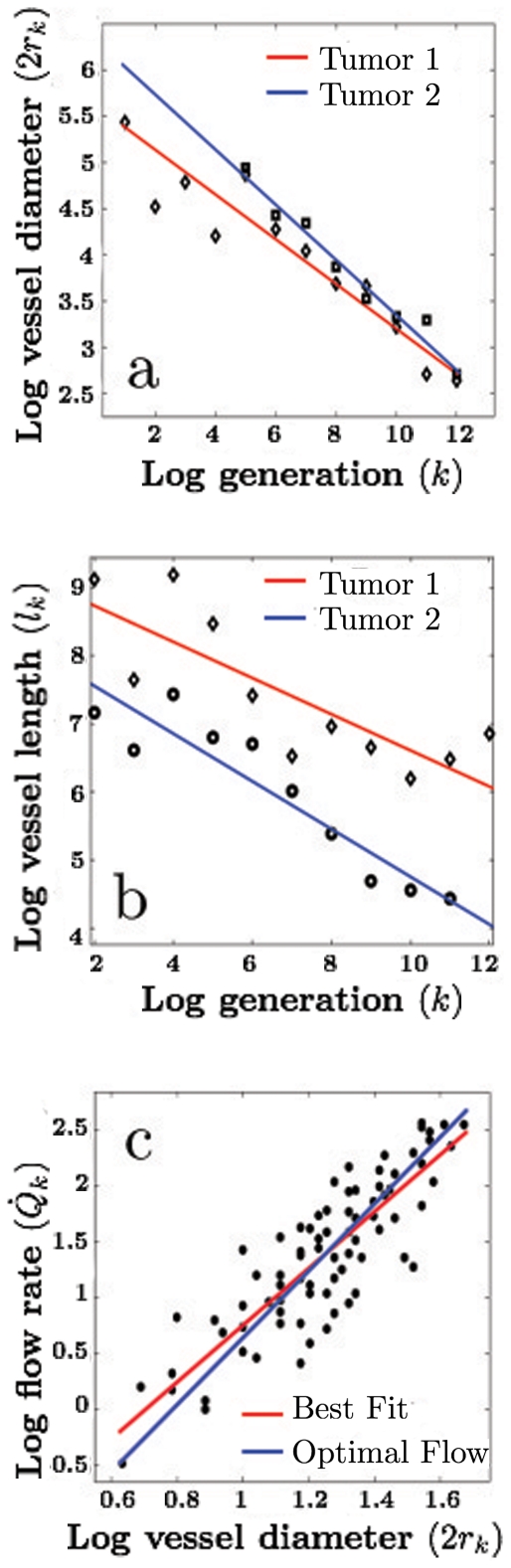
The relationships between cellular, structural and dynamical properties of tumors have traditionally been studied separately. Here, we construct a quantitative, predictive theory of solid tumor growth, metabolic rate, vascularization and necrosis that integrates the relationships between these properties. To accomplish this, we develop a comprehensive theory that describes the interface and integration of the tumor vascular network and resource supply with the cardiovascular system of the host. Our theory enables a quantitative understanding of how cells, tissues, and vascular networks act together across multiple scales by building on recent theoretical advances in modeling both healthy vasculature and the detailed processes of angiogenesis and tumor growth. The theory explicitly relates tumor vascularization and growth to metabolic rate, and yields extensive predictions for tumor properties, including growth rates, metabolic rates, degree of necrosis, blood flow rates and vessel sizes. Besides these quantitative predictions, we explain how growth rates depend on capillary density and metabolic rate, and why similar tumors grow slower and occur less frequently in larger animals, shedding light on Peto's paradox. Various implications for potential therapeutic strategies and further research are discussed.
传统上,细胞、结构和动力学特性之间的关系是分开研究的。在这里,我们构建了一个定量的、可预测的实体瘤生长、代谢率、血管生成和坏死的理论,它整合了这些特性之间的关系。为了实现这一目标,我们开发了一个全面的理论,描述了肿瘤血管网络与宿主心血管系统的界面和整合以及资源供应。我们的理论通过建立在健康血管建模和血管生成和肿瘤生长的详细过程的最新理论进展的基础上,使我们能够在多个尺度上定量理解细胞、组织和血管网络如何协同作用。该理论明确地将肿瘤血管生成和生长与代谢率联系起来,并对肿瘤特性进行了广泛的预测,包括生长速率、代谢率、坏死程度、血流速率和血管大小。除了这些定量预测,我们还解释了为什么生长速率取决于毛细血管密度和代谢率,以及为什么在较大的动物中,类似的肿瘤生长速度较慢且发生频率较低,从而解释了佩托悖论。讨论了对潜在治疗策略和进一步研究的各种影响。