Department of Cellular Neurobiology, Institute for Zoology, University of Göttingen, Göttingen, Germany.
PLoS One. 2011;6(9):e25613. doi: 10.1371/journal.pone.0025613. Epub 2011 Sep 28.
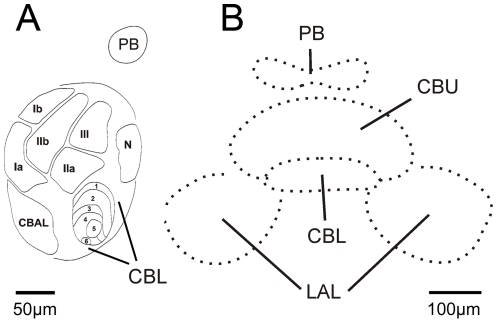
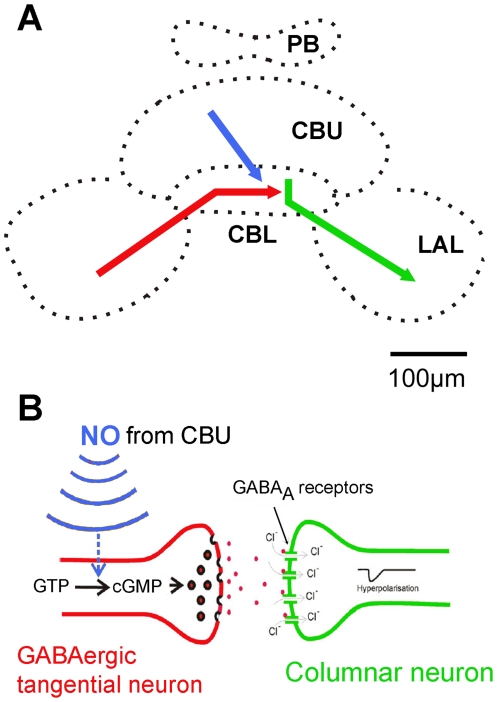
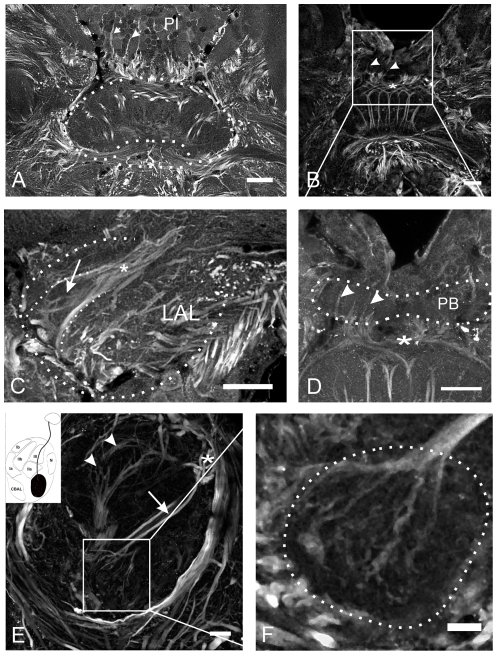
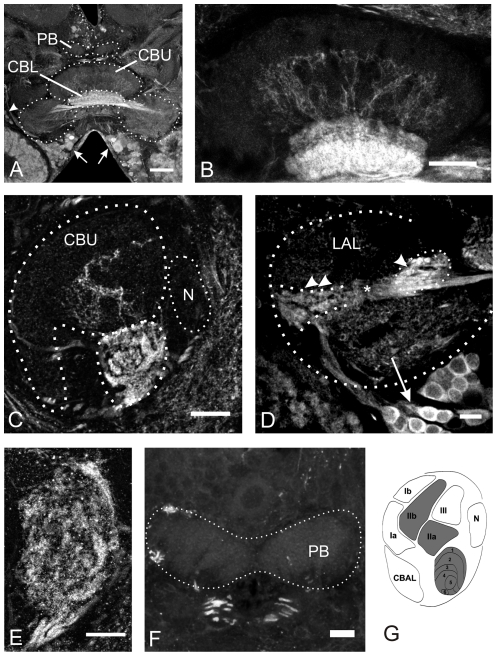
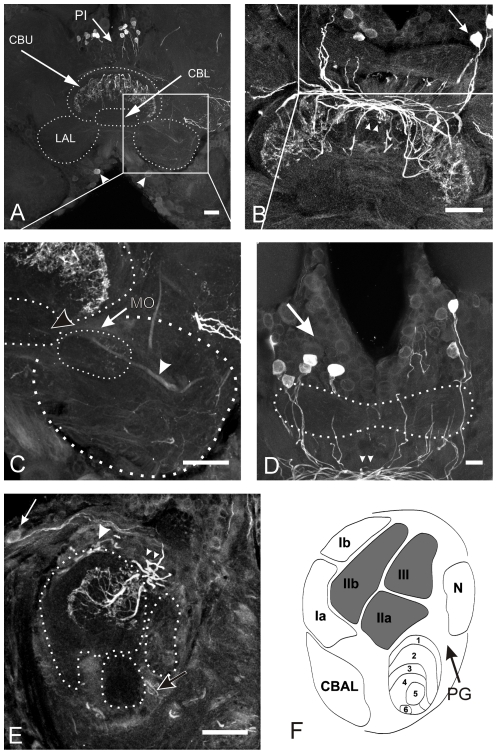
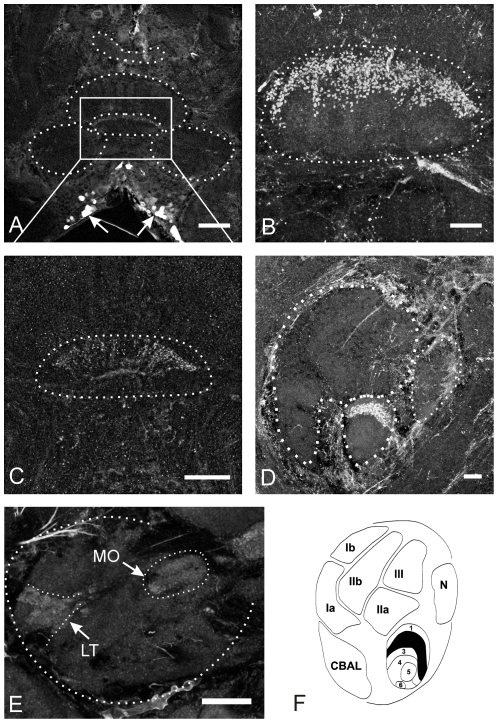
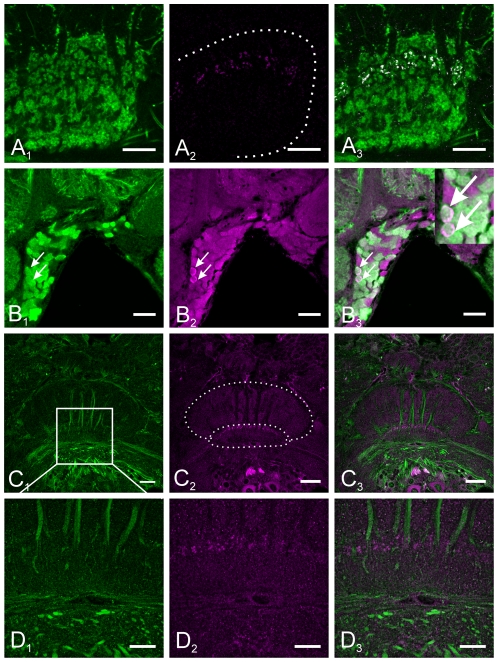
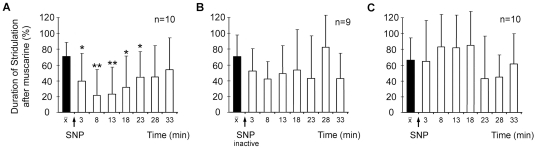
The central complex selects and coordinates the species- and situation-specific song production in acoustically communicating grasshoppers. Control of sound production is mediated by several neurotransmitters and modulators, their receptors and intracellular signaling pathways. It has previously been shown that muscarinic cholinergic excitation in the central complex promotes sound production whereas both GABA and nitric oxide/cyclic GMP signaling suppress its performance. The present immunocytochemical and pharmacological study investigates the question whether GABA and nitric oxide mediate inhibition of sound production independently. Muscarinic ACh receptors are expressed by columnar output neurons of the central complex that innervate the lower division of the central body and terminate in the lateral accessory lobes. GABAergic tangential neurons that innervate the lower division of the central body arborize in close proximity of columnar neurons and thus may directly inhibit these central complex output neurons. A subset of these GABAergic tangential neurons accumulates cyclic GMP following the release of nitric oxide from neurites in the upper division of the central body. While sound production stimulated by muscarine injection into the central complex is suppressed by co-application of sodium nitroprusside, picrotoxin-stimulated singing was not affected by co-application of this nitric oxide donor, indicating that nitric oxide mediated inhibition requires functional GABA signaling. Hence, grasshopper sound production is controlled by processing of information in the lower division of the central body which is subject to modulation by nitric oxide released from neurons in the upper division.
中央复合体会选择并协调具有物种特异性和情境特异性的鸣叫声产生,这在通过声音进行交流的蟋蟀中尤为明显。声音产生的控制是由多种神经递质和调制物、其受体和细胞内信号通路介导的。先前的研究表明,中央复合体内的毒蕈碱性乙酰胆碱能兴奋会促进声音的产生,而 GABA 和一氧化氮/环鸟苷酸信号则抑制其性能。本免疫细胞化学和药理学研究探讨了 GABA 和一氧化氮是否独立介导抑制声音产生的问题。中央复合体中的柱状输出神经元表达毒蕈碱性乙酰胆碱受体,这些神经元支配中央体的下部,并在侧附属叶终止。支配中央体下部的 GABA 能切向神经元与柱状神经元紧密相邻,因此可能直接抑制这些中央复合输出神经元。这些 GABA 能切向神经元中的一部分在中央体上部的神经突释放一氧化氮后积累环鸟苷酸。虽然中央复合体中注入毒蕈碱刺激的声音产生会被同时给予的硝普酸钠抑制,但胡椒毒素刺激的鸣唱不受这种一氧化氮供体的共同应用影响,表明一氧化氮介导的抑制需要功能性 GABA 信号。因此,蟋蟀的声音产生是由中央体下部的信息处理控制的,而中央体下部的信息处理受到来自上部神经元释放的一氧化氮的调制。