Neurobiology of Nutrition Laboratory, Pennington Biomedical Research Center, Louisiana State University System, Baton Rouge, LA, USA.
Curr Opin Neurobiol. 2011 Dec;21(6):888-96. doi: 10.1016/j.conb.2011.09.004. Epub 2011 Oct 6.
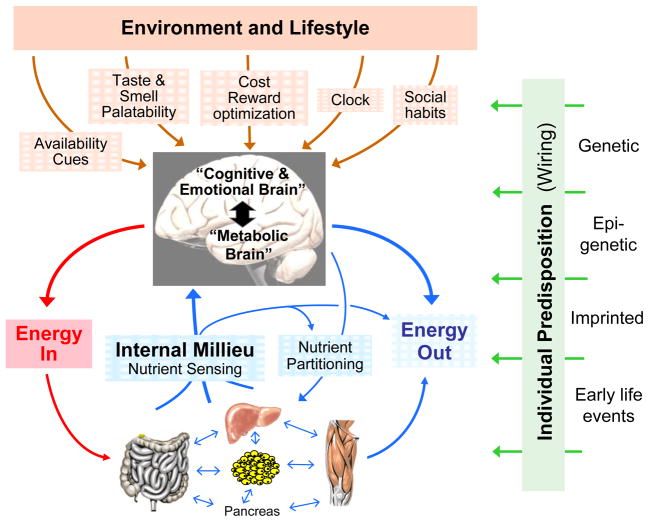
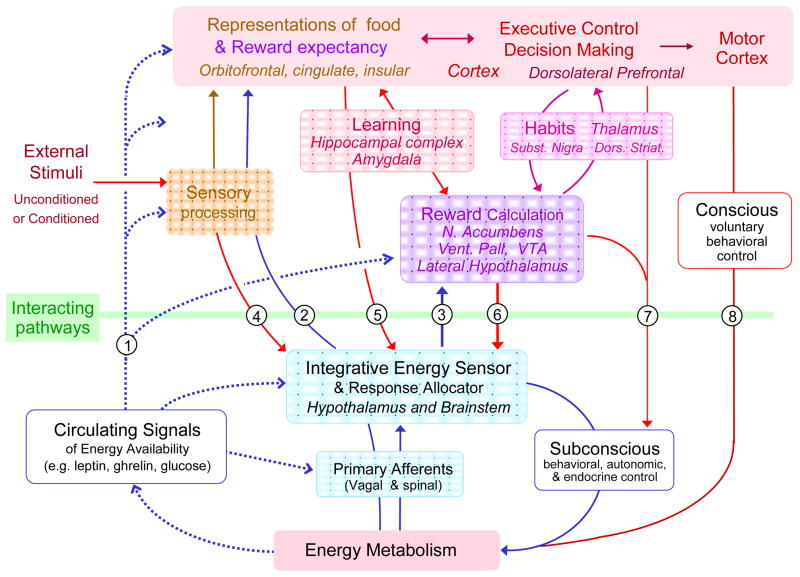
Obesity is on the rise in all developed countries, and a large part of this epidemic has been attributed to excess caloric intake, induced by ever present food cues and the easy availability of energy dense foods in an environment of plenty. Clearly, there are strong homeostatic regulatory mechanisms keeping body weight of many individuals exposed to this environment remarkably stable over their adult life. Other individuals, however, seem to eat not only because of metabolic need, but also because of excessive hedonic drive to make them feel better and relieve stress. In the extreme, some individuals exhibit addiction-like behavior toward food, and parallels have been drawn to drug and alcohol addiction. However, there is an important distinction in that, unlike drugs and alcohol, food is a daily necessity. Considerable advances have been made recently in the identification of neural circuits that represent the interface between the metabolic and hedonic drives of eating. We will cover these new findings by focusing first on the capacity of metabolic signals to modulate processing of cognitive and reward functions in cortico-limbic systems (bottom-up) and then on pathways by which the cognitive and emotional brain may override homeostatic regulation (top-down).
肥胖在所有发达国家都呈上升趋势,而这种流行现象的很大一部分归因于过量的热量摄入,这是由无处不在的食物提示和丰富环境中能量密集型食物的易得性引起的。显然,有强大的体内平衡调节机制使许多人在成年后的体重保持惊人的稳定。然而,其他一些人似乎不仅因为新陈代谢的需要而进食,还因为过度的享乐驱动,使他们感觉更好并缓解压力。在极端情况下,一些人对食物表现出类似成瘾的行为,这与毒品和酒精成瘾有相似之处。然而,有一个重要的区别,与毒品和酒精不同,食物是日常生活的必需品。最近,在识别代表饮食的代谢和享乐驱动之间接口的神经回路方面取得了相当大的进展。我们将首先关注代谢信号调节皮质-边缘系统中认知和奖励功能处理的能力(自下而上),然后关注认知和情绪大脑可能超越体内平衡调节的途径(自上而下),以此来介绍这些新发现。