Department of Neurology, Daping Hospital, Third Military Medical University, Chongqing, PR China.
J Neuroinflammation. 2011 Oct 8;8:134. doi: 10.1186/1742-2094-8-134.
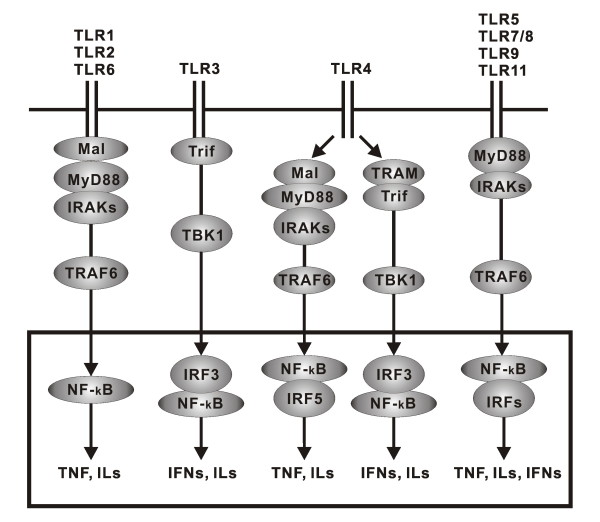
Cerebral ischemia triggers acute inflammation, which has been associated with an increase in brain damage. The mechanisms that regulate the inflammatory response after cerebral ischemia are multifaceted. An important component of this response is the activation of the innate immune system. However, details of the role of the innate immune system within the complex array of mechanisms in cerebral ischemia remain unclear. There have been recent great strides in our understanding of the innate immune system, particularly in regard to the signaling mechanisms of Toll-like receptors (TLRs), whose primary role is the initial activation of immune cell responses. So far, few studies have examined the role of TLRs in cerebral ischemia. However, work with experimental models of ischemia suggests that TLRs are involved in the enhancement of cell damage following ischemia, and their absence is associated with lower infarct volumes. It may be possible that therapeutic targets could be designed to modulate activities of the innate immune system that would attenuate cerebral brain damage. Ischemic tolerance is a protective mechanism induced by a variety of preconditioning stimuli. Interpreting the molecular mechanism of ischemic tolerance will open investigative avenues into the treatment of cerebral ischemia. In this review, we discuss the critical role of TLRs in mediating cerebral ischemic injury. We also summarize evidence demonstrating that cerebral preconditioning downregulates pro-inflammatory TLR signaling, thus reducing the inflammation that exacerbates ischemic brain injury.
脑缺血引发急性炎症,炎症与脑损伤增加有关。调节脑缺血后炎症反应的机制是多方面的。该反应的一个重要组成部分是固有免疫系统的激活。然而,固有免疫系统在脑缺血复杂机制中的作用细节仍不清楚。最近,我们对固有免疫系统的理解取得了重大进展,特别是在 Toll 样受体 (TLR) 的信号机制方面,TLR 的主要作用是初始激活免疫细胞反应。到目前为止,很少有研究检查 TLR 在脑缺血中的作用。然而,缺血实验模型的研究表明,TLR 参与了缺血后细胞损伤的增强,而其缺失与较低的梗死体积相关。也许可以设计治疗靶点来调节固有免疫系统的活动,从而减轻脑损伤。缺血耐受是多种预处理刺激诱导的保护机制。解释缺血耐受的分子机制将为治疗脑缺血开辟研究途径。在这篇综述中,我们讨论了 TLR 在介导脑缺血损伤中的关键作用。我们还总结了证据表明,脑预处理下调促炎 TLR 信号,从而减少加重缺血性脑损伤的炎症。