Department of Gastroenterology & Hepatology, Yamaguchi University Graduate School of Medicine, Ube, Yamaguchi, Japan.
Cell Tissue Res. 2011 Oct;346(1):79-88. doi: 10.1007/s00441-011-1236-0. Epub 2011 Oct 11.
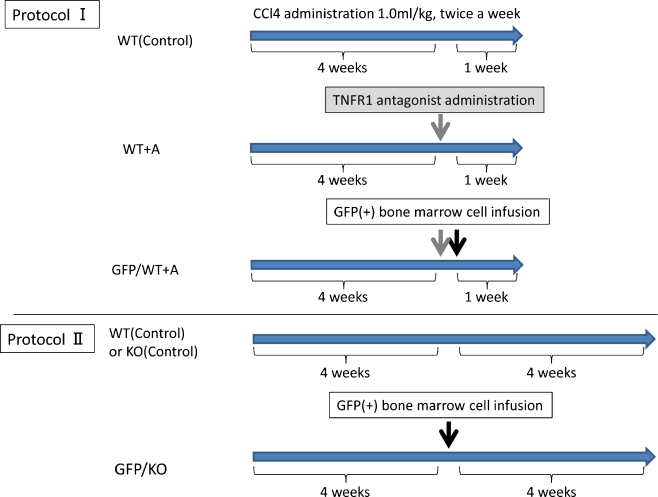
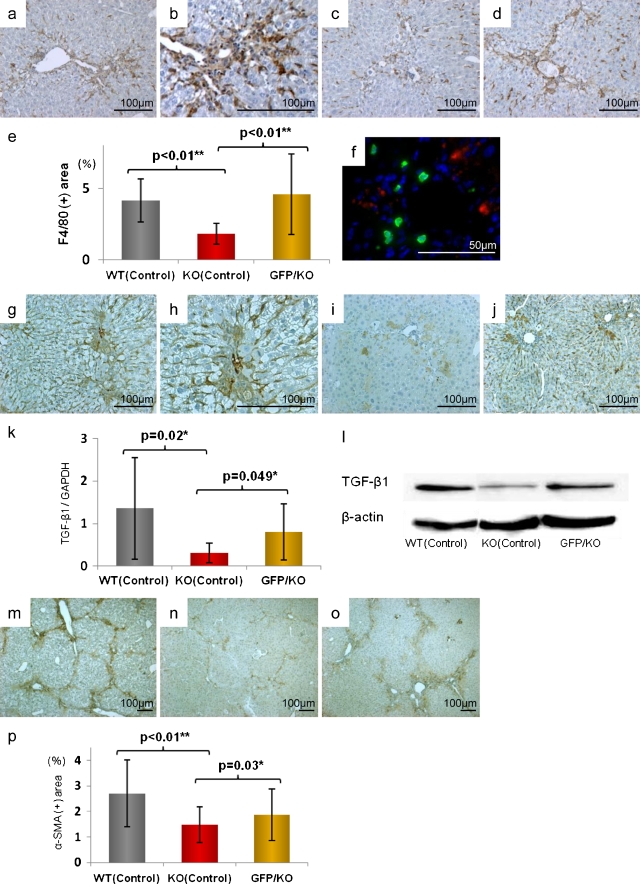
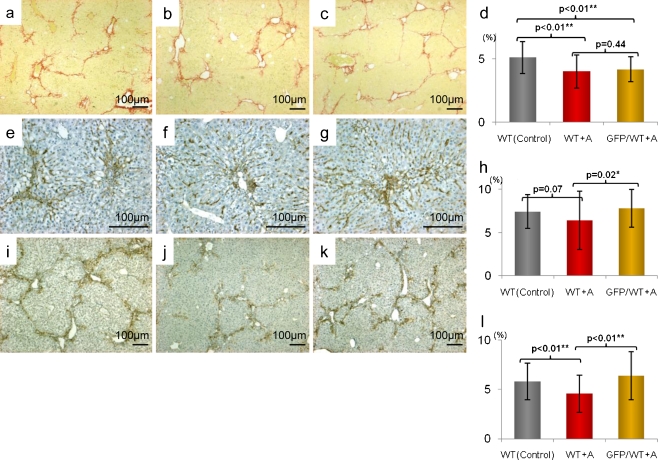
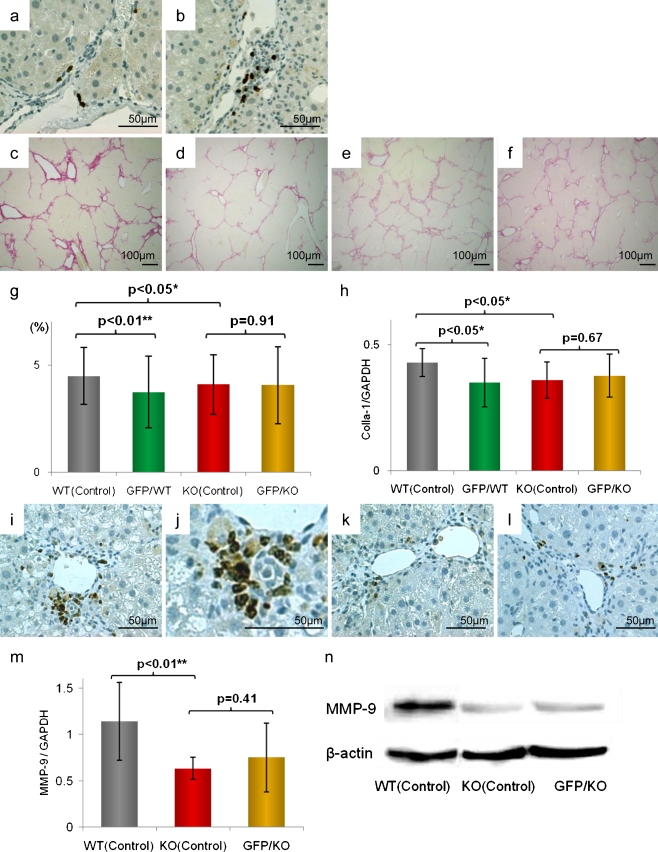
The importance of TNF-α signals mediated by tumor necrosis factor receptor type 1 (TNFR1) in inflammation and fibrosis induced by carbon tetrachloride (CCl(4)), and in post-injury liver regeneration including a GFP/CCl(4) model developed as a liver repair model by bone marrow cell (BMC) infusion, was investigated. In mice in which TNFR1 was suppressed by antagonist administration or by knockout, liver fibrosis induced by CCl(4) was significantly decreased. In these mice, intrahepatic macrophage infiltration and TGF-β1 expression were reduced and stellate cell activity was decreased; however, expression of MMP-9 was also decreased. With GFP-positive BMC (TNFR1 wild-type, WT) infusion in these mice, fibrosis proliferation, including host endogenous intrahepatic macrophage infiltration, TGF-β1 expression and stellate cell activity, increased significantly. There was no significant increase of MMP-9 expression. In this study, TNFR1 in hosts had a promoting effect on CCl(4)-induced hepatotoxicity and fibrosis, whereas BMC infusion in TNFR1 knockout mice enhanced host-derived intrahepatic inflammation and fibrosis proliferation. These findings differed from those in WT recipient mice, in which improvement in inflammation and fibrosis with BMC infusion had previously been reported. TNFR1-mediated signaling might be important to induce the improvement of liver fibrosis by bone marrow cell infusion.
研究了肿瘤坏死因子受体 1(TNFR1)介导的 TNF-α信号在四氯化碳(CCl4)诱导的炎症和纤维化、以及包括 GFP/CCl4 模型在内的损伤后肝再生中的作用,该模型是通过骨髓细胞(BMC)输注开发的肝修复模型。在 TNFR1 被拮抗剂给药或敲除抑制的小鼠中,CCl4 诱导的肝纤维化显著减少。在这些小鼠中,肝内巨噬细胞浸润和 TGF-β1 表达减少,星状细胞活性降低;然而,MMP-9 的表达也降低了。用 GFP 阳性 BMC(TNFR1 野生型,WT)输注这些小鼠,纤维化增殖,包括宿主内源性肝内巨噬细胞浸润、TGF-β1 表达和星状细胞活性,显著增加。MMP-9 的表达没有显著增加。在这项研究中,宿主中的 TNFR1 对 CCl4 诱导的肝毒性和纤维化有促进作用,而在 TNFR1 敲除小鼠中输注 BMC 增强了宿主来源的肝内炎症和纤维化增殖。这些发现与 WT 受体小鼠不同,先前有报道称 BMC 输注可改善炎症和纤维化。TNFR1 介导的信号可能对通过骨髓细胞输注诱导肝纤维化的改善很重要。