German Centre of Neurodegenerative Diseases, Tübingen, Germany.
Trials. 2011 Oct 11;12:222. doi: 10.1186/1745-6215-12-222.
Severe gait disturbances in idiopathic Parkinson's disease (PD) are observed in up to 80% of all patients in advanced disease stages with important impact on quality of life. There is an unmet need for further symptomatic therapeutic strategies, particularly as gait disturbances generally respond unfavourably to dopaminergic medication and conventional deep brain stimulation of the subthalamic nucleus in advanced disease stages. Recent pathophysiological research pointed to nigro-pontine networks entrained to locomotor integration. Stimulation of the pedunculopontine nucleus is currently under investigation, however, hitherto remains controversial. The substantia nigra pars reticulata (SNr)--entrained into integrative locomotor networks--is pathologically overactive in PD. High-frequent stimulation of the substantia nigra pars reticulata preferentially modulated axial symptoms and therefore is suggested as a novel therapeutic candidate target for neuromodulation of refractory gait disturbances in PD.
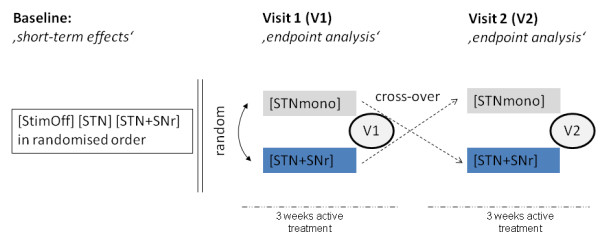
12 patients with idiopathic Parkinson's disease and refractory gait disturbances under best individual subthalamic nucleus stimulation and dopaminergic medication will be enroled into this double-blind 2 × 2 cross-over clinical trial. The treatment consists of two different stimulation settings using (i) conventional stimulation of the subthalamic nucleus [STNmono] and (ii) combined stimulation of distant electrode contacts located in the subthalamic nucleus and caudal border zone of STN and substantia nigra pars reticulata [STN+SNr]. The primary outcome measure is the change of the cumulative 'axial score' (UPDRS II items '13-15' and UPRDS III items '27-31') at three weeks of constant stimulation in either condition. Secondary outcome measures include specific scores on freezing of gait, balance function, quality of life, non-motor symptoms, and neuropsychiatric symptoms. The aim of the present trial is to investigate the efficacy and safety of a three week constant combined stimulation on [STN+SNr] compared to [STNmono]. The results will clarify, whether stimulation on nigral contacts additional to subthalamic stimulation will improve therapeutic response of otherwise refractory gait disturbances in PD.
The trial was registered with the clinical trials register of http://www.clinicaltrials.gov (NCT01355835).
在进展期疾病阶段,高达 80%的特发性帕金森病(PD)患者出现严重的步态障碍,对生活质量有重要影响。需要进一步的对症治疗策略,特别是由于进展期疾病阶段的步态障碍一般对多巴胺能药物和常规丘脑底核深部脑刺激反应不佳。最近的病理生理学研究指出,被纳入运动整合的黑质-脑桥网络。目前正在研究刺激脚桥核,但迄今为止仍存在争议。在 PD 中,被纳入整合运动网络的网状部黑质过度活跃。高频刺激网状部黑质优先调节轴性症状,因此被认为是治疗 PD 难治性步态障碍的新型神经调节候选靶点。
将 12 名特发性帕金森病和难治性步态障碍患者纳入本项双盲 2×2 交叉临床试验,这些患者在最佳个体丘脑底核刺激和多巴胺能药物治疗下仍存在步态障碍。该治疗包括两种不同的刺激设置,使用(i)常规丘脑底核刺激[STNmono]和(ii)刺激位于丘脑底核和尾状核 STN 交界区以及网状部黑质的不同电极接触[STN+SNr]。主要观察指标是在任何一种情况下,持续刺激 3 周后累积“轴性评分”(UPDRS II 项目“13-15”和 UPRDS III 项目“27-31”)的变化。次要观察指标包括冻结步态、平衡功能、生活质量、非运动症状和神经精神症状的特定评分。本试验的目的是研究 3 周持续联合刺激[STN+SNr]与[STNmono]相比的疗效和安全性。结果将阐明,在丘脑底核刺激的基础上增加刺激黑质接触是否会改善 PD 中其他难治性步态障碍的治疗反应。
该试验在 http://www.clinicaltrials.gov 的临床试验注册处注册(NCT01355835)。