Museo Erbario del Molise, Dipartimento di Scienze e Tecnologie per l'Ambiente e il Territorio, Università del Molise, Contrada Fonte Lappone, Pesche, Italy.
PLoS One. 2011;6(10):e25630. doi: 10.1371/journal.pone.0025630. Epub 2011 Oct 3.
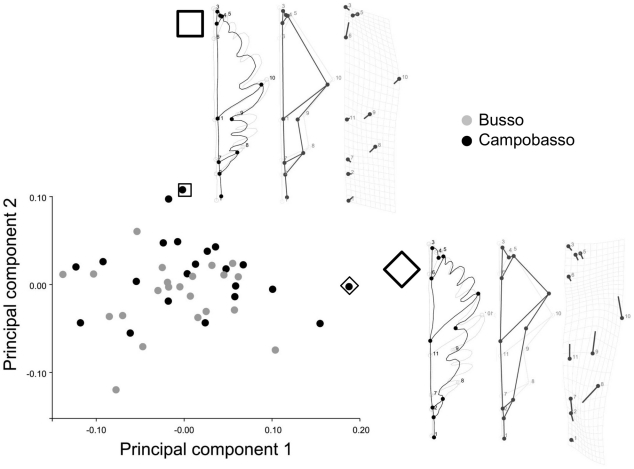
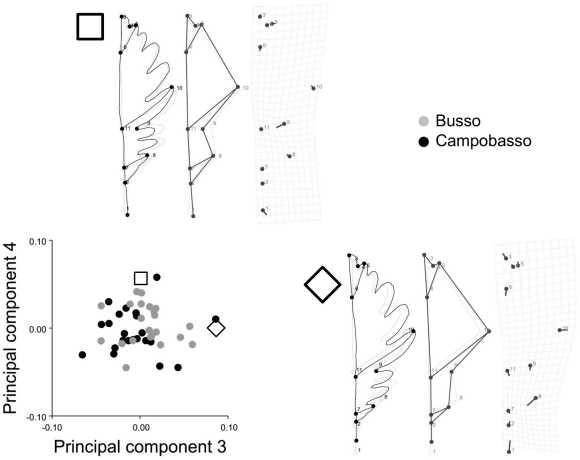
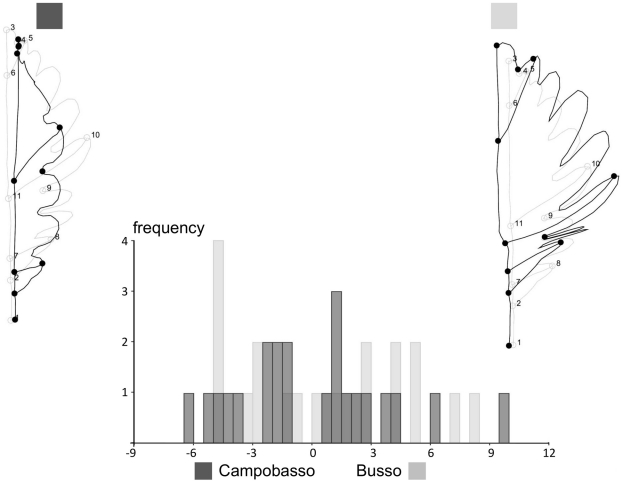
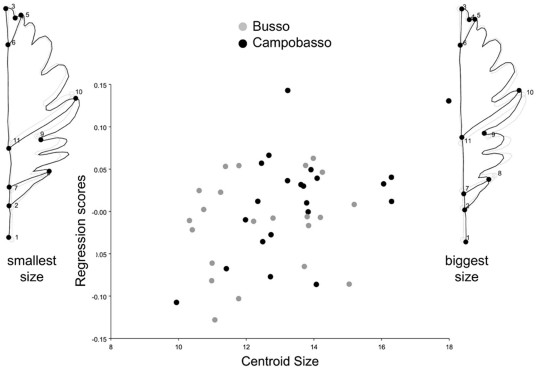
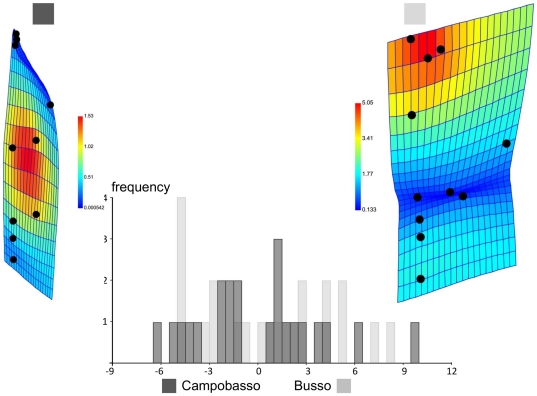
Taxonomy relies greatly on morphology to discriminate groups. Computerized geometric morphometric methods for quantitative shape analysis measure, test and visualize differences in form in a highly effective, reproducible, accurate and statistically powerful way. Plant leaves are commonly used in taxonomic analyses and are particularly suitable to landmark based geometric morphometrics. However, botanists do not yet seem to have taken advantage of this set of methods in their studies as much as zoologists have done. Using free software and an example dataset from two geographical populations of sessile oak leaves, we describe in detailed but simple terms how to: a) compute size and shape variables using Procrustes methods; b) test measurement error and the main levels of variation (population and trees) using a hierachical design; c) estimate the accuracy of group discrimination; d) repeat this estimate after controlling for the effect of size differences on shape (i.e., allometry). Measurement error was completely negligible; individual variation in leaf morphology was large and differences between trees were generally bigger than within trees; differences between the two geographic populations were small in both size and shape; despite a weak allometric trend, controlling for the effect of size on shape slighly increased discrimination accuracy. Procrustes based methods for the analysis of landmarks were highly efficient in measuring the hierarchical structure of differences in leaves and in revealing very small-scale variation. In taxonomy and many other fields of botany and biology, the application of geometric morphometrics contributes to increase scientific rigour in the description of important aspects of the phenotypic dimension of biodiversity. Easy to follow but detailed step by step example studies can promote a more extensive use of these numerical methods, as they provide an introduction to the discipline which, for many biologists, is less intimidating than the often inaccessible specialistic literature.
分类学在很大程度上依赖于形态学来区分群体。计算机化的几何形态测量方法用于定量形状分析,以高效、可重复、准确和具有统计学意义的方式测量、测试和可视化形式差异。植物叶片通常用于分类分析,特别适合基于地标点的几何形态测量。然而,植物学家似乎还没有像动物学家那样在他们的研究中充分利用这组方法。我们使用免费软件和来自两个地理种群的 sessile 栎树叶片的示例数据集,详细但简单地描述了如何:a) 使用 Procrustes 方法计算大小和形状变量;b) 使用分层设计测试测量误差和主要变异水平(种群和树木);c) 估计群体分类的准确性;d) 在控制形状差异对大小的影响(即,异速生长)后重复此估计。测量误差完全可以忽略不计;叶片形态的个体变异很大,树木之间的差异通常大于树木内部的差异;两个地理种群在大小和形状上的差异都很小;尽管存在弱的异速生长趋势,但控制大小对形状的影响略微提高了分类准确性。基于 Procrustes 的地标点分析方法在测量叶片差异的层次结构和揭示非常小尺度的变异方面非常高效。在分类学和植物学及生物学的许多其他领域,几何形态测量学的应用有助于提高对生物多样性表型维度重要方面的描述的科学严谨性。易于遵循但详细的分步示例研究可以促进更广泛地使用这些数值方法,因为它们为许多生物学家提供了学科介绍,这比通常难以获取的专门文献对他们来说不那么令人生畏。