Institute of Immunology and Molecular Biology, Department of Veterinary Medicine, Freie Universität Berlin, Berlin, Germany.
PLoS One. 2011;6(10):e25749. doi: 10.1371/journal.pone.0025749. Epub 2011 Oct 3.
To elucidate the anti-inflammatory and anabolic effects of regulated expression of IL-4 in chondrocyte-scaffolds under in vitro inflammatory conditions.
Mature articular chondrocytes from dogs (n = 3) were conditioned through transient transfection using pcDNA3.1.cIL-4 (constitutive) or pCOX-2.cIL-4 (cytokine-responsive) plasmids. Conditioned cells were seeded in alginate microspheres and rat-tail collagen type I matrix (CaReS®) to generate two types of tissue-engineered 3-dimensional scaffolds. Inflammatory arthritis was simulated in the packed chondrocytes through exogenous addition of recombinant canine (rc) IL-1β (100 ng/ml) plus rcTNFα (50 ng/ml) in culture media for 96 hours. Harvested cells and culture media were analyzed by various assays to monitor the anti-inflammatory and regenerative (anabolic) properties of cIL-4.
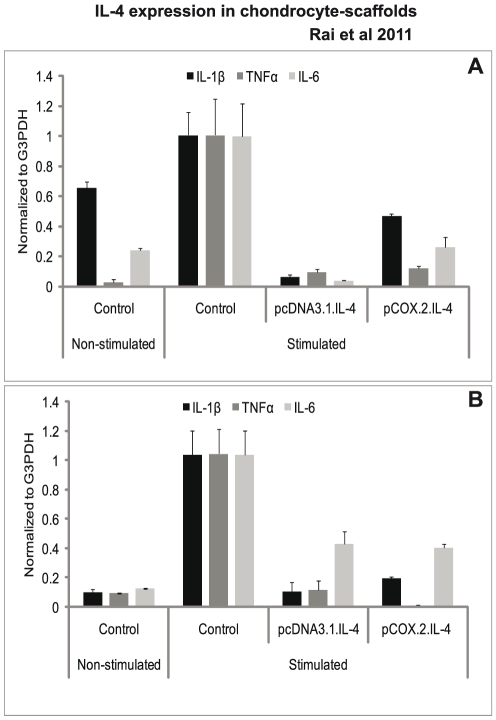
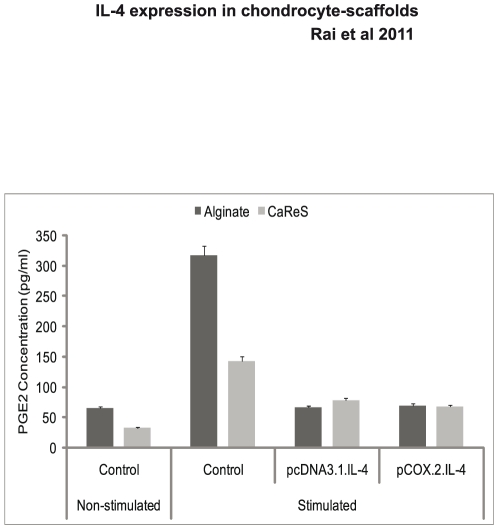
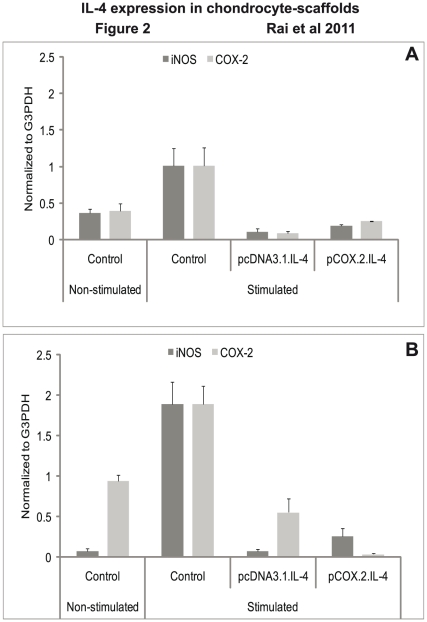
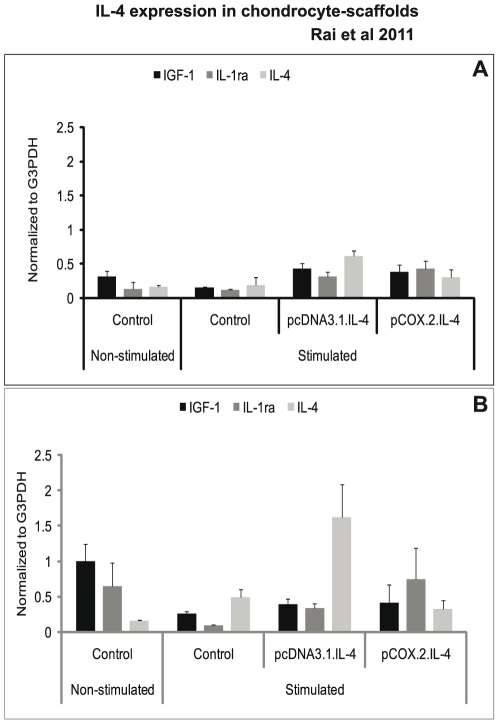
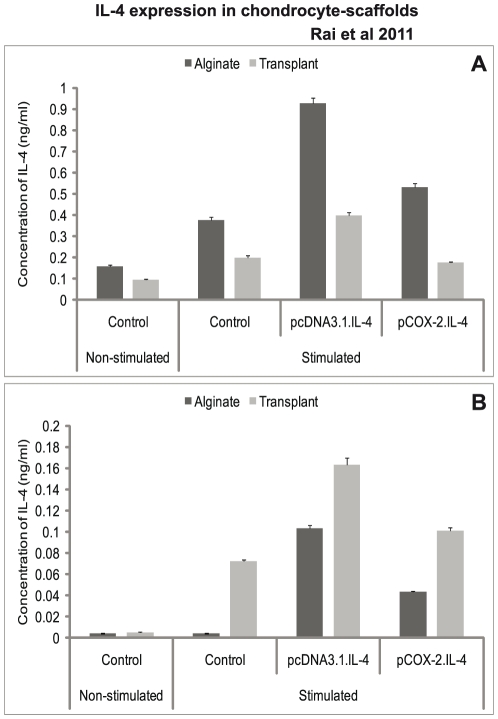
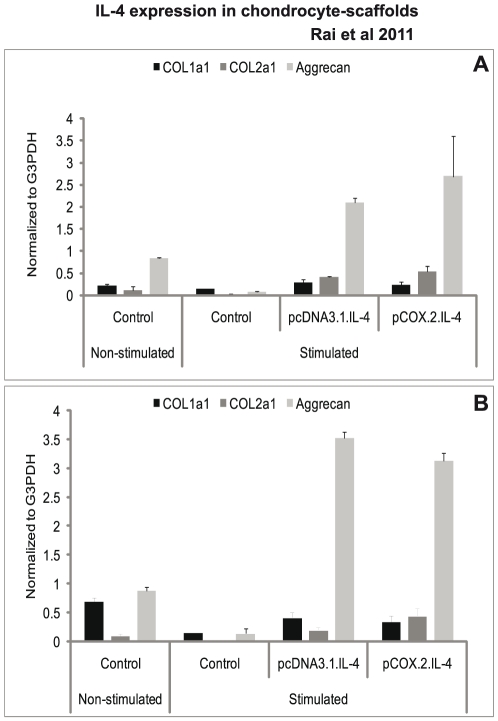
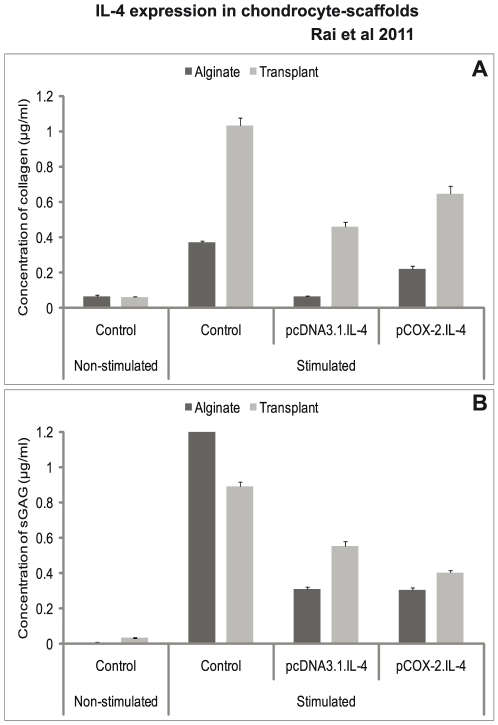
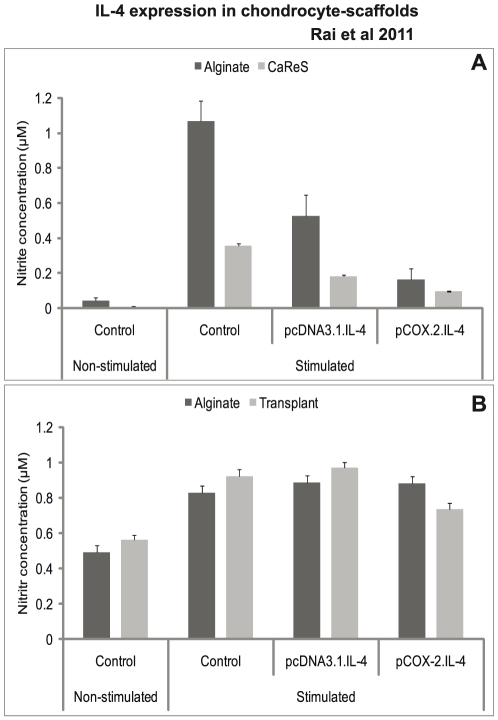
cIL-4 was expressed from COX-2 promoter exclusively on the addition of rcIL-1β and rcTNFα while its expression from CMV promoter was constitutive. The expressed cIL-4 downregulated the mRNA expression of IL-1β, TNFα, IL-6, iNOS and COX-2 in the cells and inhibited the production of NO and PGE(2) in culture media. At the same time, it up-regulated the expression of IGF-1, IL-1ra, COL2a1 and aggrecan in conditioned chondrocytes in both scaffolds along with a diminished release of total collagen and sGAG into the culture media. An increased amount of cIL-4 protein was detected both in chondrocyte cell lysate and in concentrated culture media. Neutralizing anti-cIL-4 antibody assay confirmed that the anti-inflammatory and regenerative effects seen are exclusively driven by cIL-4. There was a restricted expression of IL-4 under COX-2 promoter possibly due to negative feedback loop while it was over-expressed under CMV promoter (undesirable). Furthermore, the anti-inflammatory /anabolic outcomes from both scaffolds were reproducible and the therapeutic effects of cIL-4 were both scaffold- and promoter-independent.
Regulated expression of therapeutic candidate gene(s) coupled with suitable scaffold(s) could potentially serve as a useful tissue-engineering tool to devise future treatment strategies for osteoarthritis.
阐明在体外炎症条件下,软骨细胞 - 支架中白细胞介素 4(IL-4)的调节表达的抗炎和合成代谢作用。
使用 pcDNA3.1.cIL-4(组成型)或 pCOX-2.cIL-4(细胞因子反应型)质粒通过瞬时转染对来自 3 只狗的成熟关节软骨细胞进行条件处理。将条件化细胞接种在藻酸盐微球和大鼠尾胶原 I 基质(CaReS®)中以生成两种类型的组织工程 3 维支架。通过在培养基中外源性添加重组犬(rc)IL-1β(100 ng/ml)加 rcTNFα(50 ng/ml)模拟填充的软骨细胞中的炎症性关节炎。96 小时后,通过各种测定法分析收获的细胞和培养物,以监测 cIL-4 的抗炎和再生(合成代谢)特性。
仅在添加 rcIL-1β和 rcTNFα时,cIL-4 才从 COX-2 启动子表达,而从 CMV 启动子表达则是组成型的。表达的 cIL-4 下调了细胞中 IL-1β、TNFα、IL-6、iNOS 和 COX-2 的 mRNA 表达,并抑制了培养物中 NO 和 PGE2 的产生。同时,它在上皮细胞中上调了 IGF-1、IL-1ra、COL2a1 和聚集蛋白聚糖的表达,同时减少了总胶原蛋白和 sGAG 向培养基中的释放。在两种支架中的条件化软骨细胞的细胞裂解物和浓缩培养物中均检测到更多的 cIL-4 蛋白。中和抗 cIL-4 抗体测定证实,所见的抗炎和再生作用完全由 cIL-4 驱动。由于负反馈环,COX-2 启动子下的 IL-4 表达受到限制,而在 CMV 启动子下表达过度(不理想)。此外,两种支架的抗炎/合成代谢结果都是可重复的,并且 cIL-4 的治疗效果与支架和启动子无关。
治疗候选基因的调节表达与合适的支架相结合,可能成为设计未来骨关节炎治疗策略的有用组织工程工具。