Departamento de Ecologia, Universidade Estadual de São Paulo, São Paulo, São Paulo, Brazil.
PLoS One. 2011;6(10):e25780. doi: 10.1371/journal.pone.0025780. Epub 2011 Oct 4.
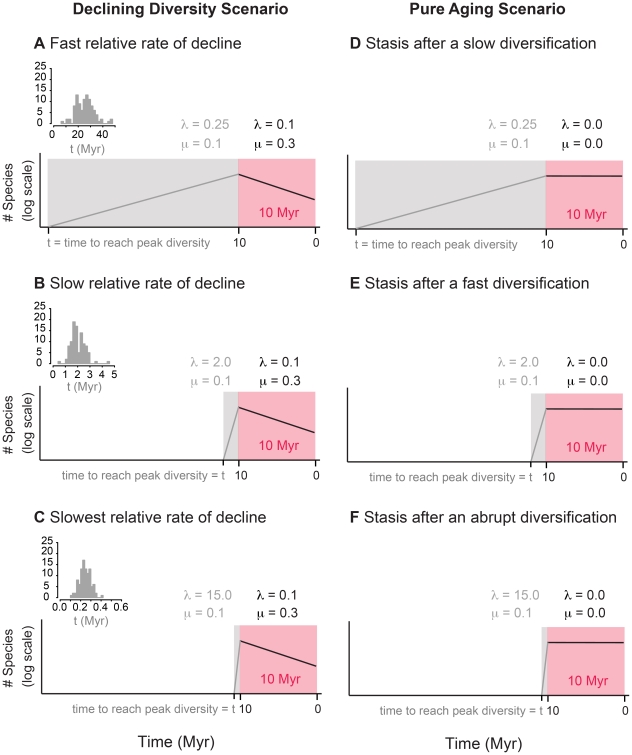
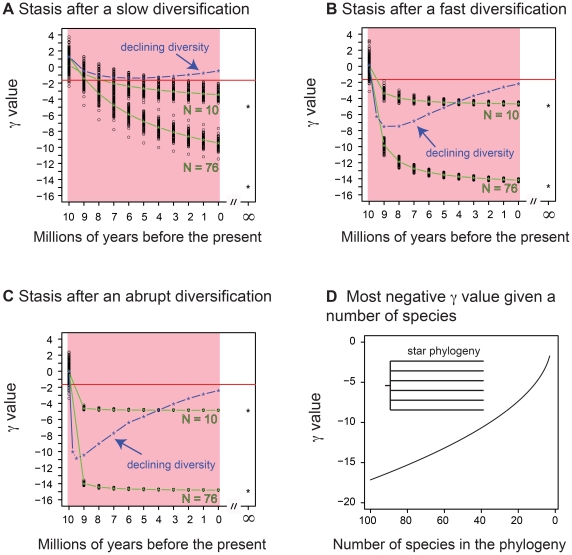
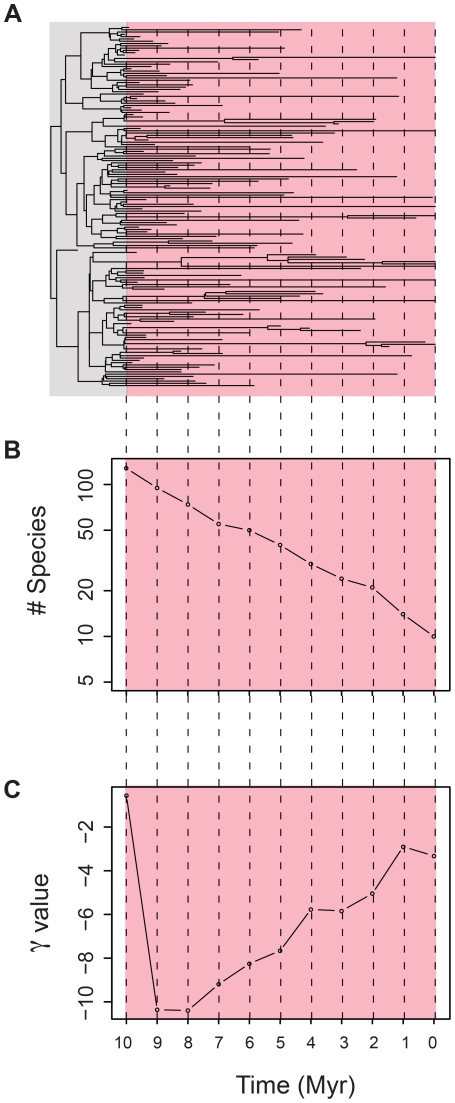
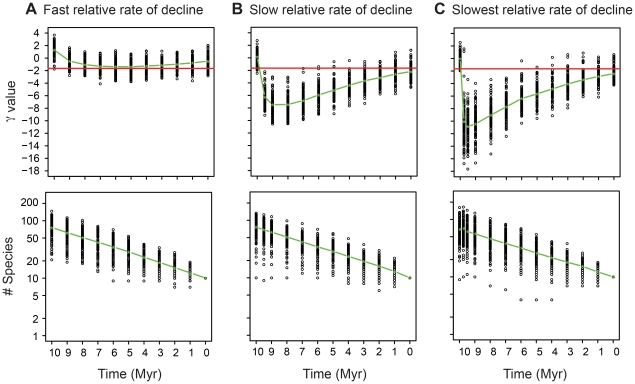
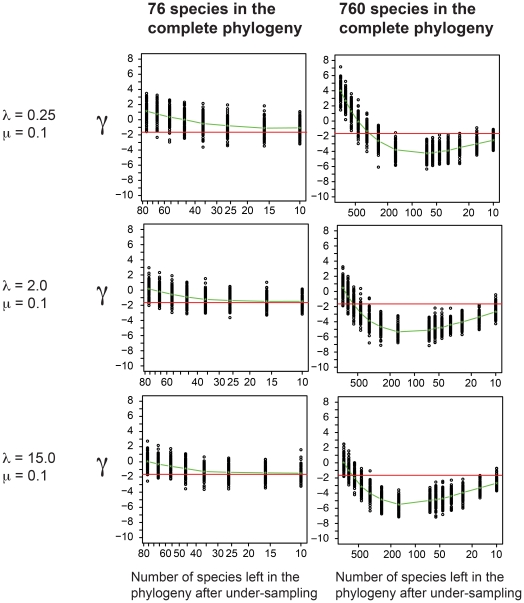
Molecular phylogenies have been used to study the diversification of many clades. However, current methods for inferring diversification dynamics from molecular phylogenies ignore the possibility that clades may be decreasing in diversity, despite the fact that the fossil record shows this to be the case for many groups. Here we investigate the molecular phylogenetic signature of decreasing diversity using the most widely used statistic for inferring diversity dynamics from molecular phylogenies, the γ statistic. We show that if a clade is in decline its molecular phylogeny may show evidence of the decrease in the diversification rate that occurred between its diversification and decline phases. The ability to detect the change in diversification rate depends largely on the ratio of the speciation rates of the diversification and decline phases, the higher the ratio the stronger the signal of the change in diversification rate. Consequently, molecular phylogenies of clades in relative rapid decline do not carry a signature of their decreasing diversification. Further, the signal of the change in diversification rate, if present, declines as the diversity drop. Unfortunately, the molecular signature of clades in decline is the same as the signature produced by diversity dependent diversification. Given this similarity, and the inability of current methods to detect declining diversity, it is likely that some of the extant clades that show a decrease in diversification rate, currently interpreted as evidence for diversity dependent diversification, are in fact in decline. Unless methods can be developed that can discriminate between the different modes of diversification, specifically diversity dependent diversification and declining diversity, we will need the fossil record, or data from some other source, to distinguish between these very different diversity trajectories.
分子系统发育已被用于研究许多类群的多样化。然而,目前从分子系统发育推断多样化动态的方法忽略了这样一种可能性,即尽管化石记录表明许多群体的情况确实如此,但类群的多样性可能会减少。在这里,我们使用最广泛用于从分子系统发育推断多样化动态的统计数据,即γ统计量,研究多样性减少的分子系统发育特征。我们表明,如果一个类群正在减少,其分子系统发育可能会显示出其在多样化和减少阶段之间的多样化率下降的证据。检测多样化率变化的能力在很大程度上取决于多样化和减少阶段的物种形成率的比率,该比率越高,多样化率变化的信号越强。因此,相对快速减少的类群的分子系统发育并没有携带其多样化减少的特征。此外,如果存在的话,多样化率变化的信号会随着多样性的下降而下降。不幸的是,减少多样性的类群的分子特征与由多样性依赖性多样化产生的信号相同。鉴于这种相似性,以及当前方法无法检测到减少的多样性,目前解释为多样性依赖性多样化证据的一些现存的多样化率下降的类群实际上可能正在减少。除非可以开发出能够区分不同多样化模式(具体来说是多样性依赖性多样化和减少多样性)的方法,否则我们将需要化石记录或其他来源的数据来区分这些非常不同的多样性轨迹。