Groningen Institute for Evolutionary Life Sciences, University of Groningen, PO Box 11103, Groningen, 9700 CC, The Netherlands.
Evolution. 2018 Jun;72(6):1294-1305. doi: 10.1111/evo.13482. Epub 2018 Apr 24.
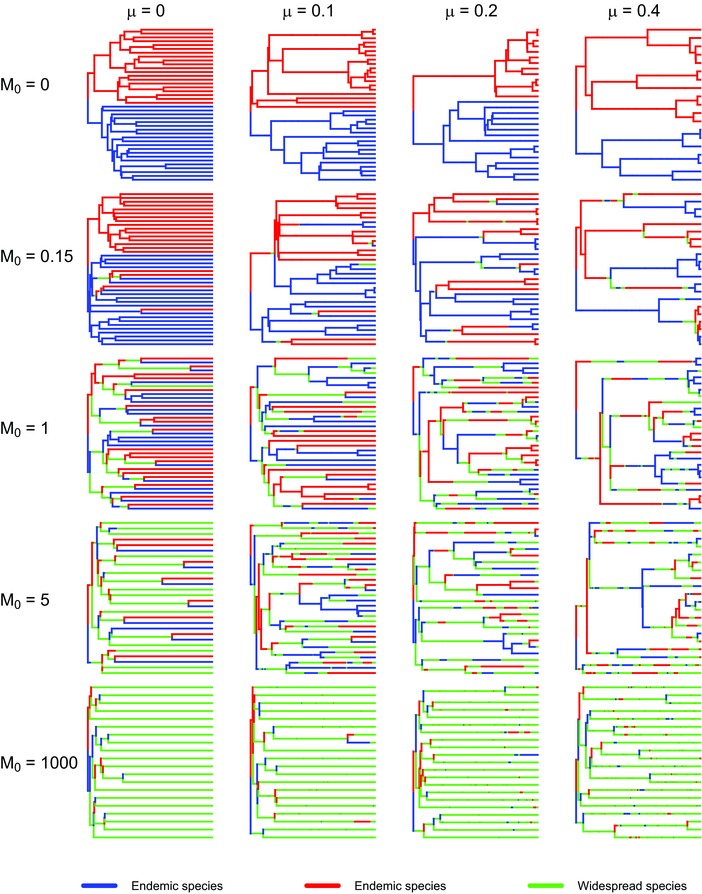
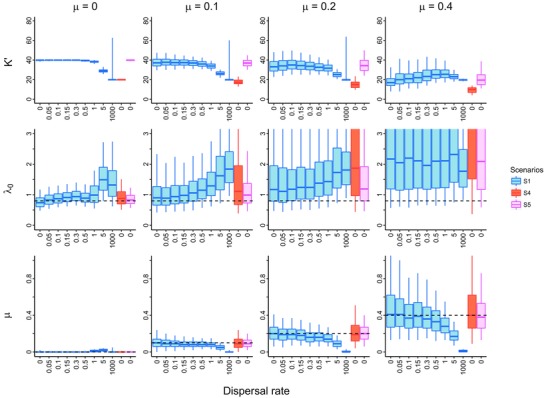
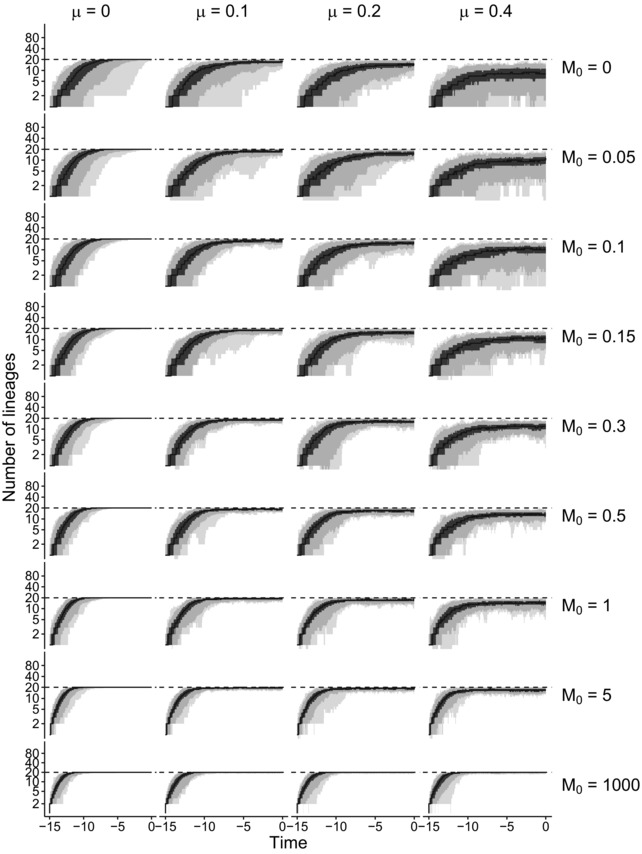
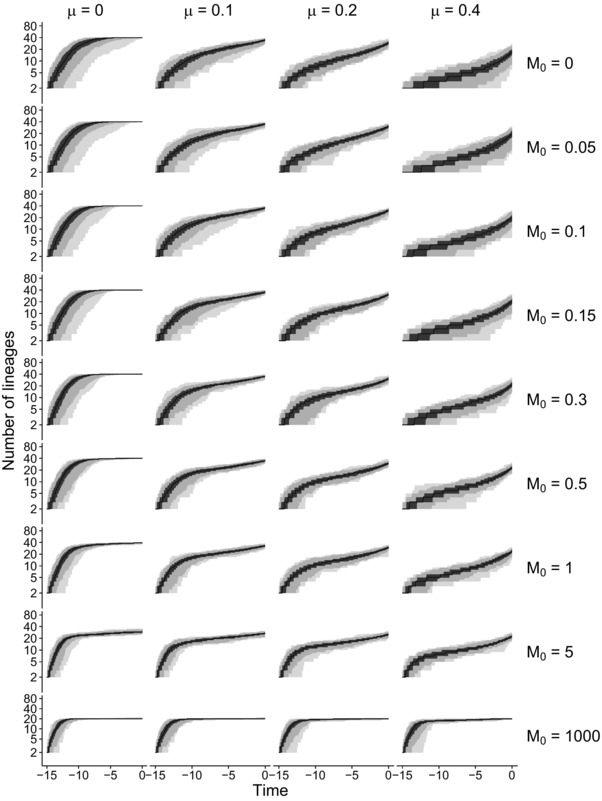
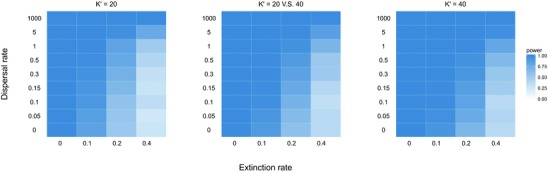
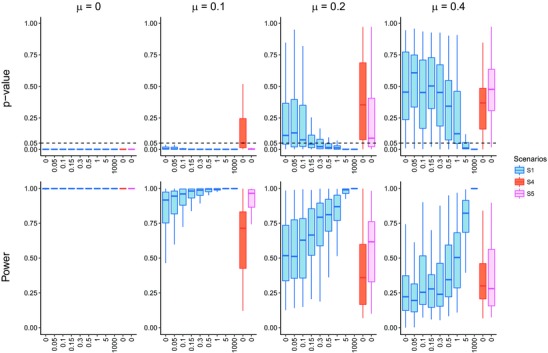
Whether there are ecological limits to species diversification is a hotly debated topic. Molecular phylogenies show slowdowns in lineage accumulation, suggesting that speciation rates decline with increasing diversity. A maximum-likelihood (ML) method to detect diversity-dependent (DD) diversification from phylogenetic branching times exists, but it assumes that diversity-dependence is a global phenomenon and therefore ignores that the underlying species interactions are mostly local, and not all species in the phylogeny co-occur locally. Here, we explore whether this ML method based on the nonspatial diversity-dependence model can detect local diversity-dependence, by applying it to phylogenies, simulated with a spatial stochastic model of local DD speciation, extinction, and dispersal between two local communities. We find that type I errors (falsely detecting diversity-dependence) are low, and the power to detect diversity-dependence is high when dispersal rates are not too low. Interestingly, when dispersal is high the power to detect diversity-dependence is even higher than in the nonspatial model. Moreover, estimates of intrinsic speciation rate, extinction rate, and ecological limit strongly depend on dispersal rate. We conclude that the nonspatial DD approach can be used to detect diversity-dependence in clades of species that live in not too disconnected areas, but parameter estimates must be interpreted cautiously.
物种多样化是否存在生态极限是一个备受争议的话题。分子系统发育表明谱系积累放缓,表明物种形成率随多样性的增加而下降。存在一种从系统发育分支时间检测与多样性相关(DD)多样化的最大似然(ML)方法,但它假设多样性相关性是一种全局现象,因此忽略了潜在的物种相互作用主要是局部的,并且系统发育中的并非所有物种都在局部共存。在这里,我们通过将其应用于通过局部 DD 物种形成、灭绝和两个局部群落之间扩散的空间随机模型模拟的系统发育,来探索这种基于非空间多样性相关模型的 ML 方法是否可以检测局部多样性相关性。我们发现,当扩散率不太低时,I 型错误(错误地检测到多样性相关性)的发生率较低,并且检测到多样性相关性的能力很高。有趣的是,当扩散率较高时,检测多样性相关性的能力甚至比非空间模型更高。此外,内在物种形成率、灭绝率和生态极限的估计强烈依赖于扩散率。我们得出的结论是,非空间 DD 方法可用于检测生活在不太离散区域的物种类群中的多样性相关性,但必须谨慎解释参数估计。