Suzuki Takuto, Arai Makoto, Matsumura Tomoaki, Arai Eiji, Hata Sachio, Maruoka Daisuke, Tanaka Takeshi, Nakamoto Shingo, Imazeki Fumio, Yokosuka Osamu
Department of Medicine and Clinical Oncology, Graduate School of Medicine, Chiba University, Inohana 1-8-1, Chiba 260-8670, Japan.
ISRN Gastroenterol. 2011;2011:619128. doi: 10.5402/2011/619128. Epub 2011 Jun 1.
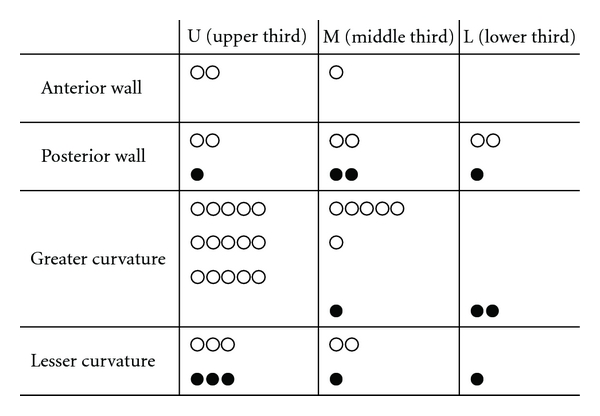
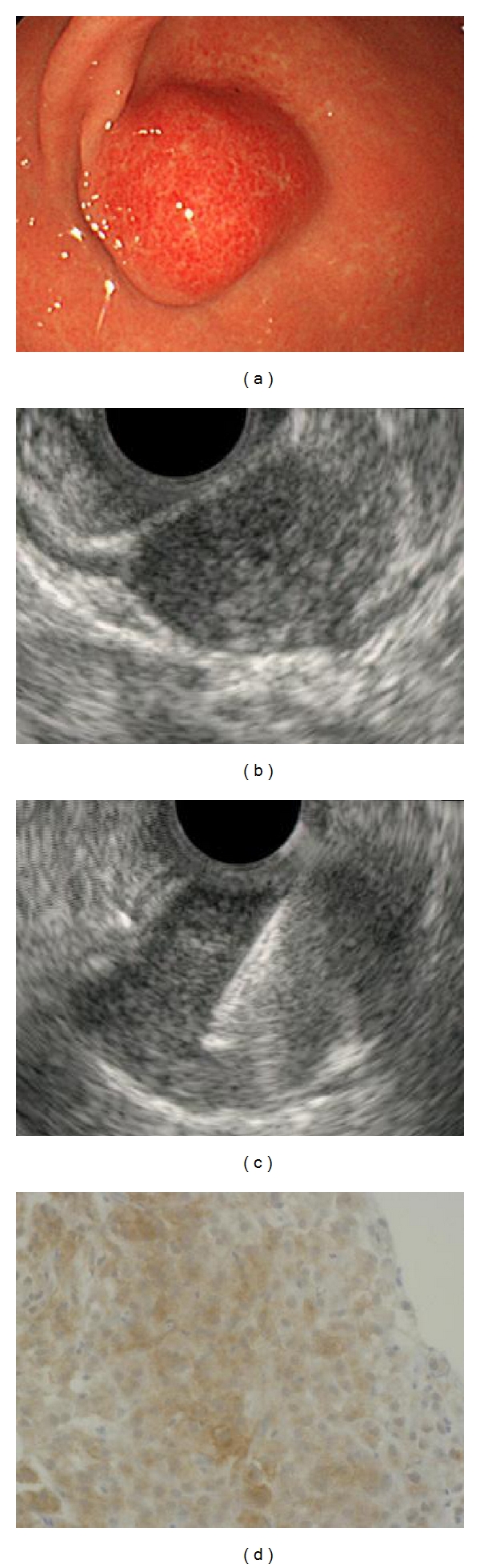
Aims. Our aim was to identify the factors that made the specimens inadequate and nondiagnostic in endoscopic ultrasound-guided fine-needle aspiration (EUS-FNA) biopsy of suspected submucosal tumors (SMTs). Methods. From August 2001 to October 2009, 47 consecutive patients with subepithelial hypoechoic tumors originating in the fourth sonographic layer of the gastric wall suspected as GIST by standard EUS in Chiba University hospital underwent EUS-FNA for histologic diagnosis. We evaluated patient age, sex, location of lesion, size, pattern of growth in a stomach, and pattern of echography retrospectively. We defined a case of gaining no material or an insufficient material for immunohistological diagnosis as nondiagnostic. Results. The diagnostic yield of EUS-FNA for the diagnosis of gastric SMTs was 74.5%. Multivariate logistic regression analysis identified that age of under 60 years (compared with patients older than 60 years: odds ratio [OR] = 11.91, 95% confidence interval [CI] = 1.761-80.48) and location of SMT at lower third area (compared with upper or middle third area: OR = 10.62, 95% CI = 1.290-87.42) were the predictive factors for inadequate tissue yield in EUS-FNA. Conclusions. The factors associated with inadequate tissue yield in EUS-FNA were younger age and the location of lesion at lower third area in stomach.
目的。我们的目的是确定在超声内镜引导下细针穿刺活检(EUS-FNA)疑似黏膜下肿瘤(SMT)时导致标本不充分及无法诊断的因素。方法。2001年8月至2009年10月,千叶大学医院中47例经标准超声内镜检查怀疑为胃肠道间质瘤(GIST)、起源于胃壁第四超声层的上皮下低回声肿瘤患者连续接受EUS-FNA以进行组织学诊断。我们回顾性评估了患者的年龄、性别、病变位置、大小、胃内生长模式及超声图像模式。我们将未获取到材料或获取材料不足以进行免疫组织学诊断的病例定义为无法诊断。结果。EUS-FNA对胃SMT诊断的阳性率为74.5%。多因素逻辑回归分析确定,年龄小于60岁(与60岁以上患者相比:优势比[OR]=11.91,95%置信区间[CI]=1.761 - 80.48)以及SMT位于胃下三分之一区域(与上三分之一或中三分之一区域相比:OR = 10.62,95% CI = 1.290 - 87.42)是EUS-FNA中组织取材不足的预测因素。结论。EUS-FNA中与组织取材不足相关的因素是年龄较小以及病变位于胃下三分之一区域。