Department of Radiation Oncology, Chang Gung Memorial Hospital, Taoyuan 333, Taiwan.
Radiat Oncol. 2011 Oct 12;6:136. doi: 10.1186/1748-717X-6-136.
Oral cavity cancers (ORC) are the most common cancers, and standard treatment is radical surgery with postoperative radiotherapy. However, locoregional failure remains a major problem, indicating radioresistance an important issue. Our previous work has shown that GP96 contributed to radioresistance in nasopharyngeal and oral cancer cell lines. In this study, we determined clinical significance of GP96 in ORC by evaluation of GP96 expression and its association with disease prognosis in patients receiving radiotherapy
Total of 79 ORC patients (77 males, median age: 48 years old) receiving radical surgery and postoperative radiotherapy between Oct 1999 and Dec 2004 were enrolled. Patients in pathological stages II, III and IV were 16.5%, 16.5% and 67%, respectively. For each patient, a pair of carcinoma tissue and grossly adjacent normal mucosa was obtained. GP96-expression was examined by western blot analysis, and the association with clinicopathological status was determined.
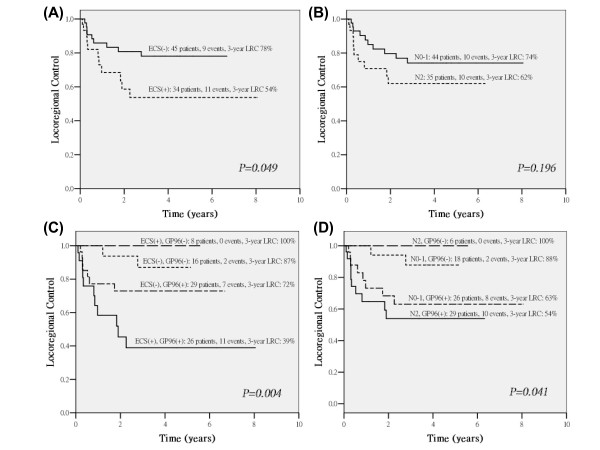
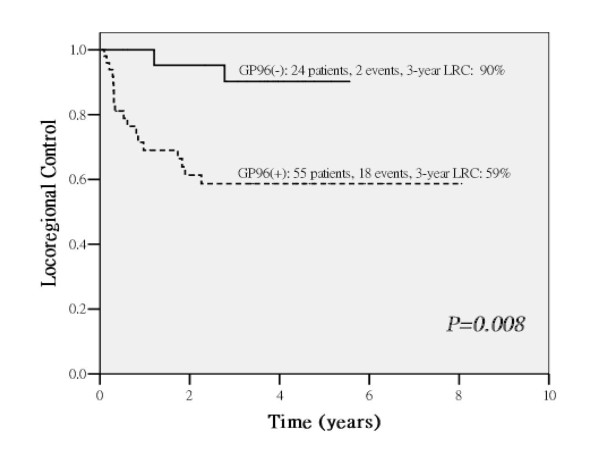
Three-year locoregional control (LRC), distant metastasis-free survival (DMFS), disease-specific survival (DSS) and overall survival (OS) rates were 69%, 79%, 63% and 57%, respectively. We found that 55 patients (70%) displayed GP96-overexpression in the tumor tissue, which correlated with a higher pN stage (p = 0.020) and tumor depth (> 10 mm) (p = 0.045). Nodal extracapsular spreading (ECS) and GP96-overexpression predicted adverse LRC (p = 0.049 and p = 0.008). When stratified by nodal ECS, the adverse impact of GP96 remained significant in three-year LRC (p = 0.004). In multivariate analysis, GP96-overexpression was also an independent predictor of LRC, DSS and OS (p = 0.018, p = 0.011 and p = 0.012).
GP96 may play roles in radioresistance which attributes to tumor invasiveness in oral cancer patients receiving radiotherapy. GP96 may serve as a novel prognostic marker of radiotherapy. However, further independent studies are required to validate our findings in a larger series.
口腔癌(ORC)是最常见的癌症,标准治疗方法是根治性手术加术后放疗。然而,局部区域复发仍然是一个主要问题,表明放射抵抗是一个重要问题。我们之前的工作表明,GP96 有助于鼻咽和口腔癌细胞系的放射抵抗。在这项研究中,我们通过评估 GP96 表达及其与接受放疗的患者疾病预后的关系,确定了 GP96 在 ORC 中的临床意义。
共纳入 79 例接受根治性手术和术后放疗的 ORC 患者(77 例男性,中位年龄:48 岁),这些患者于 1999 年 10 月至 2004 年 12 月期间入组。病理分期为 II、III 和 IV 期的患者分别占 16.5%、16.5%和 67%。对于每位患者,均获得一对癌组织和大体相邻正常粘膜。通过 Western blot 分析检测 GP96 的表达,并确定其与临床病理特征的关系。
三年局部区域控制(LRC)、无远处转移生存(DMFS)、疾病特异性生存(DSS)和总生存(OS)率分别为 69%、79%、63%和 57%。我们发现,55 例患者(70%)的肿瘤组织中显示 GP96 过表达,与较高的 pN 分期(p=0.020)和肿瘤深度(>10mm)(p=0.045)相关。淋巴结包膜外扩散(ECS)和 GP96 过表达预测不良 LRC(p=0.049 和 p=0.008)。当按淋巴结 ECS 分层时,在三年 LRC 中,GP96 的不良影响仍然显著(p=0.004)。多变量分析显示,GP96 过表达也是 LRC、DSS 和 OS 的独立预测因子(p=0.018、p=0.011 和 p=0.012)。
GP96 可能在接受放疗的口腔癌患者中发挥放射抵抗作用,这归因于肿瘤侵袭性。GP96 可能成为放疗的一种新的预后标志物。然而,需要进一步的独立研究来验证我们在更大系列中的发现。